
Why Is Your Blood Sugar Highest in the Morning?
Inside this episode
The video’s narration, chapter by chapter, with stills from the video and every source at the end.
The short version
Welcome to Health Loom. Here's the short version. Overnight, the liver keeps releasing sugar, and many people with type 2 diabetes get a rise before dawn, so the fasting reading, the one before breakfast, is often the highest of the before-meal readings. 116 to 130 sits near the top of common ranges, and an A1c of 6.9, a blood test of average sugar over recent months, meets a common goal. We'll also look at the late dinner, the pills, and what people discuss with their clinician.
Why mornings run high
Overnight, with no food coming in, the sugar in your blood comes mostly from your own body, mainly the liver. In type 2 diabetes, insulin doesn't turn that output down enough for the sugar level, and the body's tissues take sugar up less readily, so the level settles higher. In small studies that measured this output, people with type 2 diabetes who had higher fasting sugar tended to have higher overnight output.
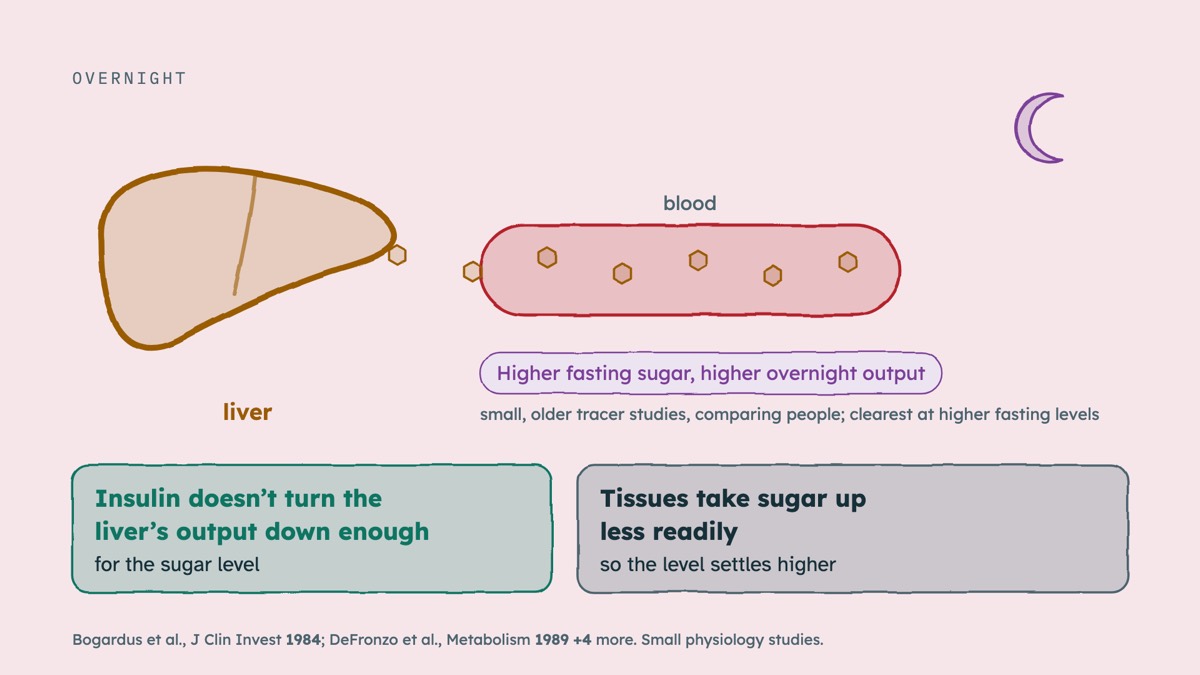
On top of that, many people get a rise before dawn, called the dawn phenomenon. Nighttime hormones such as cortisol can make the body less responsive to insulin toward morning. In a Shanghai hospital study of 306 adults on diabetes pills, average age 66, about 4 in 10 had a rise of 20 or more from their overnight low to breakfast. In 21 heavier U.S. adults with type 2 diabetes, wearing sensors, it appeared on about half of days, varying day to day.
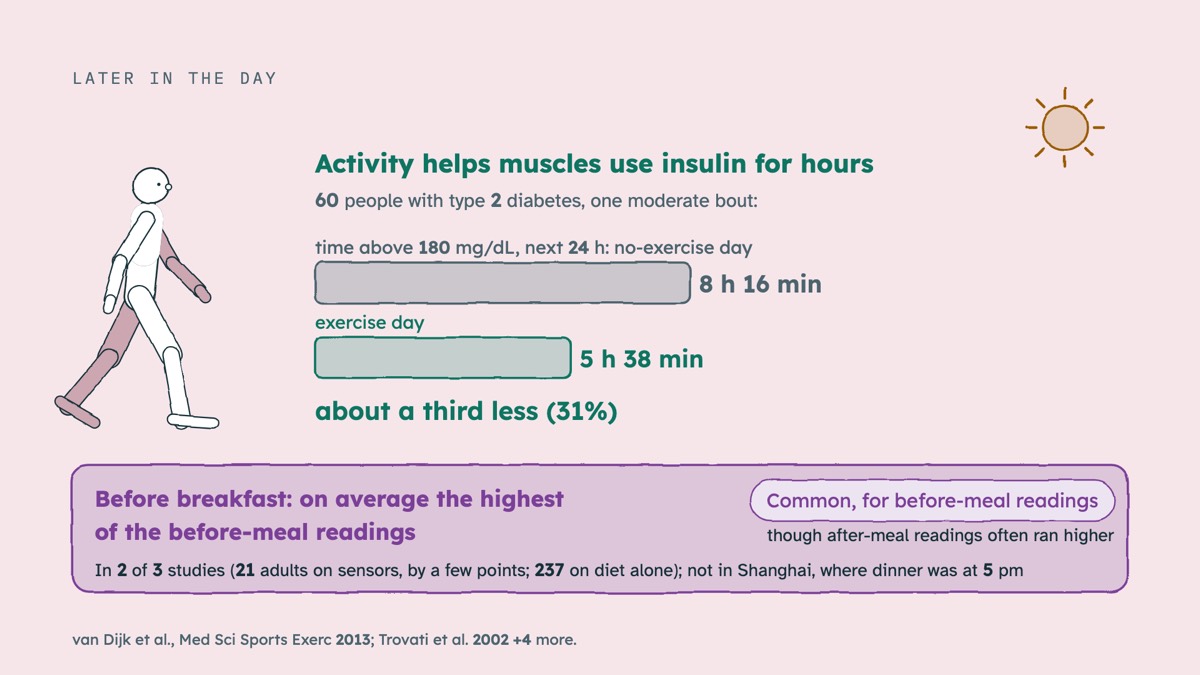
Later in the day, other things pull readings down. Activity helps muscles use insulin for hours afterward: in 60 people with type 2 diabetes, one moderate workout cut the time spent high over the next 24 hours by about a third. And in two of three studies we read, the before-breakfast reading was, on average, the highest of the before-meal readings, though not in one where dinner was at 5. So a fasting number above the later before-meal readings is common, though after-meal readings often ran higher.
Is 116 to 130 high?
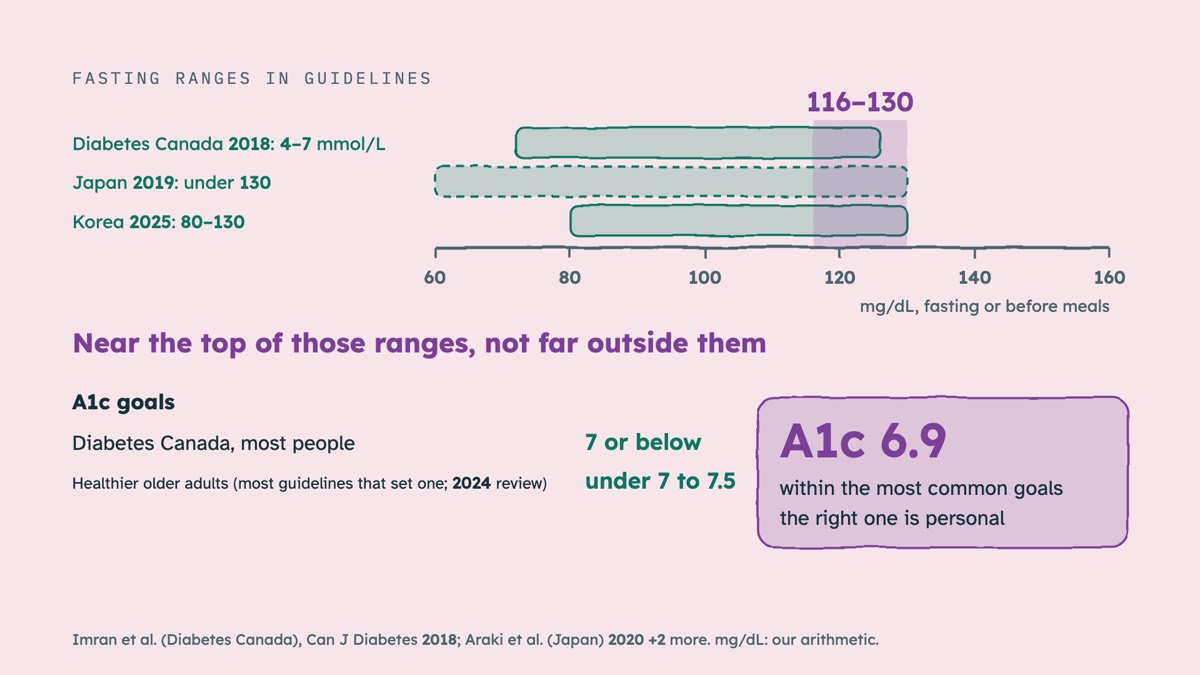
Assuming these are in milligrams per deciliter: Diabetes Canada's before-meal target is 4 to 7 millimoles per liter, about 72 to 126. Japan's 2019 guideline links an A1c under 7 with fasting under 130, and Korea's suggests 80 to 130. So 116 to 130 sits near the top of those ranges, not far outside them. For A1c, Diabetes Canada aims for 7 or below for most, and a 2024 review found most guidelines setting a goal for healthier older adults use under 7 to 7.5. An A1c of 6.9 sits within the most common goals, and every group says the right one is personal.
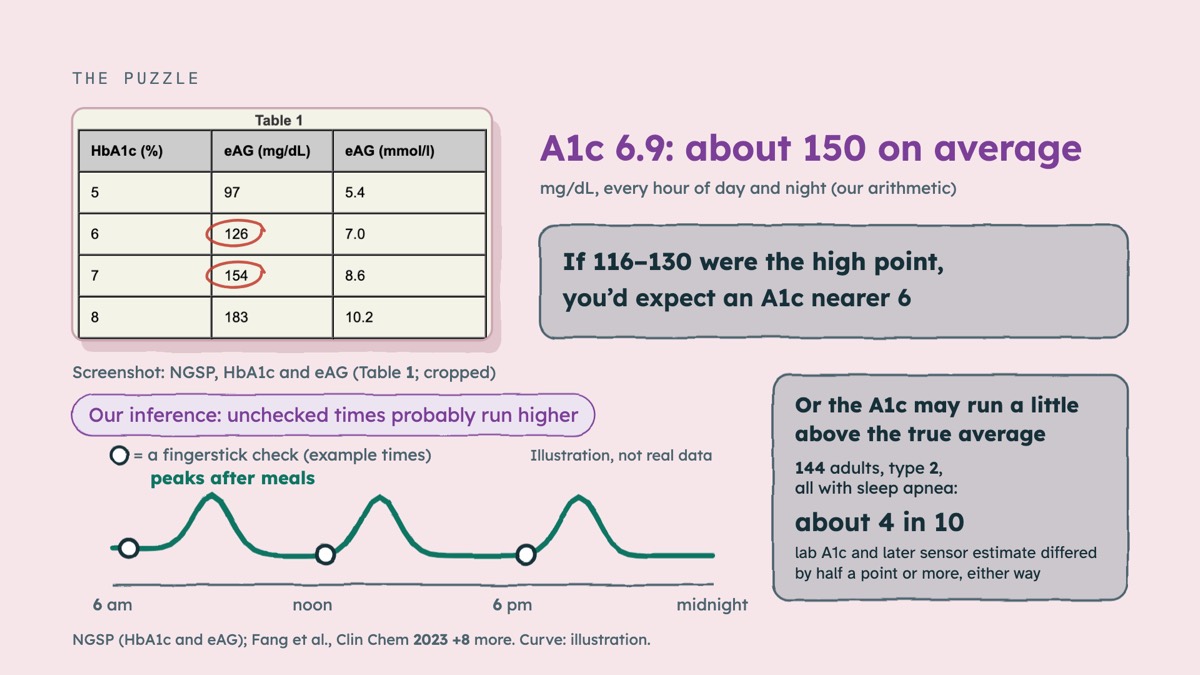
Here's the puzzle. An A1c of 6.9 goes, on average, with a blood sugar of about 150, counting every hour of the day and night. If 116 to 130 were the day's high point, you'd expect an A1c nearer 6. So our inference: some unchecked times probably run higher, most likely after meals, when peaks can come and go between checks. Or our listener's A1c may run a little above their true average: in one study of 144 adults with type 2 diabetes and sleep apnea, lab A1c and a later sensor-based estimate differed by half a point or more, either way, in about 4 in 10.
And the gap between 116 and 130 is within normal meter and body variation. The international meter standard asks that at least 95 in 100 readings land within 15% of a lab value: for a true 123, that's about 105 to 141. In people without diagnosed diabetes, lab fasting sugar varied about 6% between tests two weeks apart. So the pattern over many mornings tells you more than any single reading.
Does a late dinner matter?
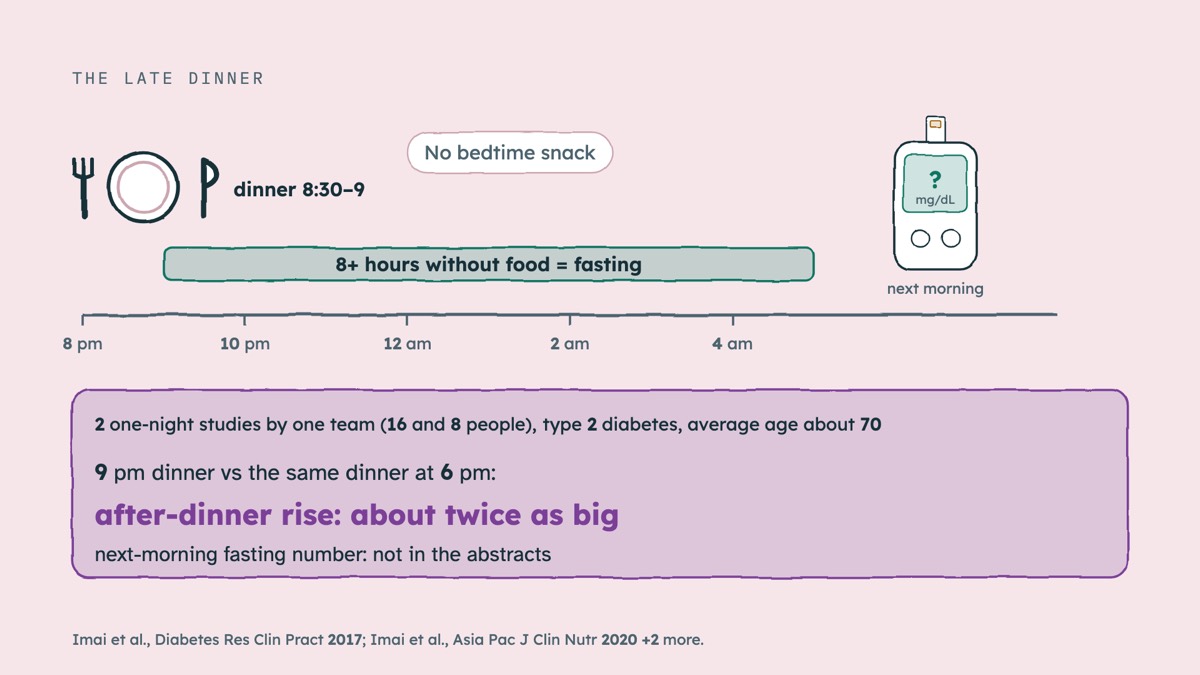
Our listener eats dinner between 8:30 and 9 and has no bedtime snack. Fasting means at least 8 hours without food, so the next morning's reading still counts as fasting. Can the late dinner nudge it up? In two one-night Japanese studies of 16 and 8 people with type 2 diabetes, average age about 70, the rise in blood sugar after dinner was roughly twice as big with a 9 p.m. dinner as with the same dinner at 6. Neither abstract gave a next-morning fasting number.
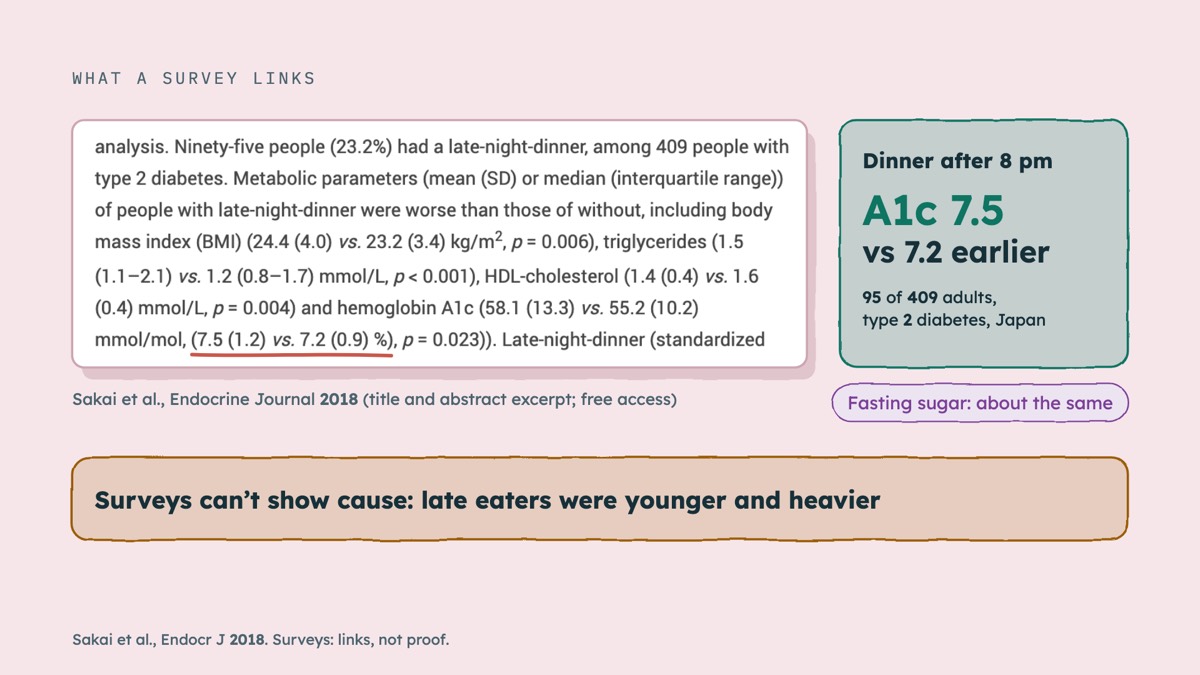
A survey points the same way, loosely. In 409 Japanese adults with type 2 diabetes, those who ate dinner after 8 had an average A1c of 7.5, versus 7.2, though their fasting sugar was about the same. But surveys can't show cause: the late eaters were also younger and heavier.
Pooled trials that shorten the daily eating window lowered fasting sugar in type 2 diabetes by about 9 points, with a little weight loss and no clear change in A1c. In a three-week Dutch trial of 14 heavier adults with type 2 diabetes, average age about 68, eating within 10 hours, finished by 6, lowered fasting sugar by about 16 to 18, versus 14 hours or more. Our reading: a dinner around 9 is at most a small part of the story, and not having a bedtime snack is unlikely to be the reason.
The pills overnight
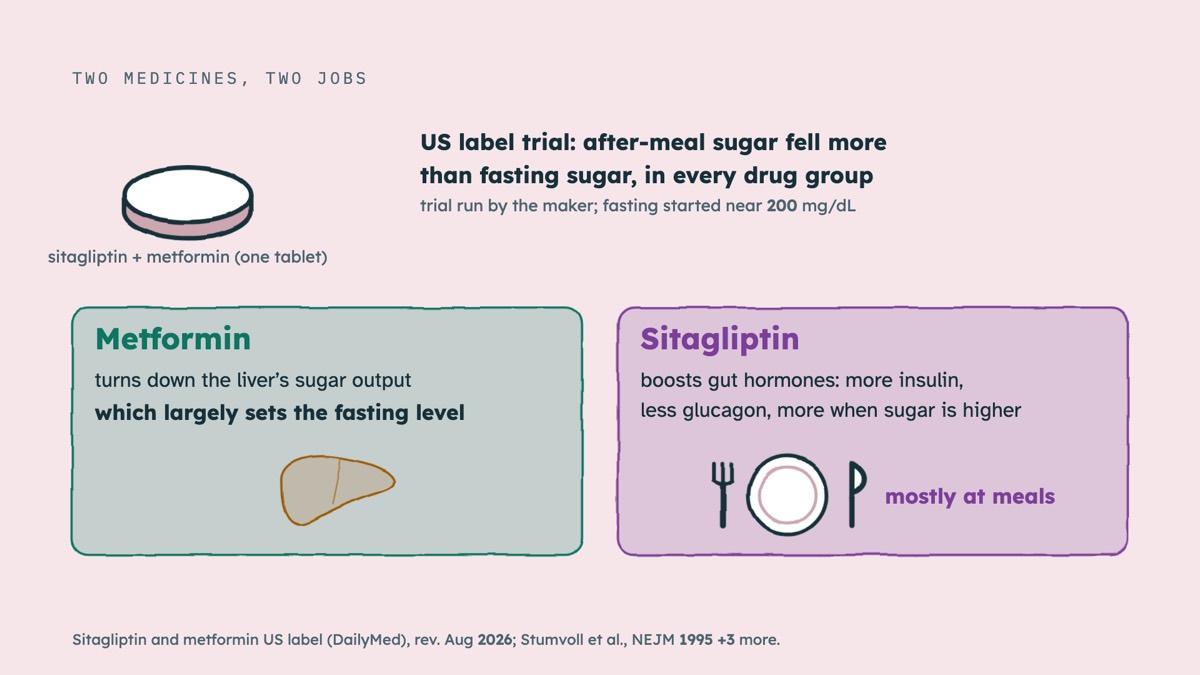
The listener's pill appears to combine sitagliptin and metformin. Metformin's main known effect is turning down the liver's sugar output, which largely sets the fasting level. Sitagliptin boosts gut hormones that raise insulin and lower glucagon, more so when sugar is higher, and mostly around meals. In the main trial on the U.S. label, the combination lowered after-meal sugar more than fasting sugar.
Taken twice a day, the 50 and 1,000 tablet adds up to the maximum daily dose this U.S. label recommends for both drugs.
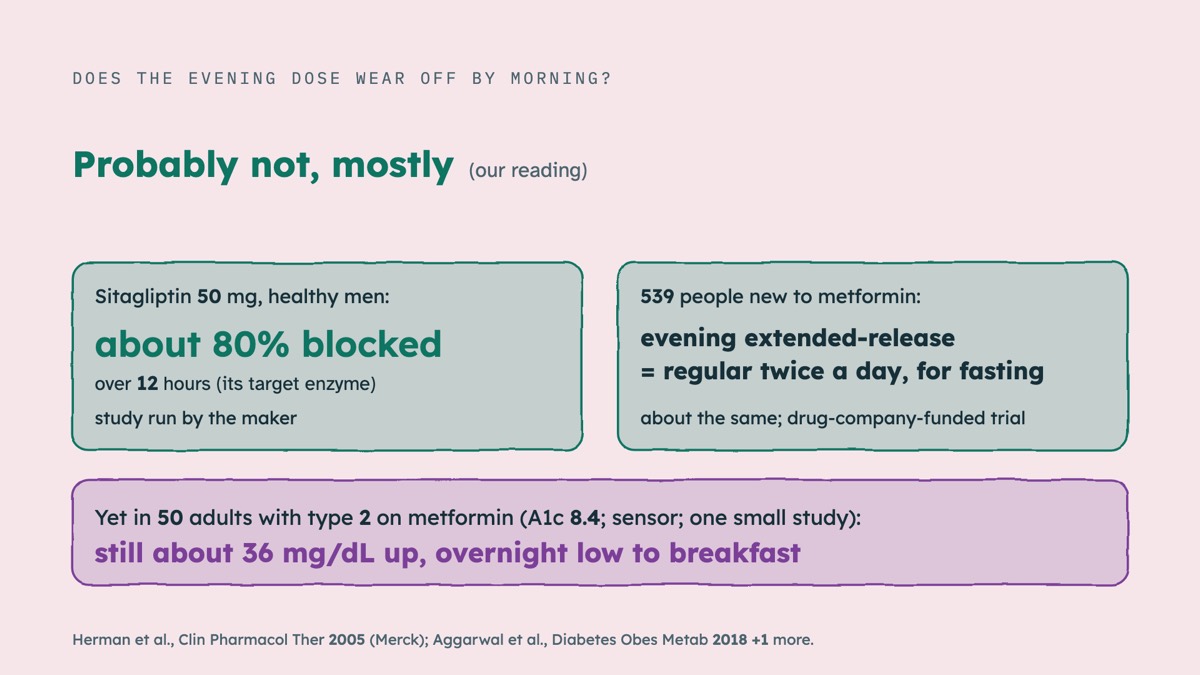
Does the evening dose wear off by morning? Our reading: probably not, mostly. In healthy men, one 50 milligram sitagliptin dose kept its target enzyme about 80% blocked over 12 hours. In a trial of 539 people new to metformin, once-daily extended-release metformin with the evening meal gave about the same fasting drop as regular metformin twice a day. Yet in 50 adults on metformin whose diabetes was less well controlled, sugar still rose about 36 points from the overnight low to breakfast.
On this combination alone, low blood sugar was uncommon in the label's main trial, run by the maker: reported by 1.6 in 100 people over 24 weeks, versus 0.6 on a dummy pill. So a rebound from nighttime lows, an old idea called the Somogyi effect, is unlikely here, and large sensor studies haven't supported it even in people on insulin.
What can help
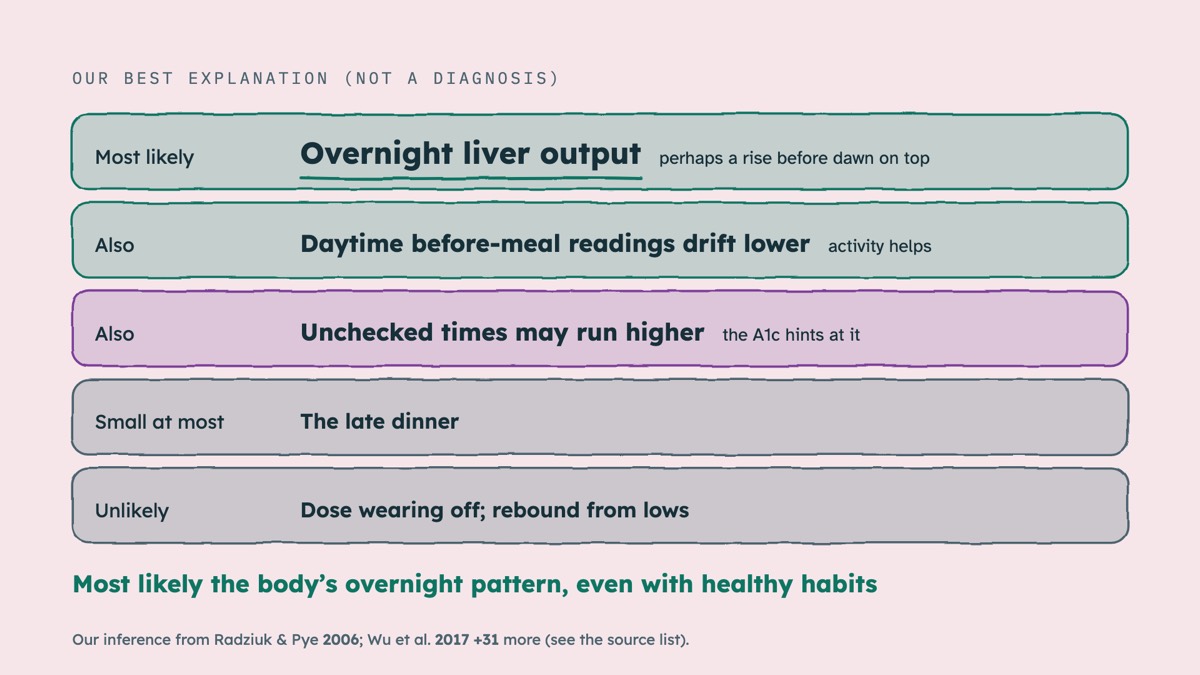
Here's our best explanation, not a diagnosis. Most likely, the liver's overnight output largely sets the morning number, perhaps with a rise before dawn on top: metformin partly turns that output down, and sitagliptin works mostly at meals. Daytime before-meal readings tend to drift lower anyway, and activity helps. And the A1c hints that some unchecked times run higher than the morning. The late dinner is a small part at most, and the evening dose wearing off, or a rebound from lows, are unlikely. So the morning number most likely reflects the body's overnight pattern, even with healthy habits.
First, does anything need to change? Diabetes Canada pairs the before-meal range with an A1c of 7 or below for most people, and considers lower fasting goals when that A1c goal isn't reached, weighed against the risk of lows. Which goal fits our listener is the clinician's call. And for older adults, guidelines put extra weight on avoiding lows, especially with medicines that can cause them, and relax goals for people who are frail.
To learn the pattern, Diabetes Canada describes structured checks when A1c targets aren't met: before and two hours after meals, and at bedtime. With a clinician, a few after-meal readings, or one in the night, could help show whether the morning really is the high point. A glucose sensor is another option; in small trials, mostly of people above target and not on insulin, sensors worn for weeks to months lowered A1c a little, and short courses gave mixed results.
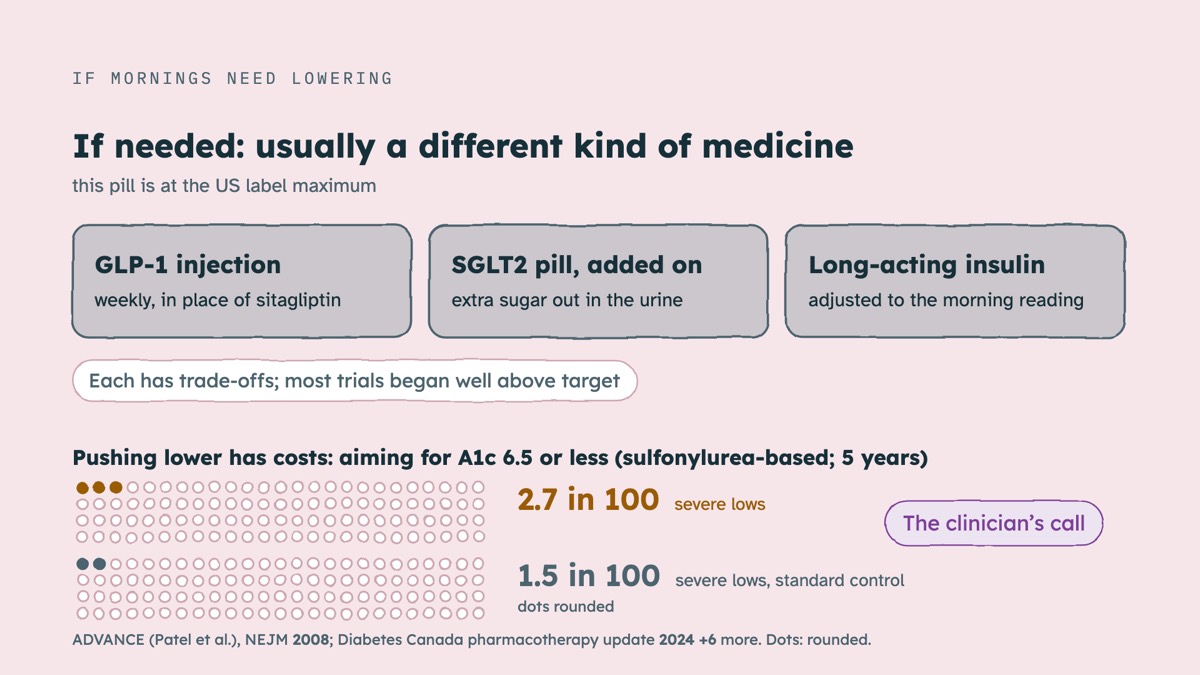
If mornings do need lowering, this pill is at the U.S. label maximum, so the next step is usually a different kind of medicine, such as a weekly GLP-1 injection, which acts like a gut hormone, in place of sitagliptin; an SGLT2 pill, which sends extra sugar out in the urine; or long-acting basal insulin, adjusted to the morning reading. Each has trade-offs; their trials mostly started well above target. Pushing lower has costs too: in one large trial, aiming for an A1c of 6.5 or less, with treatment based on a sulfonylurea, which boosts insulin release, meant severe lows in 2.7 in 100 people over five years, versus 1.5. That's the clinician's call.
Evening habits are the other change people try: finishing dinner earlier or making it smaller, eating the starch last, or a short walk after; the last two mainly trim the after-meal rise, with little clear effect on the morning number. The trials are small, and mostly in heavier people further from target, so gains near target may be smaller; that's our inference. And it's harder than it sounds: in a small four-week type 2 diabetes study, people asked to eat between 10 a.m. and 7 p.m., on as many days as they could, managed about 7 days in 10, on average; most slip-ups were evening eating. Simple if-then plans helped a little in fruit-and-vegetable studies, and new habits often took two months or more to feel automatic. Because the U.S. label says to take this pill with meals, a new dinner time is worth a word with the prescriber.
So, questions for your clinician: Is my fasting range in line with the target you'd set for me? Would a few nighttime readings, or a short time on a sensor, help show what my sugar does before dawn? And does the timing of my evening dose, or my dinner, matter for me? One general note: Diabetes Canada's patient page says thirst, extra bathroom trips and tiredness may come with fasting readings of about 200 or more, and that very high readings need medical care right away.
Sources
76 sources cited in the video, in the order they come up.
Opening
- Radziuk 2006 (small study, a full day's fast)
- Magnusson 1992 (small study)
- Wu 2017 (Shanghai hospital study, 306 adults on pills; sensor + fingerstick)
- NIDDK, The A1C Test & Diabetes (reviewed Apr 2018)
- NIDDK, Diabetes Tests & Diagnosis (reviewed Jul 2022)
1 why mornings run high
- Bogardus 1984 (tracer study, comparing people)
- DeFronzo 1989 (tracer study, comparing people)
- Alatrach 2017 (slightly raised fasting sugar, no diabetes)
- Mittendorfer 2024 (people with obesity, most without diabetes)
- Jospe 2023 (21 heavier US adults; type 2 self-reported; Dexcom sensors at a discount)
- Campbell 1985 (type 1 diabetes)
- Dinneen 1993 (people without diabetes)
- Atiea 1990 (7 people with type 2)
- van Dijk 2013 (60 people; vs a no-exercise day)
- Trovati 2002 (237 adults on diet alone)
- Mikines 1988 (healthy young men)
2 is 116 to 130 high?
- Imran 2018 (Diabetes Canada, targets)
- Araki 2020 (Japan's 2019 guideline)
- Kang 2025 (Korea's 2025 guideline)
- Bolt 2024 (review of 23 guidelines)
- Screenshot, shown on screen: NGSP, HbA1c and eAG, Table 1 (an average across many people)
- Fang 2023 (144 adults, all with sleep apnea)
- Woerle 2007 (German treatment study)
- Peter 2009 (52 adults, UK)
- Wang 2011 (121 not on insulin, Taiwan)
- Hay 2003 (25 older adults, all on a sulfonylurea)
- Johansen 2012 (type 1 diabetes)
- Monnier 2014 (100 not on insulin, A1c under 7)
- Pleus 2020 (restates ISO 15197; meter makers funded the tests)
- Selvin 2007 (lab samples, no diagnosed diabetes)
- "The meter" footer "+1 more": Pleus 2024 (a meter maker funded it)
3 does a late dinner matter?
- Imai 2017 (one night, 16 people)
- Imai 2020 (same Kyoto team, 8 people)
- Roach 2022 (bedtime-snack review; gives Imai 2017's ages)
- Paper shot, shown on screen: Sakai 2018, Endocrine Journal (survey of 409; same Kyoto team as Imai; authors report drug-maker fees): ; PubMed [link 2]
- Viple 2026 (pooled trials, a little weight loss; probably pools a trial we don't rely on)
- Andriessen 2022 (3 weeks, 14 heavier adults)
- Abbie 2020 (15 adults, bedtime snack vs none; partly egg-industry funded)
4 the pills overnight
- Sitagliptin and metformin US label (Merck), DailyMed, rev. Aug 2026 (its trials were run by the maker)
- Stumvoll 1995 (10 people)
- Natali 2006 (review of tracer studies)
- Screenshot, shown on screen, shown for what it said: sitagliptin and metformin label (Apotex), DailyMed, rev. Oct 2026. Source: National Library of Medicine
- Herman 2005 (Merck trial, healthy men)
- Aggarwal 2018 (AstraZeneca-funded trial)
- "Evening dose" footer "+1 more": Wang 2021 (50 adults, A1c 8.4)
- Choudhary 2013 (type 1, on insulin)
- "Nighttime lows?" footer "+1 more": Huang 2022 (2,600 on insulin; past records)
5 what can help
- Guo 2016 (Chinese hospital study)
- Li 2018 (29 adults, one day, dinner at 5 pm)
- Heden 2015 (13 adults, strength exercise after dinner)
- Engeroff 2023 (review; Heden's next-morning result)
- Meneilly 2018 (Diabetes Canada, older adults; consensus)
- "Options" footer "+1 more": Haneda 2017 (Japan's older-adult goals)
- Cheng 2021 (Diabetes Canada, monitoring)
- Jancev 2024 (12 trials, mostly above target)
- Ferreira 2024 (6 trials; erratum not read)
- Moon 2023 (61 people, short courses)
- Aronson 2025 (Abbott-supported review)
- ADVANCE, Patel 2008 (Servier and NHMRC funded)
- Shah 2024 (Diabetes Canada pharmacotherapy update)
- Bailey 2016 (Novo Nordisk-funded)
- Ahrén 2017 (Novo Nordisk trial; weekly GLP-1 vs sitagliptin)
- Lee 2026 (SGLT2 add-on; drug-company-funded)
- GRADE 2022 (NIDDK-funded)
- Zoungas 2010 (ADVANCE severe lows)
- Parr 2020 (19 people, 4 weeks, no comparison group)
- Singh 2024 (review; self-rated habits)
- Shukla 2017 (16 adults, single meals)
- Okami 2022 (8 small trials)
- Reynolds 2016 (41 adults)
- MacLeod 2013 (short exercise studies)
- Pavlou 2023 (6 months, people with obesity)
- Parr 2024 (6-month trial)
- Melum 2026 (if-then plans, fruit and vegetables)
- Keller 2021 (how long habits take)
- Diabetes Canada, Hyperglycemia (patient page)


