
Are Microplastics Really Harming Your Body?
Inside this episode
The video’s narration, chapter by chapter, with stills from the video and every source at the end.
The short version
Welcome to Health Loom. It's understandable to feel uneasy about this, so here's the short version. "Chemically active" can mean several things, mostly shown in lab dishes and animals. Plastic particles do get into people; how much is uncertain. Harm at everyday levels hasn't been shown. No one can yet reliably rank the everyday sources. Some simple steps may cut exposure, and no test can tell you how much plastic you carry.
What “chemically active” means
Microplastics are plastic pieces under five millimetres; below about a micrometre, a thousandth of a millimetre, they're often called nanoplastics. Particles bigger than about 150 micrometres are very likely not absorbed from the gut; in animal and lab-tissue tests, only a small fraction of smaller ones were.
So "chemically active" could mean four things. One: the particle itself. In lab tests, weathered plastic can carry reactive spots, and in cell and animal studies, particles can raise signs of inflammation. Two: chemicals leaking out. Thousands of chemicals are used in or found in plastics, and a few, like BPA and some phthalates, harm animals at certain doses. Three: hitchhikers, pollutants that stick to the surface. Four: lab experiments.
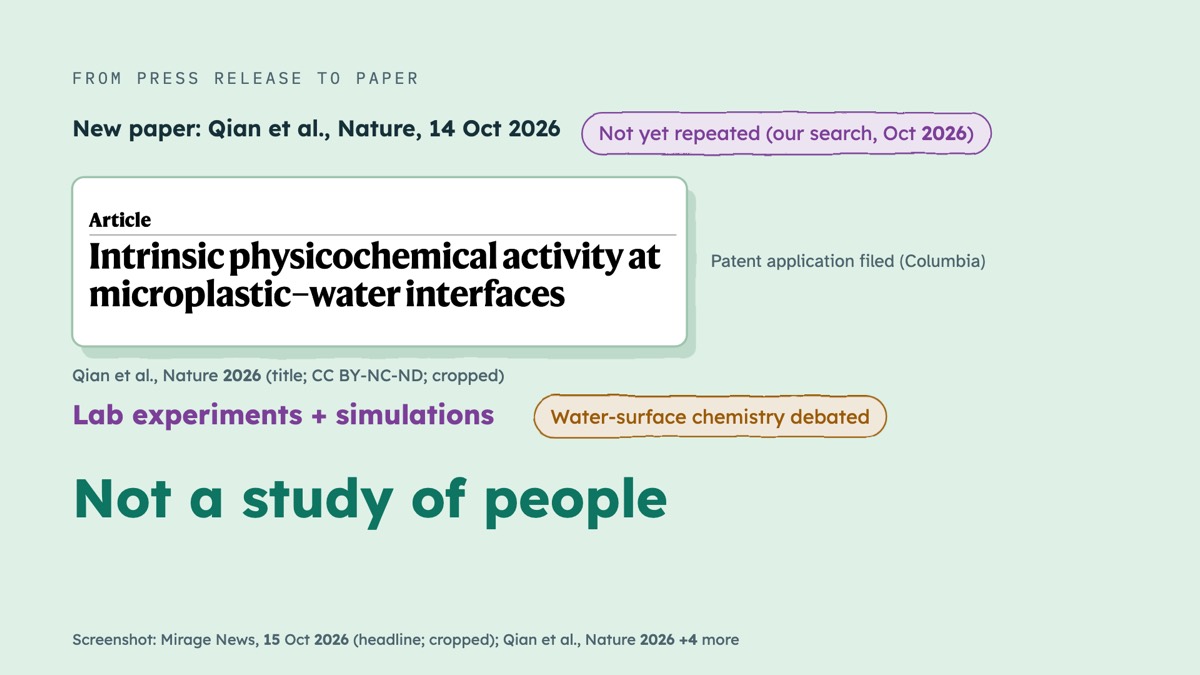
Those October headlines most likely trace to a new paper in Nature, press-released as "microplastics are chemically active, and could cause biological harm". One republished copy ran it as "Microplastics' Chemical Activity Could Harm Living Organisms". We've read the paper itself: it's lab experiments and computer simulations, not a study of people or of living animals. In its tests, fresh plastic powder in water made a reactive form of oxygen at its surface. By our comparison, the tests used far more plastic than careful labs find in human blood.
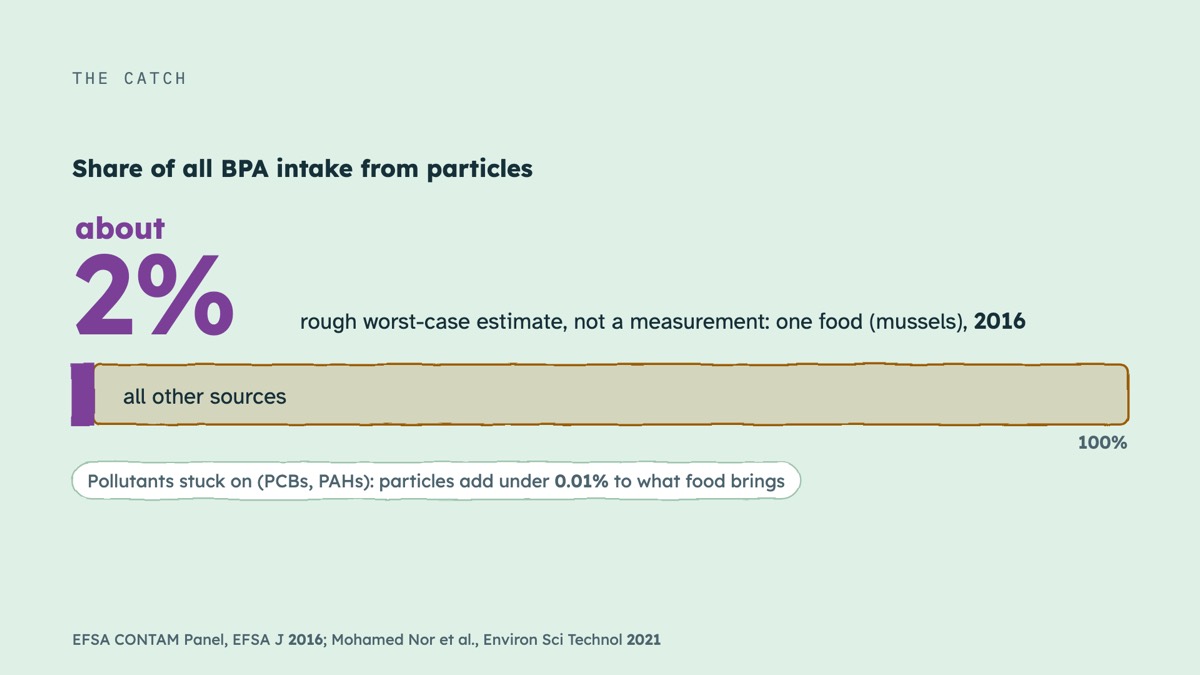
Here's the catch. For the few chemicals checked, particles add only a small share; most comes by other routes. In a rough worst case from Europe's food-safety agency, particles would add about 2 percent to BPA intake, and far less for two pollutant groups, PCBs and PAHs.
And many lab studies use smooth polystyrene beads, often at doses far above levels in the environment.
Evidence about harm
Plastic particles have been reported in human stool, lungs, blood and placentas, and careful lung studies that subtract lab contamination still find some.
How much is another matter: labs' blood results disagree widely, and careful ones find little, often too little to measure.
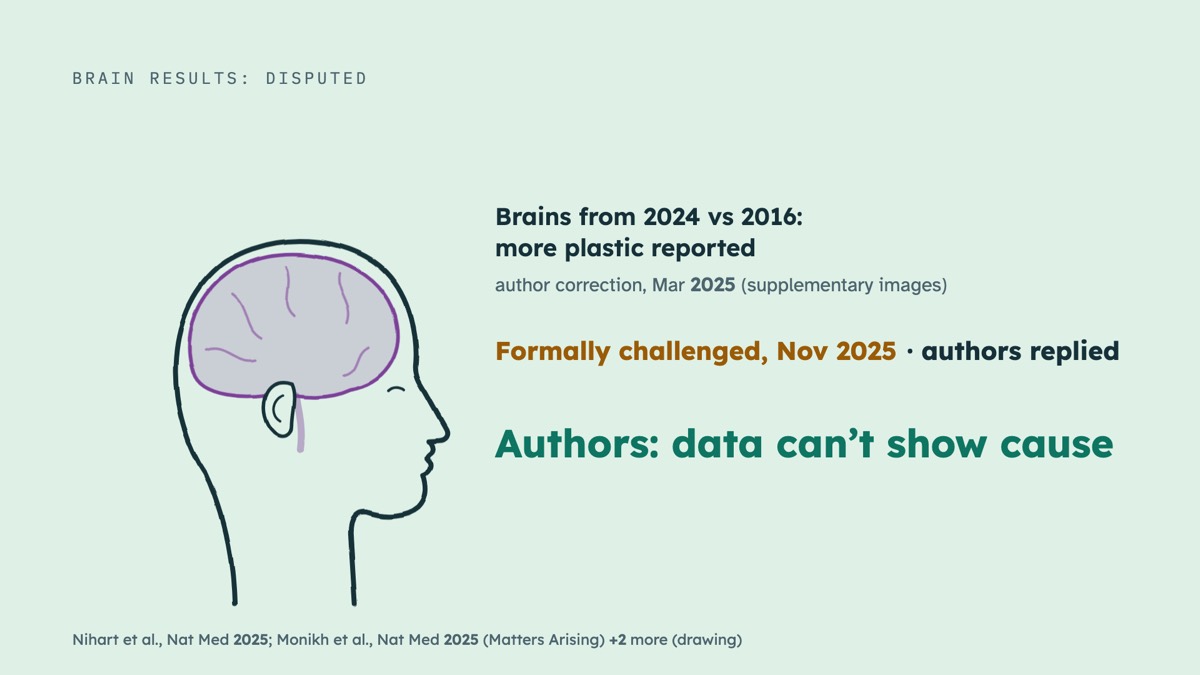
Brain results are disputed too: a much-cited study reported more plastic in brains from 2024 than 2016. Other scientists formally challenged its methods, the authors replied, and they say their data can't show cause.
The most-cited health finding comes from one 2024 study of 257 people who had plaque removed from a neck artery. Those whose plaque contained detectable plastic had more heart attacks, strokes or deaths over about three years. But it's one observational study. Other differences between the groups could explain it, its plastic readings have been questioned, and it hasn't been repeated.
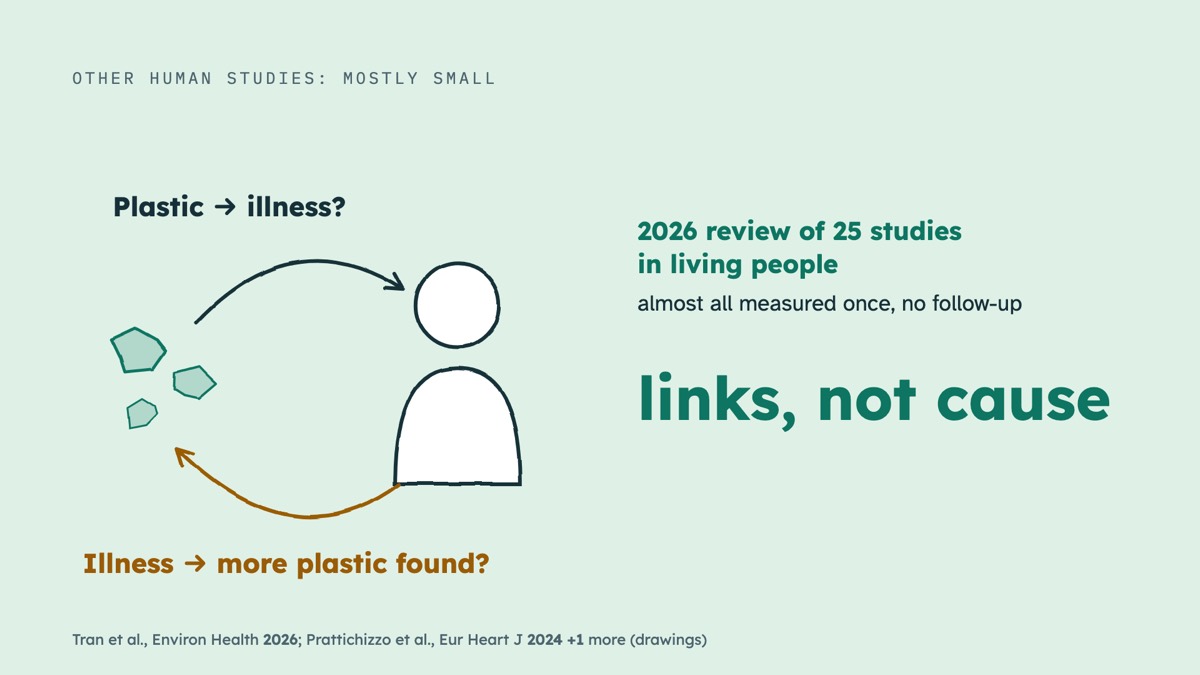
Most other human studies are small, and many can't tell which came first: illness itself can change how the body takes up or clears particles. A 2026 review of 25 studies in living people said bias and inconsistent methods limit conclusions about cause.
The clearest harm was in nylon-flock factory workers, who developed a lung disease linked to fibre dust at work, not everyday exposure.
Health agencies say the data are thin. In 2019, the World Health Organization said microplastics in drinking water don't appear to pose a health risk at current levels, based on limited information. None of the agencies we read has set a health-based limit.
A 2024 University of California review called microplastics a "suspected" harm, the third of four levels, mostly from rodent studies; for people, the evidence was too weak to classify. So, at everyday levels: not shown to be harmful, and not shown to be safe.
Where exposure comes from
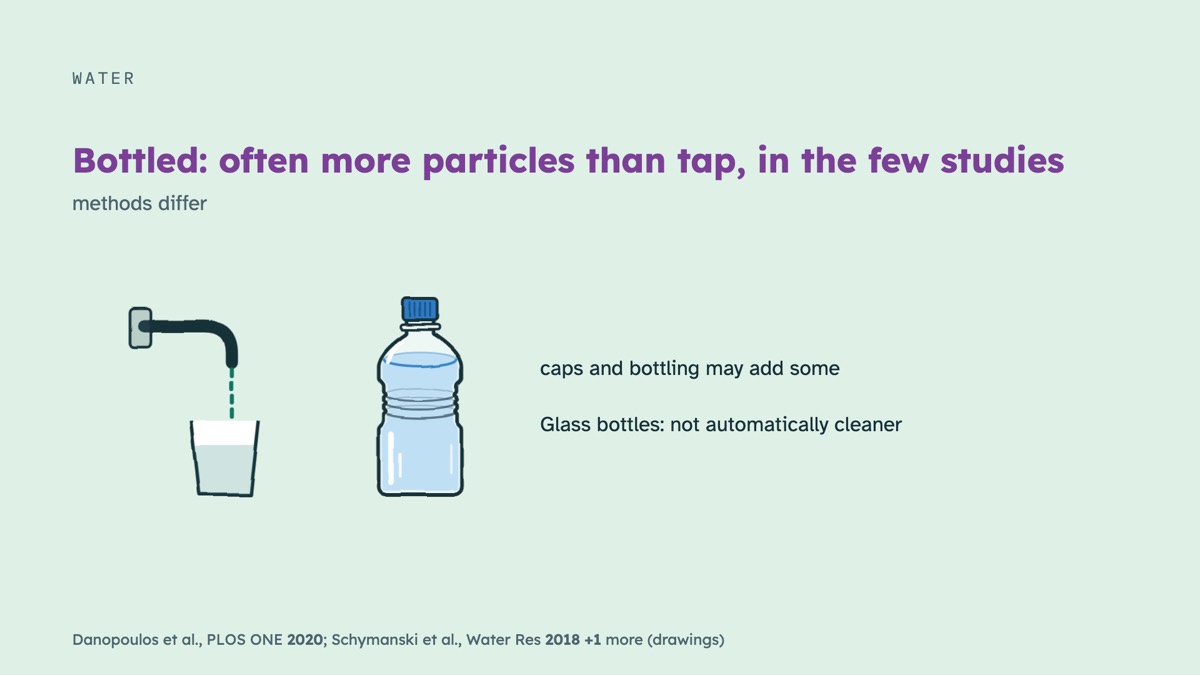
In the few studies available, bottled water seems to carry more particles than tap, perhaps partly from caps and bottling; glass bottles weren't automatically cleaner.
One 2024 study's new method estimated about 240,000 tiny plastic particles per litre in three brands, mostly nanoplastics. Another scientist disputed its contamination controls, and by weight that's about ten billionths of a gram per litre.
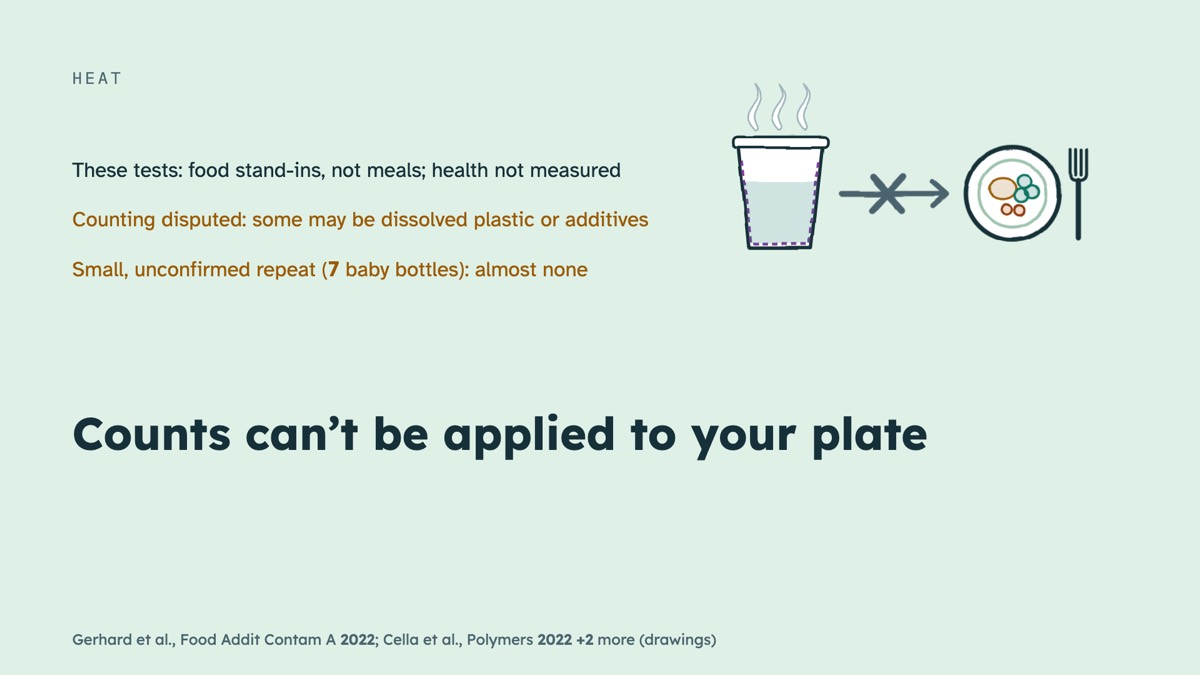
In lab tests, heat sometimes makes plastic shed more particles, but not always. Microwaving plastic containers of water or mild acid, and hot water in plastic-lined cups, released more than cooler conditions.
But these used food stand-ins, some "particles" may be dissolved plastic or additives, and a repeat of one baby-bottle study found almost none, so the counts can't be applied to your plate.
At home, clothes and furnishings shed fibres, some synthetic, and one French study found more fibres in indoor air than outdoors.
For personal care, the U.S. banned plastic microbeads in rinse-off products in stages from 2017, and intact skin is thought to be a minor route for particles.
So which source matters most? No one can yet say reliably. Labs count different particle sizes, some count particles while others weigh them, and many tests use stand-ins, not meals.
One model of some foods and air put a typical adult at hundreds of particles a day, under a millionth of a gram, though its authors say real intake may be higher. That's about a million times below the WWF-funded "credit card a week".
Cutting down, and testing
Some simple steps have lab support. Where tap water is safe, it has tended to carry fewer particles than bottled. Heated plastic can shed more in lab tests, and glass or ceramic in the microwave has no plastic to shed. But this is lab evidence about particles, not studies of people. No study has shown that cutting microplastics improves health, and no step gets exposure to zero.
Cutting plastic chemicals has been tested in people. In a one-week pilot of 60 adults, funded by a foundation with its own plastics-and-health programme, people given low-plastic food and kitchenware ended with less BPA than people who changed nothing, but one common plasticizer didn't fall.
Doing it alone looks harder: teenagers who tried a low-BPA diet themselves saw no BPA change, and most said it would be hard to keep up. Most studies of changes like these lasted only weeks to months, and we found none that checked whether people kept them up for years.
What about testing yourself? A mail-in particle blood test is on sale, but we found no published validation, and its dye can light up things that aren't plastic.
One sample is a snapshot, not your total exposure, and there's no normal range or risk level. Urine tests for plastic chemicals, not particles, are more established, but mostly reflect the last day or so.
And "blood cleaning" to remove microplastics is unproven. The few reports we found were all co-written by clinic or company staff, and none measured a health benefit.
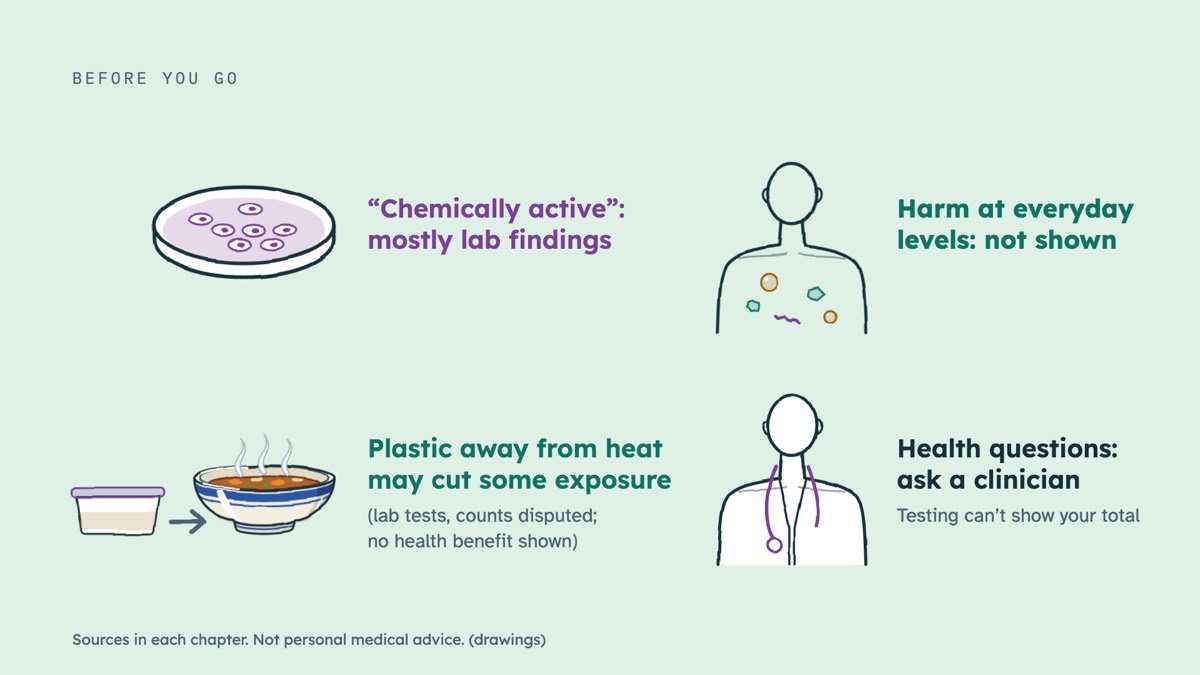
So "chemically active" mostly describes lab findings. Plastic does get into us; how much is uncertain, and harm at everyday levels hasn't been shown. Simple steps, like keeping plastic away from heat, may cut some exposure. For your own health questions, a clinician is the right person to ask.
Sources
70 sources cited in the video, in the order they come up.
The October 2026 headline
- Columbia University press release, 14 Oct 2026, "Microplastics Are Chemically Active, and Could Cause Biological Harm": headline as listed in search results (dated by its listing URL); text read as republished by Mirage News, 15 Oct 2026 (screenshot: date line and headline, cropped), shown for what it said, not as evidence
- Qian 2026, Nature, the lab and simulation study the headlines most likely trace to (AFOSR, NIH, DOE and foundation funding; no industry funder declared; Columbia has filed a provisional patent application; "not yet repeated": our search, 15 Oct 2026)
- Paper shot: Qian et al., Nature 2026 (title; CC BY-NC-ND; cropped)
- "Far more plastic than careful labs find in human blood": our comparison, using Nardella, Rauert (below) and Durkin 2026
- Chan 2026, review (never mentions plastics; the link is our inference)
- Eatoo & Mishra 2024 ; Nguyen 2023 [link 2]
What 'chemically active' can mean
- EFSA CONTAM Panel 2016 (absorption ≤0.3%, 0.2–7% at 50 nm; no in vivo human data; BPA case: all additive taken as BPA)
- US EPA, Microplastics Research
- California Water Board, microplastics
- Monclús 2025 (hazard label, not proof of harm; Food Packaging Forum (FPF) staff, advisers among authors)
- EFSA 2023, BPA from all sources (mouse data; disputed by BfR, EMA, DFG) ; vom Saal 2024 (NIEHS-supported) ; Prueitt & Goodman 2024 (American Chemistry Council-funded) [link 2] [link 3]
- EFSA 2019, phthalates (temporary; rat studies)
- Xie 2024 (lab-aged plastic)
- Coffin 2022 (water-board workshop and funding; some authors declare industry links; mostly polystyrene spheres; no health-based level for people)
- Yang 2023 (narrative review)
- Zhang 2026 (88 studies, mostly wildlife)
Found in people, and the evidence about harm
- Schwabl 2019 (stool, 8 people)
- Lung (lab blanks): Jenner 2022 (13 samples) ; Marfella 2026 (one hospital archive; a co-author has Minderoo support) ; Dimeas 2026 (small; particles mostly identified by eye) [link 2] [link 3]
- Leslie 2022 (22 donors; the lab's later method found much less)
- Garcia 2024 (placenta; one lab's method; polyethylene readings disputed)
- Nardella 2025 (1 in 5 quantifiable; public funding; questions the artery study's markers)
- Rauert 2025 (Minderoo-funded; fats inferred, not proven)
- Cui 2025 (20 patients; a high reading)
- Brain: Nihart 2025 (post-mortem) ; correction (spectra data unaffected) ; Monikh 2025, Matters Arising ; Campen 2025, reply (both unread) [link 2] [link 3] [link 4]
- Marfella 2024 (257 of 304 followed; abstract read; Italian PRIN, Ministry of Health, NIEHS funding; most-cited (Europe PMC) and "not repeated" (our search), 15 Oct 2026)
- Event counts (two reviews): Irfan 2025 ; Zhou 2026 [link 2]
- Prattichizzo 2024 (Marfella team: associative)
- Tran 2026 (public funding; abstract stronger than its bias ratings)
- Flock workers: Kern 1998 (8 cases; agent never pinned down) ; Boag 1999 ; Turcotte 2013 (9 cases) [link 2] [link 3]
- WHO news release, 22 Aug 2019
- FSANZ, Microplastics in food (cites EFSA 2016)
- ECCC and Health Canada 2020
- US EPA draft Contaminant Candidate List 6 (final due 17 Nov 2026)
- Chartres 2024 (28 rodent, 3 human studies; 79% polystyrene; a hazard grade, not a risk estimate)
Where exposure comes from
- Danopoulos 2020 (12 studies; bottled vs tap rests mainly on two); paper shot, CC BY
- Schymanski 2018 (glass no different from the blank)
- Oßmann 2018 (glass mean from reusable bottles)
- Qian 2024, PNAS (not repeated: our scan of 262 citing records) ; Materić 2024 letter ; reply [link 2] [link 3]
- Zimmermann 2025 (Spronck Foundation and FPF funding)
- Hussain 2023 (counts per cm², not per meal; NSF-funded; cell-death figure not relied on)
- Challenge: Sun 2024 ; authors' rebuttal (both unread) [link 2]
- Zangmeister 2022 (lab test; particles too small to identify singly)
- Son 2024 (more above ~80 °C)
- Gerhard 2022 (additives miscounted as particles; no funding)
- Li 2020: the study Gerhard repeated; named only, not relied on
- Cella 2022 (EU JRC authors; no PMID in our records)
- Dris 2017 (1 outdoor site)
- Vianello 2019 (breathing mannequin)
- De Falco 2020 (lab estimate)
- Microbead-Free Waters Act of 2015
- Menichetti 2024 (no in vivo human data)
- Mohamed Nor 2021 (a model of ~20% of the diet; adult median 583 ng a day)
- Senathirajah 2021: origin of the "credit card a week" claim, not evidence (WWF-funded); "a million times" is our arithmetic
Cutting down, and testing
- Cole 2024 (lab kitchen test; non-plastic cookware)
- Hartmann 2024 (15 volunteers)
- "No health benefit shown": our Europe PMC searches, 15 Oct 2026 (closest: Zhang 2024, gut microbes, not health)
- Harray 2026, PERTH (not blinded; BPA −59.7% vs the no-change group, 95% CI −82.5 to −6.9; Minderoo-funded)
- Sieck 2024 (scoping review to Nov 2022; "none checked": also our searches)
- Galloway 2018 (94 students aged 17–19)
- Helgeson 2026 (kit not validated; likely undeclared tie to its co-developer; lung link not relied on; "no validation": our search, 15 Oct 2026)
- Yang 2025 (dye not plastic-specific; in blood, our inference)
- Tsalouchos & Dattolo 2026 (kidney review; no funding)
- Thayer 2015 (BPA half-life ~6 h after a single test dose)
- Ye 2011 (8 adults; BPA in 91% of samples)
- Xiao 2026 (stool repeats, 16 young men)
- Mol 2022 (urine lab methods)
- Thomas 2026 (Minderoo among funders)
- Mörtzell Henriksson 2016 (hospital registry: mild 2.4%, moderate 3%, severe 0.4%)
- Green 2025 (heart-bypass tubing, lab tests)
- "Blood cleaning" reports we found, counted, not relied on: Bornstein 2025 ; Weinstein 2026 ; Kiprov 2026 ; Castillo-Aleman 2025 (abstract: no microplastic data) [link 2] [link 3] [link 4]


