
How Much Should You Walk Each Day at 77?
Inside this episode
The video’s narration, chapter by chapter, with stills from the video and every source at the end.
The short version
Welcome to Health Loom. Here's the short version. The guidelines we read talk mostly in minutes: for most older adults, about 150 a week of moderate activity like brisk walking, plus balance and strength work, built up gradually. Walking after a meal blunts that meal's blood sugar rise. And on these two medicines alone, low blood sugar is uncommon.
How much walking?
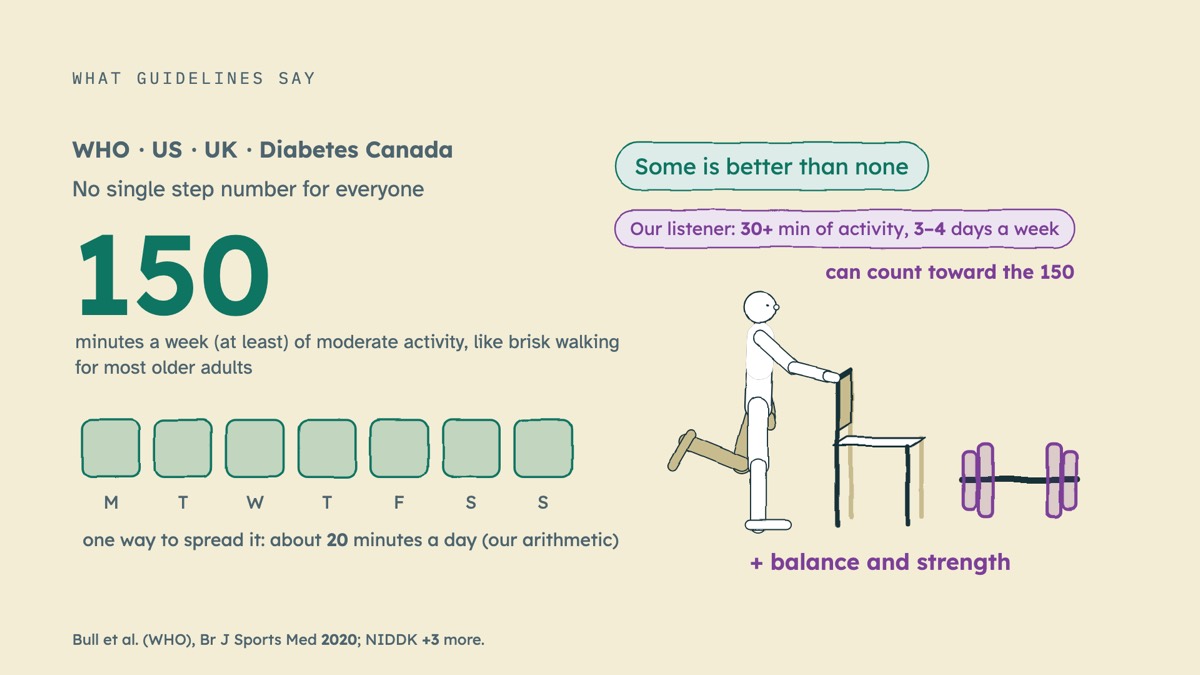
The guidelines we read, from the World Health Organization, the U.S., the U.K. and Diabetes Canada, don't give one step number for everyone. They talk in minutes: for most older adults, at least 150 a week of moderate activity, like brisk walking, built up gradually, plus balance and strength work. Moderate means you can talk but not sing. Some activity is better than none. Our listener already reports 30 minutes or more of activity on three or four days a week, and that can count toward it.
Pooling 15 studies of about 47,000 adults, death rates were lower the more people walked, and for people 60 and over, the drop seemed to level off around 6,000 to 8,000 steps a day. In about 17,000 women averaging 72, as few as 4,400 steps went with lower death rates than 2,700. These are links, not proof: people who are unwell tend to walk less.
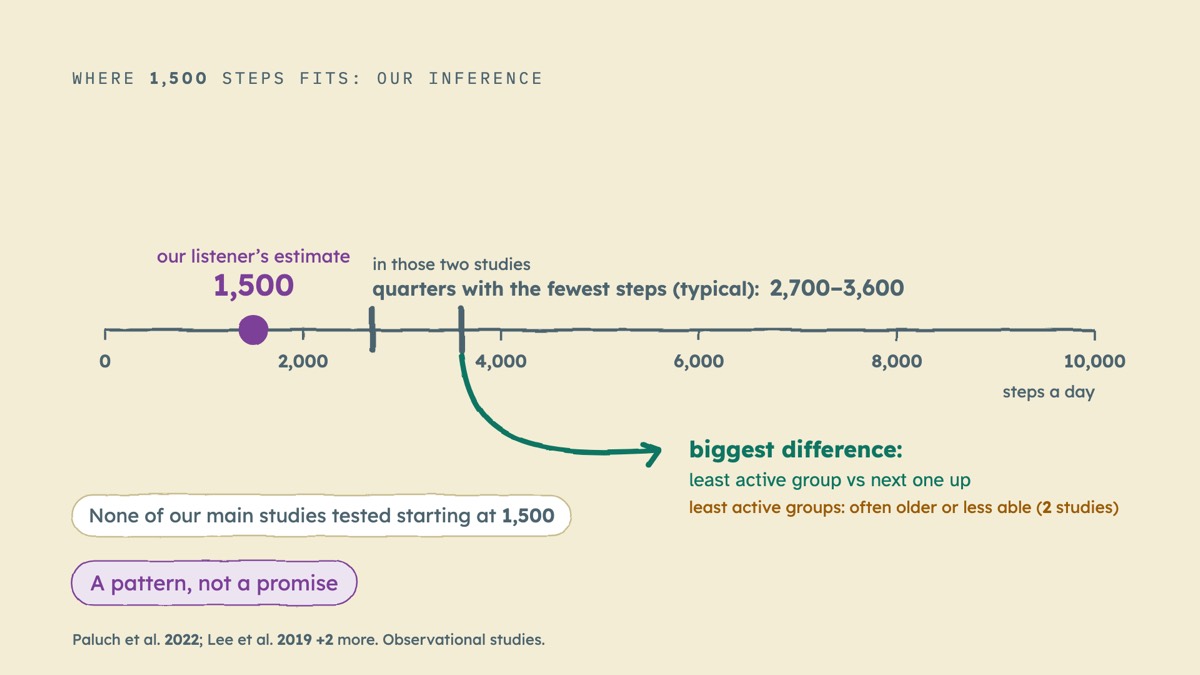
Where does 1,500 fit? Our inference: it's below what the quarter of people who walked least typically took in those two studies, about 2,700 to 3,600 steps, and none of the main studies we used tested starting from 1,500. But in several analyses, the biggest difference was between the least active group and the next one up, though the least active groups were often older or less able. That's a pattern, not a promise for any one person.
In the Life trial, inactive people aged 70 to 89 who were starting to slow down did a partly supervised walking-based program with strength and balance work. Over about two and a half years, fewer lost the ability to walk a quarter mile: 30 in 100, versus 35 in 100 in a comparison group.
Walking and blood sugar
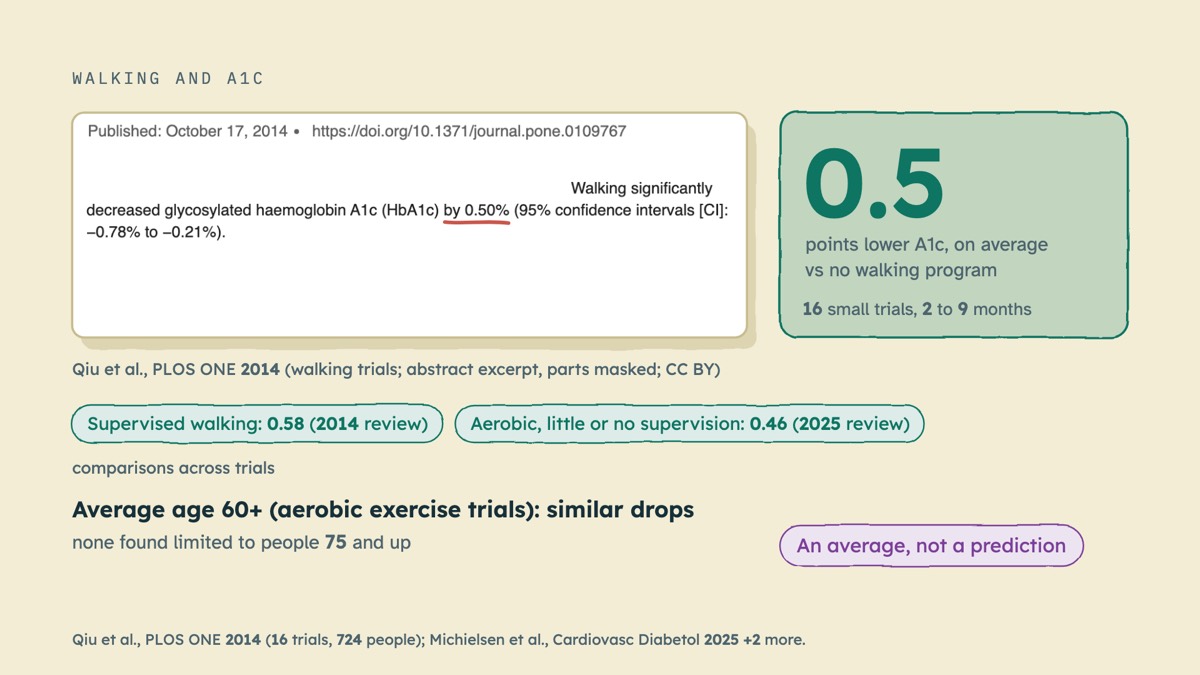
In trials of people with type 2 diabetes, walking programs lasting two to nine months lowered A1c, a measure of average blood sugar over the past two to three months, by about half a point on average. Supervised walking did a little better, but in a larger 2025 review, walking and similar exercise with little or no supervision still lowered A1c. Trials of aerobic exercise in people averaging 60 and over found similar drops, though we found none limited to people 75 and up. That's an average, not a prediction.
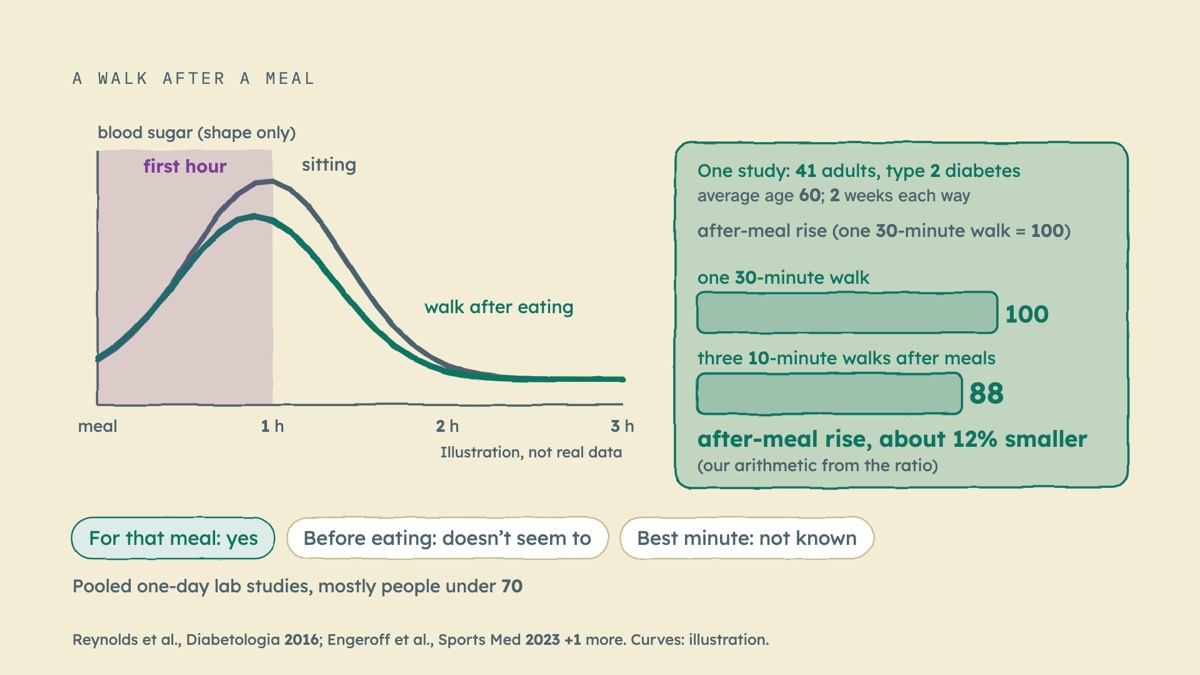
So, does walking soon after a meal help? For that meal, yes. Pooled lab studies find a walk after eating lowers that meal's blood sugar rise; the same walk before eating doesn't seem to. In a study of 41 adults with type 2 diabetes, average age 60, three 10-minute walks after meals made after-meal rises about 12% smaller than one 30-minute walk. Any time in the first hour or so has support; the best minute isn't known.
Over weeks and months, though, the few small trials haven't consistently shown that timing beats simply doing the walking. In our reading, the listener's after-meal walks are well timed for each meal, and the A1c trials point to walking regularly.
Building up safely
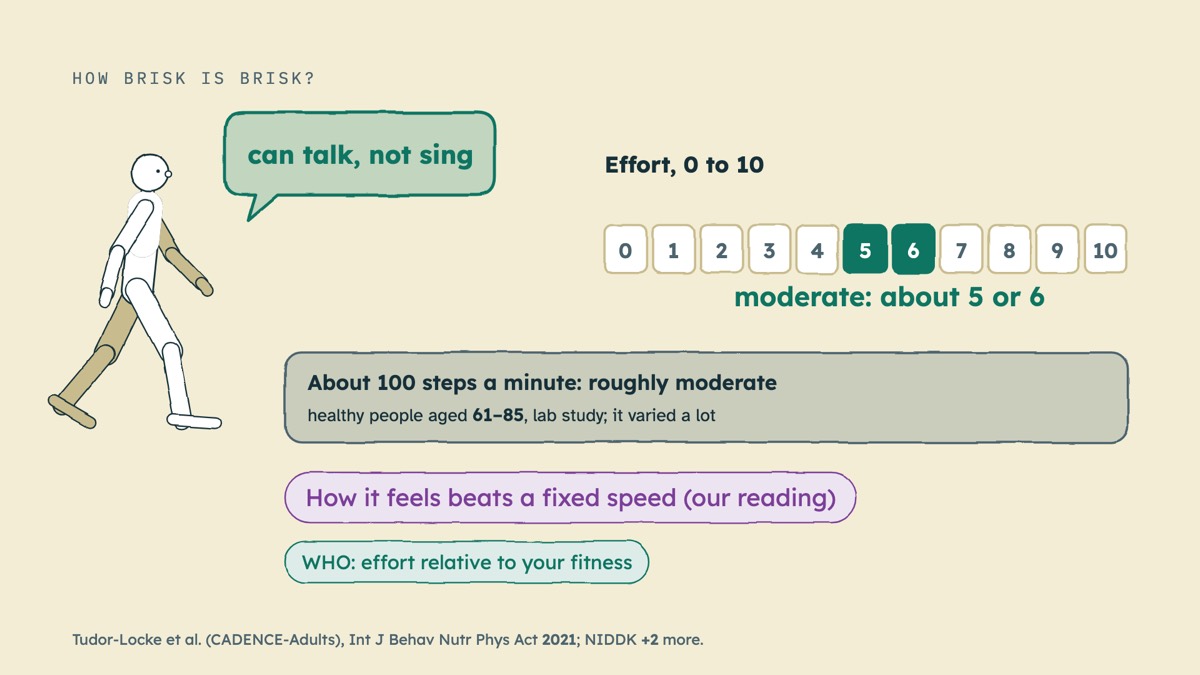
How brisk? Moderate means breathing harder but still able to talk, not sing. On a zero-to-ten effort scale, about a five or six. In a lab study of healthy people aged 61 to 85, about 100 steps a minute was roughly moderate, but it varied a lot. Our reading: how it feels beats a fixed speed, and the World Health Organization says older adults should judge effort against their own fitness.
The guidelines we read agree: start small and add gradually. No trial we found in older adults compared build-up rates, and the main trials started well above 1,500 steps. Diabetes Canada's example starts with 5 to 15 minutes of comfortable walking and builds over about 12 weeks. Short walks count: three 10-minute walks after meals can stand in for one 30-minute walk. By our rough arithmetic, a thousand brisk steps take about ten minutes.
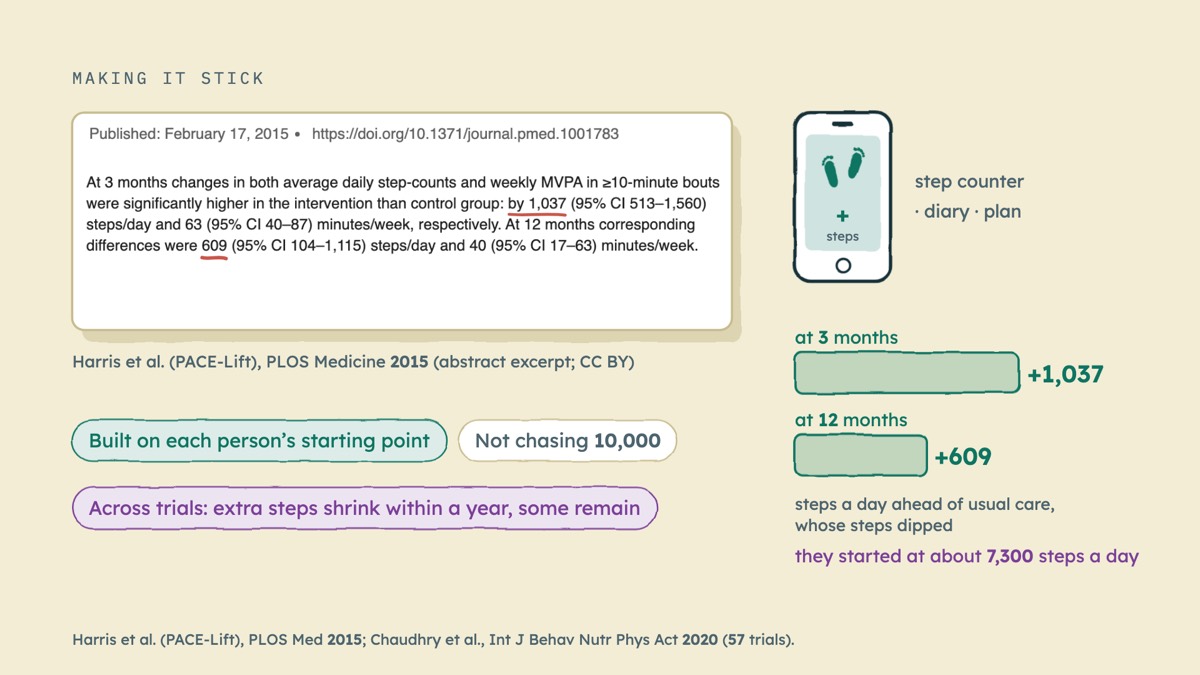
In a U.K. trial of people aged 60 to 75 who already walked about 7,300 steps a day, nurses helped people build on their own starting point with a step counter, a diary and a plan, instead of chasing 10,000. They ended up about 1,000 steps a day ahead of a usual-care group at three months, and about 600 ahead a year later. Across many trials, the extra steps shrink within a year, though some remain.
Walking alone hasn't been shown to prevent falls, but exercise programs with balance work cut falls by about a quarter in people 60 and over, and the World Health Organization includes balance and strength activities on three or more days a week. Good shoes and foot care matter with diabetes. If you ever get pain or pressure in your chest, neck, shoulder or arm, extreme shortness of breath, or feel dizzy or sick while walking, U.S. health advice is to stop and get help right away. It also suggests people treated for diabetes or high blood pressure check in with their clinician about building up.
The medicine and walking
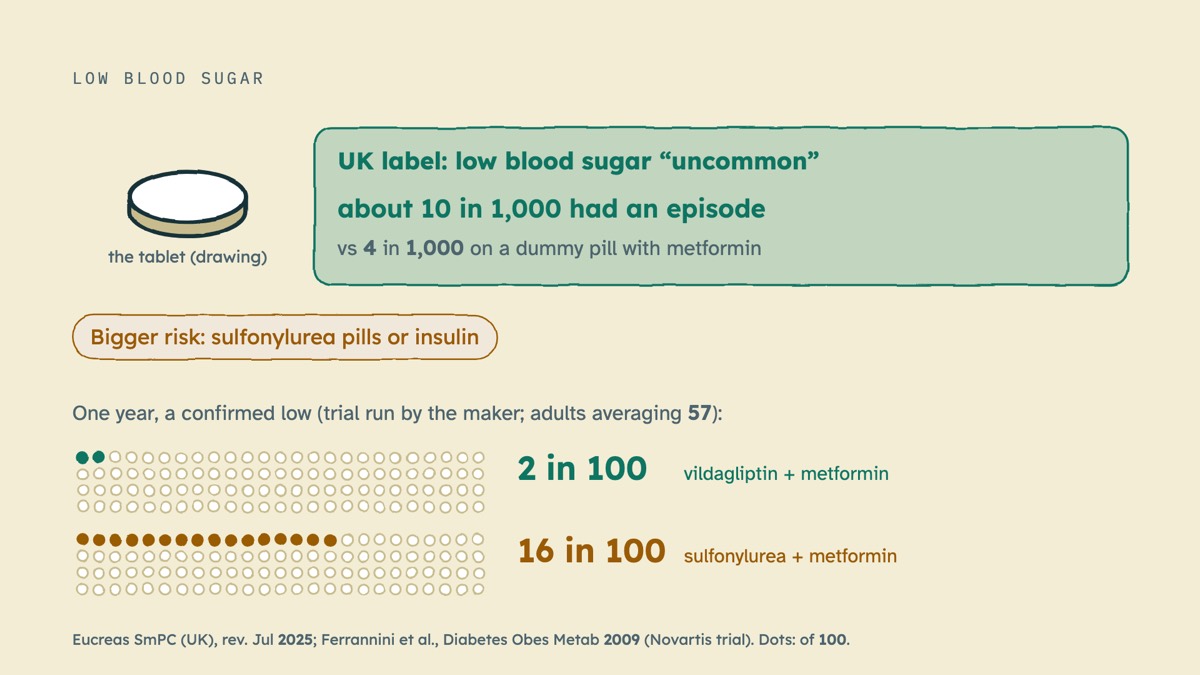
The U.K. label for vildagliptin with metformin lists low blood sugar as uncommon: in its trials, about 10 in 1,000 people had an episode, versus 4 in 1,000 on a dummy pill with metformin. The bigger risk comes with insulin, or with sulfonylureas, another type of diabetes pill. In a big year-long trial run by the maker, in adults averaging 57, about 2 in 100 on vildagliptin with metformin had a low confirmed by a finger-prick test, versus 16 in 100 on a sulfonylurea with metformin.
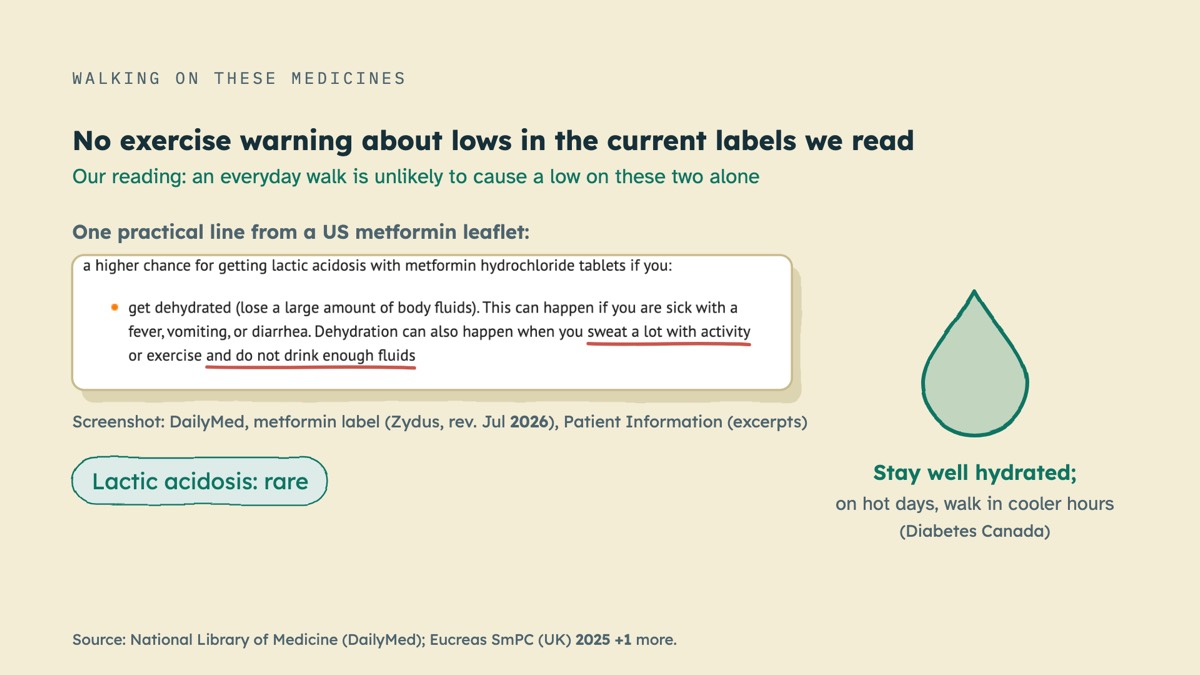
The current labels we read carry no exercise warning about lows, and our reading is that on these two medicines alone, an everyday walk is unlikely to cause a low. One practical line from a U.S. metformin leaflet: sweating a lot during activity without drinking enough can dehydrate you, which raises metformin's rare risk of a serious problem called lactic acidosis, a buildup of acid in the blood. Diabetes Canada suggests staying well hydrated and, on hot days, walking in cooler hours.
So for most older adults, guidelines point to building gradually toward about 150 minutes a week, plus balance and strength work. After-meal walks are well timed for each meal. Questions for your clinician: How brisk should I go, and how fast should I build up? Is there anything about my heart, blood pressure, feet or eyes to know first? And do any of my medicines change how I should exercise?
Sources
34 sources cited in the video, in the order they come up.
Intro
- Paluch 2022, Lancet Public Health (15 step-count studies, about 47,000 adults; leveled off around 6,000 to 8,000 at 60 and over; links, not proof; abstract read; US CDC funding)
- Intro footer "+1 more": Reynolds 2016, Diabetologia (New Zealand crossover study: 41 adults with type 2 diabetes, average age 60, 2 weeks each way; abstract read)
- Engeroff 2023, Sports Med (pooled one-day lab studies of walking before or after a meal; small, mostly people under 70, all at high risk of bias)
- Bull 2020, Br J Sports Med: WHO 2020 guidelines (balance and strength on 3 or more days is WHO's advice): ; WHO fact sheet [link 2]
- Eucreas (vildagliptin with metformin) SmPC, UK, Novartis, revised 24 Jul 2025 (the maker's label)
- Short-version footer "+2 more": Engeroff 2023 (above) and Diabetes Canada: Sigal 2018 (next chapter) plus its chapters behind "uncommon on these two medicines alone", Lega 2023 (hypoglycemia) and Meneilly 2018 (older people; an AstraZeneca grant is listed, not examined) [link 2]
How much walking?
- US PAG 2018: Piercy 2018, JAMA (Physical Activity Guidelines for Americans)
- UK Chief Medical Officers' guidelines (2019, updated Jul 2026)
- Sigal 2018, Can J Diabetes: Diabetes Canada, Physical Activity and Diabetes (authors report drug-company grants and fees, outside this work): ; chapter [link 2]
- Lee 2019, JAMA Intern Med (about 17,000 US women averaging 72; adjusted for other factors; abstract read; bars are relative death rates, our arithmetic from its hazard ratios)
- Jefferis 2019, Br J Sports Med (older British men; the least active were often older or less able)
- Watanabe 2025, GeroScience (adults 65 and over in Japan; disability, not death)
- Pahor 2014, JAMA (LIFE trial: inactive adults 70 to 89 starting to slow down; partly supervised walking, strength and balance vs health education; abstract read)
- Fielding 2011, J Gerontol A Biol Sci Med Sci (LIFE design paper: the plan, not what people did)
Walking and blood sugar
- Paper shot, shown on screen: Qiu 2014, PLOS ONE (walking trials; title block and abstract excerpt, parts masked; CC BY; −0.50 points pooled from 16 small trials, 724 people; supervised 0.58 is a comparison across trials; no funding): ; PubMed [link 2]
- Michielsen 2025, Cardiovasc Diabetol (the larger 2025 review; little or no supervision 0.46; possible publication bias)
- Zhan 2026, Front Endocrinol (aerobic exercise trials averaging 60 and over; not walking only)
- A1c footer "+2 more": Zhan 2026 (just above) and Park 2026, Diabetes Res Clin Pract (older adults with type 2 diabetes; abstract only; backs Zhan, no number aired)
- After-meal footer: Reynolds 2016 and Engeroff 2023 (above); "about 12% smaller" is our arithmetic from Reynolds's ratio. "+1 more": Kang 2023, Nutrients (one-day studies, ages 21 to 69)
- Rees 2025, Med Sci Sports Exerc (FED trial: 16 adults, 16 weeks of walking before or after breakfast; A1c didn't clearly differ overall; abstract read)
- Verboven 2020, Med Sci Sports Exerc (25 men, 12 weeks; exercise after breakfast did a little better; abstract read)
- Brinkmann 2019, Scand J Med Sci Sports (30 patients, 8 weeks; no difference; abstract read)
Building up safely
- Tudor-Locke 2021, Int J Behav Nutr Phys Act (98 healthy adults 61 to 85 on a treadmill; about 100 steps a minute was roughly moderate, and it varied a lot)
- NIDDK, Staying Active at Any Size (warning signs; last reviewed Jul 2016)
- ODPHP, Get Active (talk test; reviewed Jul 2026)
- Build-up footer "+5 more": Dasgupta 2017, Diabetes Obes Metab (SMARTER, Canada: adults averaging 60 who started near 4,500 to 5,000 steps): ; Harris 2015 (PACE-Lift, below); Harris 2017, PLOS Med (PACE-UP: adults 45 to 75 who started near 7,500 steps): ; Tudor-Locke 2021 (above; "1,000 brisk steps, about 10 minutes" is our arithmetic); Reynolds 2016 (above; short walks count) [link 2]
- Paper shot, shown on screen: Harris 2015, PLOS Medicine (PACE-Lift, UK: people 60 to 75 who already walked about 7,300 steps a day; a gap vs usual care, whose steps dipped; title block and abstract results; CC BY): ; PubMed [link 2]
- Chaudhry 2020, Int J Behav Nutr Phys Act (57 trials, mostly healthy adults; two authors ran the PACE trials)
- Sherrington 2019, Cochrane (adults 60 and over living at home; programs with balance work, about a quarter fewer falls; walking programs alone uncertain; "7 fewer fallers per 100" is Cochrane's example, rounded)
- Bus (IWGDF) 2023, Diabetes Metab Res Rev 2024 (foot guideline; wound-care company grants listed, not examined)
The medicine and walking
- Ferrannini 2009, Diabetes Obes Metab (Novartis trial: one year, vildagliptin vs glimepiride, a sulfonylurea, both with metformin; abstract read; the paper's own funding statement unread)
- "Adults averaging 57" and "a confirmed low" come from Ahrén 2014, Diabetes Ther, a Novartis-funded post hoc analysis of that trial
- Web shot, shown on screen: Metformin label (Zydus), Patient Information, DailyMed, rev. 15 Jul 2026 (excerpts). Shown for what it said: the U.S. leaflet's own line on dehydration and "rare" lactic acidosis. Source: National Library of Medicine


