
Why Does Perimenopause Wake You Up at 3 A.M.?
Inside this episode
The video’s narration, chapter by chapter, with stills from the video and every source at the end.
The short version
Waking in the night is the most common sleep complaint in the menopause transition, and hot flashes are tied to part of it, but not all. Sleep apnea is easy to miss in women, so it's worth ruling out. Hormone therapy helps sleep mainly when night sweats are part of the picture. Melatonin has little evidence for staying asleep. And for insomnia itself, CBT-I has the strongest evidence, though no head-to-head trial against hormone therapy has reported results yet.
Why 3 a.m.?
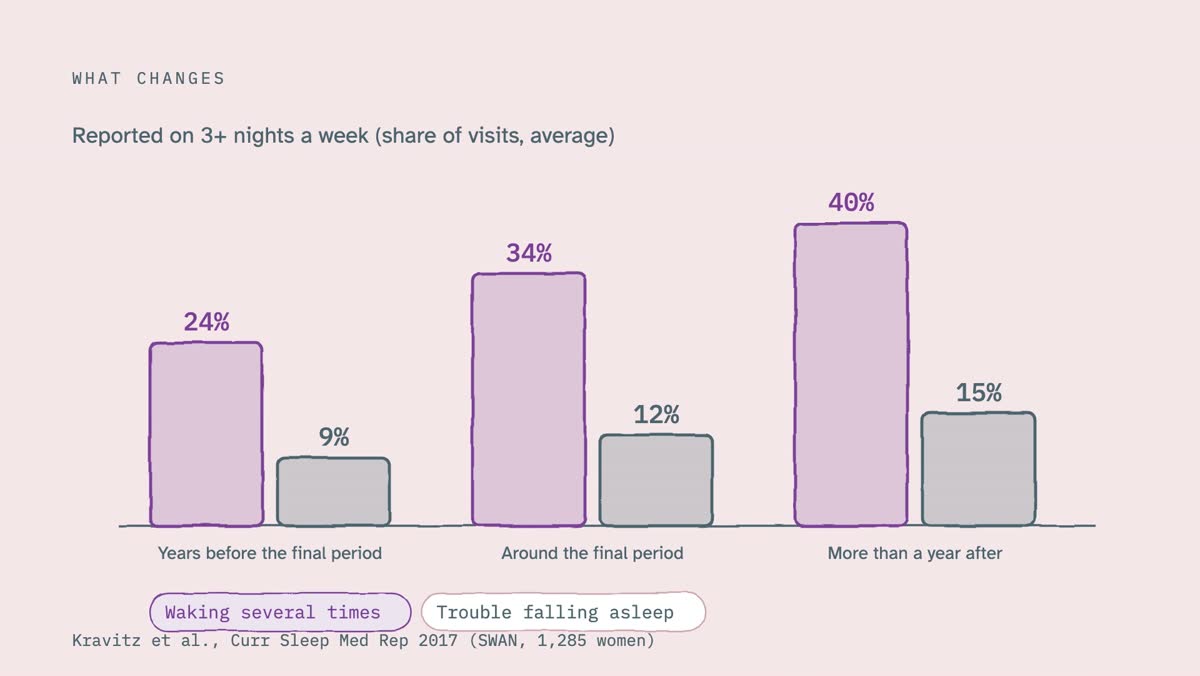
In a large US study that followed more than twelve hundred women through menopause, waking several times a night was the dominant sleep complaint. It was reported on at least three nights a week at about a quarter of visits years before the final period, and about four in ten after it, on average, though women differed a lot. Trouble falling asleep was far less common.
Part of the reason is how a normal night is built. Deep sleep is packed into the first few hours. Later, deep sleep has mostly been used up, sleep is lighter, and dream sleep gets longer toward morning. So in the early hours, sleep may be easier to disturb. That's an explanation that fits the physiology; no study has pinned down 3 a.m. itself.
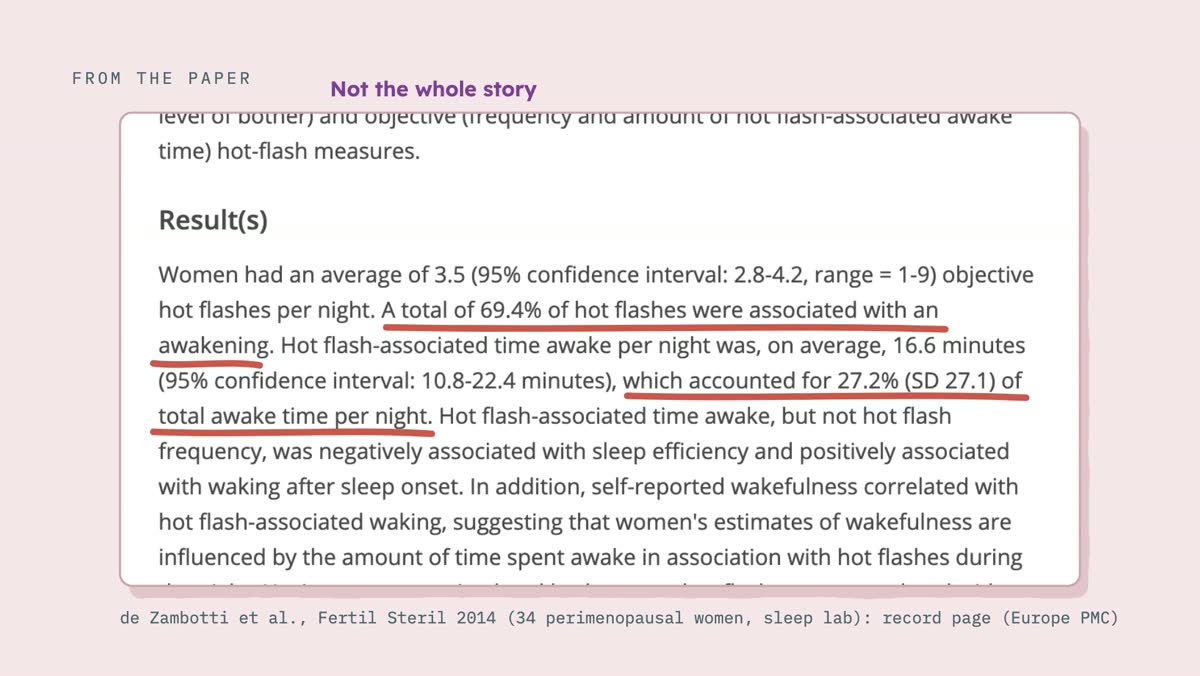
Hot flashes are tied to some of it. In a sleep lab study of 34 women in perimenopause, about 7 in 10 night-time hot flashes came with an awakening. But on nights with hot flashes, they were timed with about a quarter of the time spent awake, on average, with huge variation between women. So night sweats matter, but they aren't the whole story.
A racing heart can have several sources. In one lab study, when a night hot flash came with waking, heart rate rose by about 12 beats a minute on average, for a few minutes. That's a measured rise, not the same as feeling your heart race. In the same large US study, about half of women had a moderate to high chance of a pounding or racing heart around the transition, and it wasn't linked to early signs of artery disease. But palpitations have other causes too, which is why they're worth mentioning to a clinician.
Brain recordings add one more piece. In later perimenopause and after, sleep shows more fast, alert-type brain activity, which researchers read as a brain that's more on guard. It hasn't been shown to explain any particular awakening, and average time awake didn't differ by stage.
Perimenopause, apnea or something else?
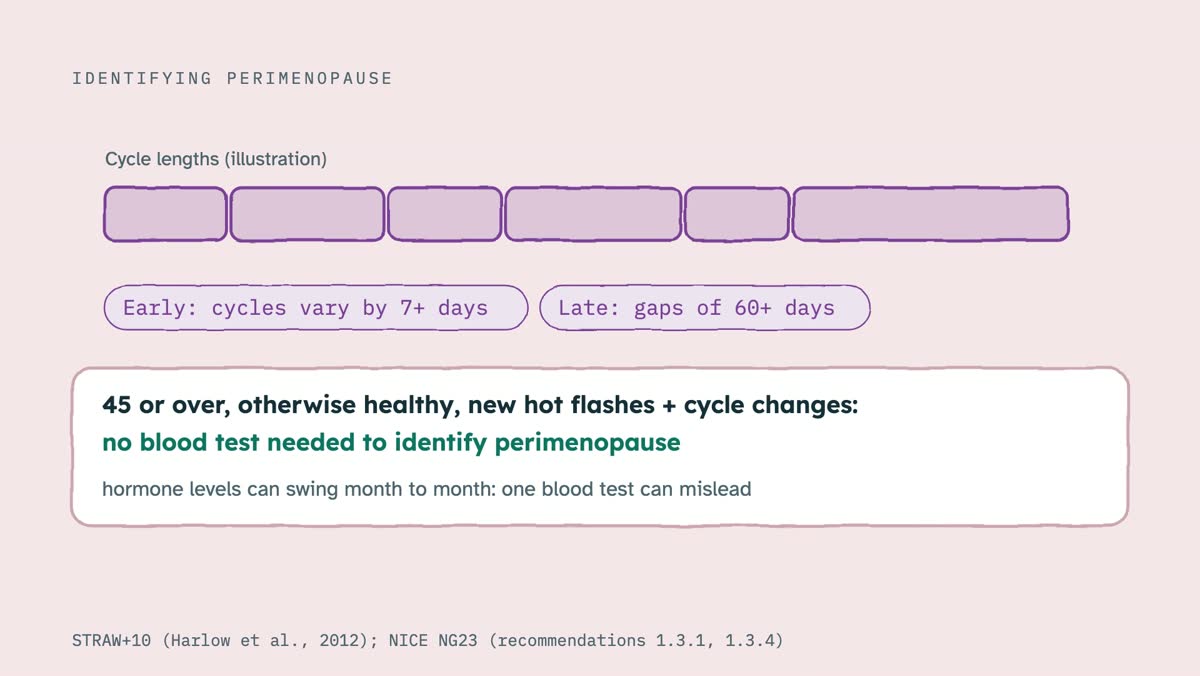
Perimenopause is identified mostly from your cycle, not a blood test. Cycles that start to vary by a week or more, and later gaps of two months or more, mark the stages. UK national guidance says that for otherwise healthy women over 45 with recent hot flashes and cycle changes, it can be identified without lab tests. And during the transition, hormone levels can swing a lot from month to month, so a single blood test can mislead.
Sleep apnea is the one that's easy to miss. Its risk becomes clearly higher after menopause; during the transition itself, the picture is less certain. In US estimates, moderate to severe apnea affected about 3 percent of women aged 30 to 49, and about 9 percent at 50 to 70.
In women it can look different. In one clinic study of women and men with equally severe apnea, snoring was about as common, but women more often named insomnia as their main complaint, and in another clinic, women reported night-time palpitations more. Screening questionnaires can miss women: in one population study, one of them caught only about half of women with moderate to severe apnea, against nearly nine in ten men. Night sweats were more common with apnea in some studies but not others, so sweating alone doesn't point to apnea.
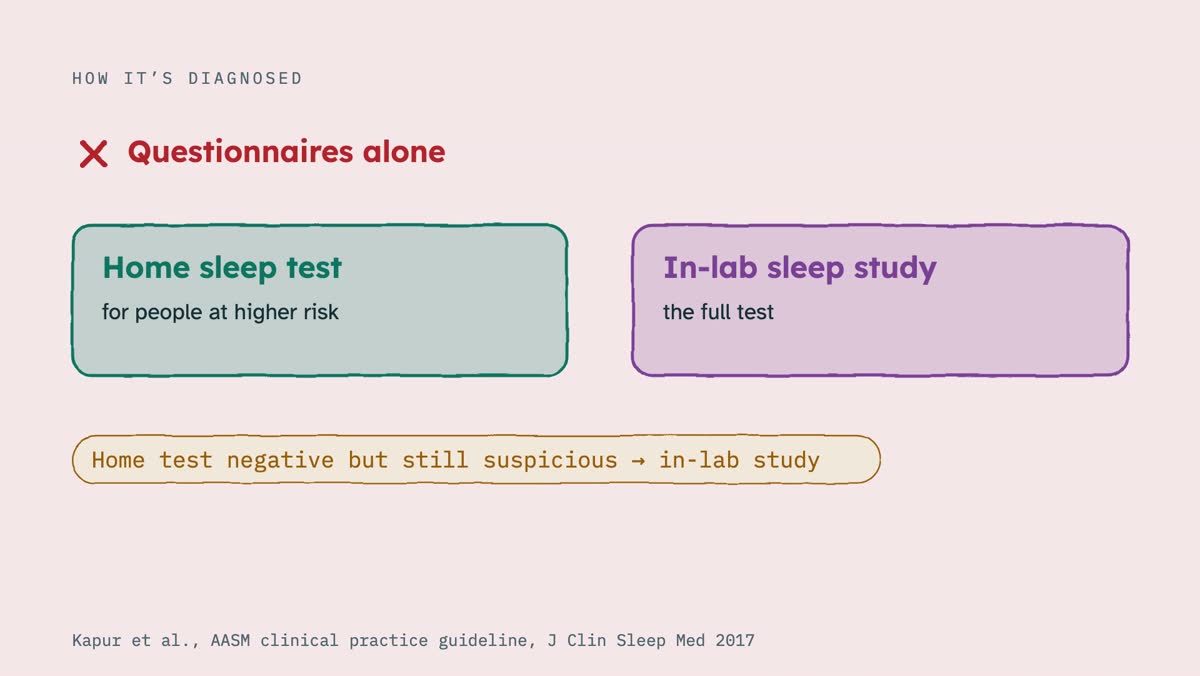
So questionnaires can't settle it. The American Academy of Sleep Medicine says apnea is diagnosed with a sleep study, at home or in a lab. And if a home test is negative but suspicion remains, an in-lab study should follow.
Other causes a clinician may consider: an overactive thyroid, which can cause sweating and a racing heart, checked with a blood test called TSH. Alcohol in the evening, which in lab studies tends to disturb the second half of the night. Some medicines, including certain antidepressants, which can cause night sweats. Restless legs, which is linked to low iron. And anxiety or low mood, which can disrupt sleep too.
Some signs need prompt attention rather than waiting: night sweats with fever, weight loss or swollen glands, or a racing heart with fainting, chest pain, or signs of heart failure such as breathlessness.
No single clue, including the time you wake, has been shown to tell these causes apart. Clinicians often ask for a two-week sleep diary: when you wake, whether you were sweating, alcohol and caffeine, and any snoring or gasping a bed partner notices.
Hormone therapy and sleep
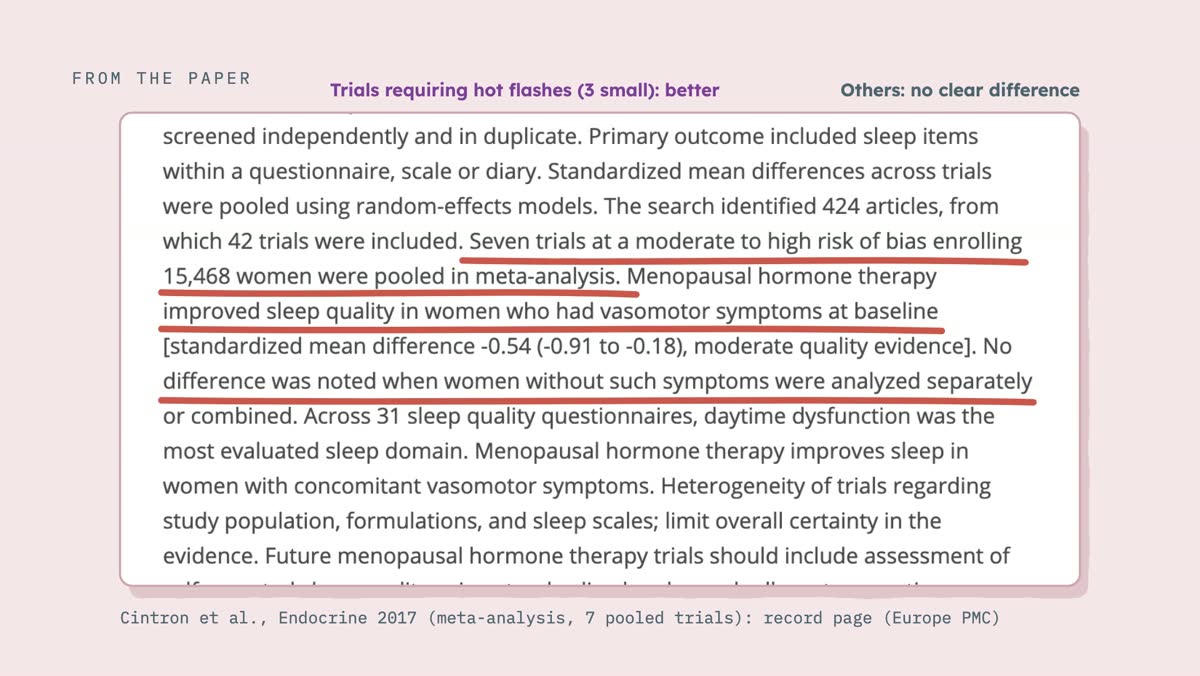
A 2017 meta-analysis pooled seven trials. In the three small trials of women with hot flashes, about 140 women in all, hormone therapy improved self-reported sleep quality. In the other four trials, which didn't require hot flashes and held almost all of the more than 15,000 women, there was no clear difference.
A larger 2022 review of 15 trials, mostly in older women, found the average effect on sleep was small. And in the few small sleep-lab studies, measures like total sleep time and sleep efficiency didn't clearly change.
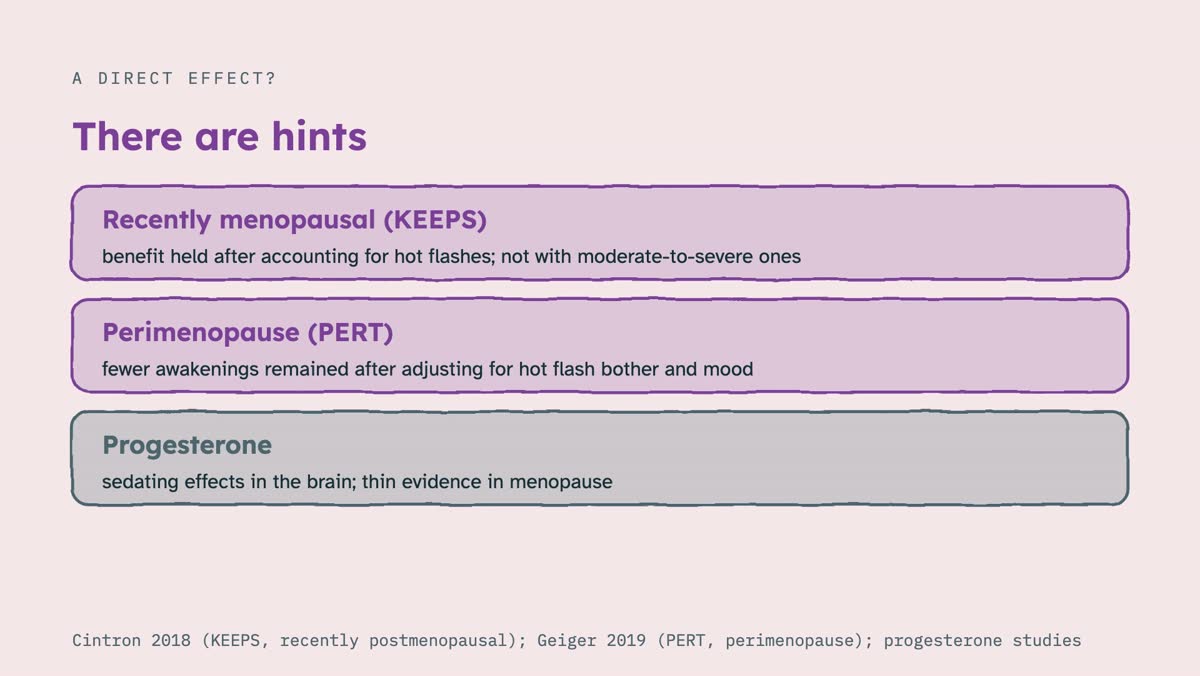
Is there a direct effect? There are hints. In one trial of recently menopausal women, the sleep benefit held up after accounting for hot flashes, though not among women whose hot flashes were moderate to severe. In a trial in perimenopause, fewer self-reported awakenings remained after adjusting for hot flash bother and mood. Progesterone has sedating effects in the brain, but evidence in menopausal women is thin.
So the Menopause Society's summary is that hormone therapy improves sleep in women with bothersome night sweats, and may have some effect beyond them, though that evidence is limited. It isn't approved as a sleep treatment. Whether it fits is a benefit-and-risk conversation, generally most favourable for bothersome symptoms before 60 or within 10 years of menopause. And in trials, relief of hot flashes only partly lined up with better sleep, so treating them doesn't always fix sleep.
Newer non-hormonal hot flash drugs, fezolinetant and elinzanetant, gave a little better self-reported sleep than placebo in company-run trials of women with frequent hot flashes, though they're approved for hot flashes, not sleep. And in a small 2026 sleep-lab study of elinzanetant, the drop in time awake was clear at four weeks but not at twelve, though the authors' modelling still favoured the drug.
Hormone therapy and sleep
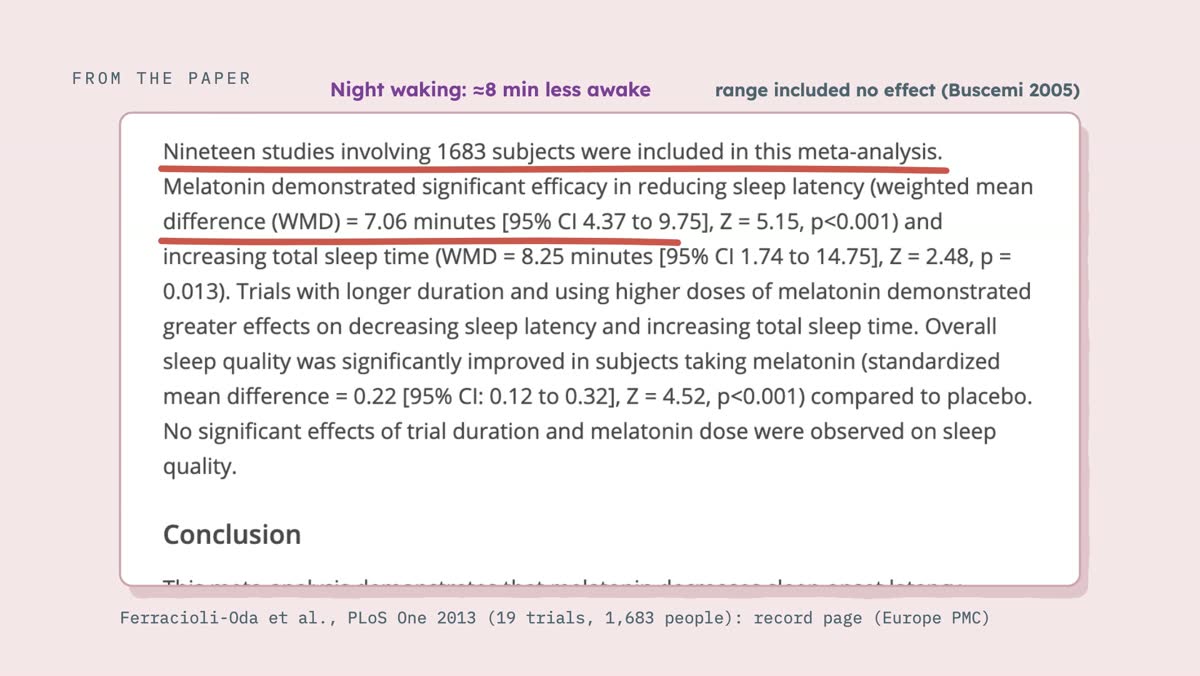
Melatonin first. In a meta-analysis of 19 trials, people fell asleep about seven minutes faster on average. For waking in the night, the evidence is thin and mixed: one pooled estimate was about eight minutes less time awake, with a range that included no effect at all.
Studies in menopausal women are small and inconclusive. The American Academy of Sleep Medicine suggests against melatonin for chronic insomnia, a weak recommendation. Prescription slow-release melatonin is licensed in Europe only for people 55 and over. And supplements vary: in a 2023 test of US gummies, actual doses ran from 74 to 347 percent of the label.
CBT-I is a short, structured program, usually four to eight sessions, in person, by phone or through an app. It retrains sleep: at first limiting time in bed to the time you're actually asleep, getting up when you can't sleep, and changing unhelpful thoughts about sleep. It's much more than sleep hygiene.
In a trial of 106 women in perimenopause or after, all with hot flashes and insomnia symptoms, six phone sessions cut insomnia scores by about ten points, against about five with menopause education. By 24 weeks, 84 percent of women assessed in the CBT-I group no longer had clinically significant insomnia, against 43 percent. Hot flashes didn't become less frequent or less severe, but they interfered less with daily life.
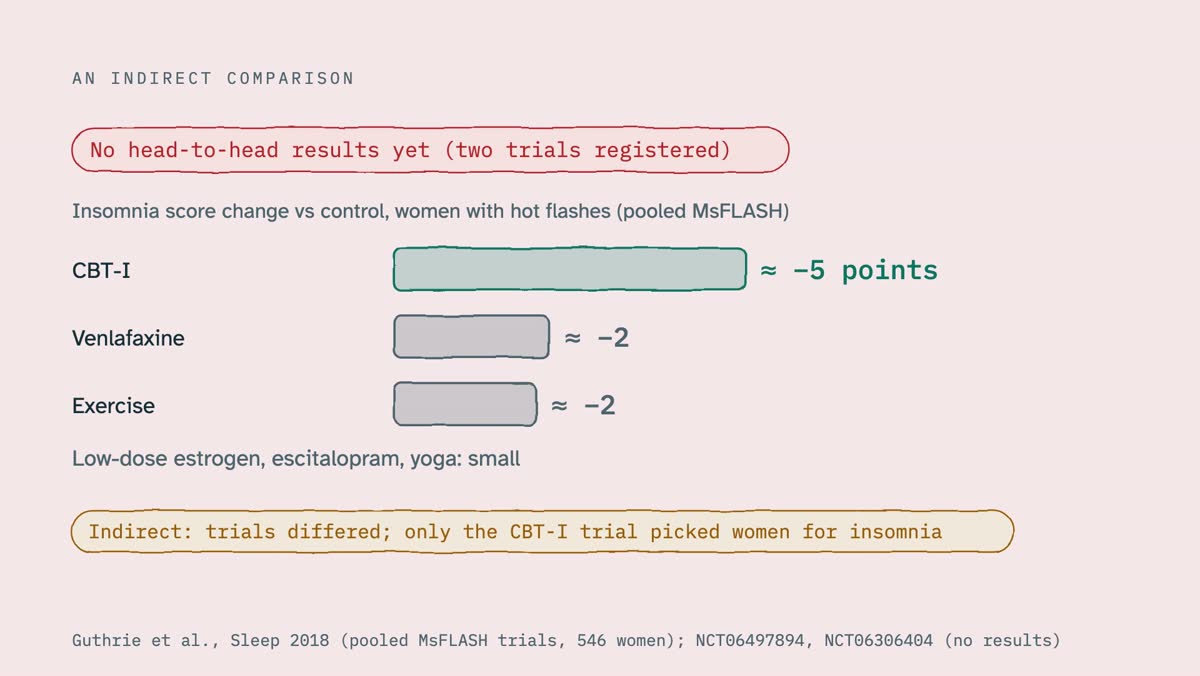
How does that compare with hormone therapy? No head-to-head trial has reported results yet; two are registered. But one research network ran several trials with the same insomnia measure in women with hot flashes. Pooled, CBT-I, from that same trial, improved insomnia scores by about five points against controls; low-dose estrogen, antidepressants, yoga and exercise had smaller effects. But the trials differed, and only the CBT-I trial picked women for insomnia, so treat it as a guide, not a verdict.
Separately, sleep and medical guidelines recommend CBT-I first for chronic insomnia in adults in general. And UK menopause guidance suggests considering menopause-specific CBT for sleep problems with hot flashes, while noting the evidence is low quality.
Put together: hormone therapy mostly helps sleep in women with night sweats, and whether it does more is unclear; melatonin helps a little with falling asleep, with thin evidence for staying asleep; and CBT-I has the strongest evidence for insomnia itself, with benefits still there at about six months in the trials, though smaller. They can be combined, though combinations haven't been well tested.
If you're in a similar spot, here are questions worth bringing to your clinician. One: do my cycle and my symptoms fit perimenopause? Two: could this be sleep apnea, and would a sleep study help? Three: should my thyroid, iron or medicines be checked? Four: is my racing heart worth an ECG or a heart monitor? Five: if night sweats are a big part of this, what are the options, and their risks, for me? And six: where can I get CBT-I, in person, by phone or online?
So, why 3 a.m.? Honestly, no study has pinned that down. Deep sleep is mostly behind you by then and sleep is lighter, and in the transition, hot flashes are tied to awakenings and the brain is more on guard in sleep. How those fit at that hour is an educated guess. Sleep apnea and other causes are worth ruling out. Hormone therapy helps sleep mainly in women with night sweats, melatonin has little evidence for staying asleep, and CBT-I has the strongest evidence for insomnia itself.
Sources
52 sources cited in the video, in the order they come up.
Why 3 a.m.?
- Kravitz et al. 2017, SWAN sleep trajectories
- Kravitz et al. 2008, sleep in the menopausal transition
- Matthews et al. 2021, SWAN sleep studies
- Campbell et al. 2011, brain activity in sleep by menopausal status
- de Zambotti et al. 2014, hot flashes and sleep in perimenopause
- Joffe et al. 2013, hot flashes and sleep (experimental model)
- Baker et al. 2019, heart rate during night hot flashes
- Carpenter et al. 2023, palpitations across the transition (SWAN)
- Dijk 2009, deep sleep
- Dijk & Czeisler 1995, REM timing
Perimenopause, sleep apnea or something else?
- Harlow et al. 2012, STRAW+10 staging
- Peppard et al. 2013, sleep apnea prevalence
- Young et al. 2003, menopause and sleep apnea
- Mirer et al. 2017, sleep apnea across the transition
- Shepertycky et al. 2005, sleep apnea in women vs men
- Valipour et al. 2007, symptoms by sex
- Lindberg et al. 2017, women less likely to be diagnosed
- Bauters et al. 2020, screening questionnaires by sex
- Arnardottir et al. 2013, night sweats and sleep apnea
- Kapur et al. 2017, AASM diagnostic guideline
- Bryce 2020, night sweats evaluation
- Gauer et al. 2024, palpitations evaluation
- Ebrahim et al. 2013, alcohol and sleep
- Mold et al. 2002, night sweats and medicines
- Winkelman et al. 2025, AASM restless legs guideline
- Schutte-Rodin et al. 2008, insomnia evaluation guideline
- Carney et al. 2012, consensus sleep diary
- NICE NG23, menopause
- NICE NG145, thyroid disease
Hormone therapy and sleep
- Cintron et al. 2017, meta-analysis
- Pan et al. 2022, meta-analysis
- Cintron et al. 2018, KEEPS
- Geiger et al. 2019, perimenopausal estradiol
- Ensrud et al. 2015, low-dose estradiol (MsFLASH)
- The Menopause Society 2022 position statement
- Shapiro et al. 2024, fezolinetant and sleep
- Pinkerton et al. 2024, elinzanetant (OASIS 1-2)
- Baker et al. 2026, elinzanetant sleep-lab study
Melatonin
- Ferracioli-Oda et al. 2013, meta-analysis
- Buscemi et al. 2005, meta-analysis
- Sateia et al. 2017, AASM pharmacologic insomnia guideline
- Yi et al. 2021, melatonin in menopausal women
- Cohen et al. 2023, melatonin gummies
- Riemann et al. 2023, European Insomnia Guideline
- EMA, Circadin (prolonged-release melatonin) product information
CBT-I and how they compare
- McCurry et al. 2016, telephone CBT-I (MsFLASH)
- Drake et al. 2019, CBT-I in postmenopausal women
- Guthrie et al. 2018, pooled MsFLASH comparison
- Edinger et al. 2021, AASM behavioral treatment guideline
- Qaseem et al. 2016, ACP insomnia guideline
- Registered head-to-head trials (no results yet): NCT06497894
- and NCT06306404


