
What Actually Lowers Your LDL Cholesterol?
Inside this episode
The video’s narration, chapter by chapter, with stills from the video and every source at the end.
The short version
Prescription medicine can lower LDL the most, and statins have the strongest trial proof of fewer heart attacks and strokes. Food changes lower LDL too, more when combined. Psyllium and plant sterols lower LDL modestly; most other drug-free supplements don't. Whether medicine makes sense depends on the whole risk picture, not just the LDL number.
How much does each lower LDL?
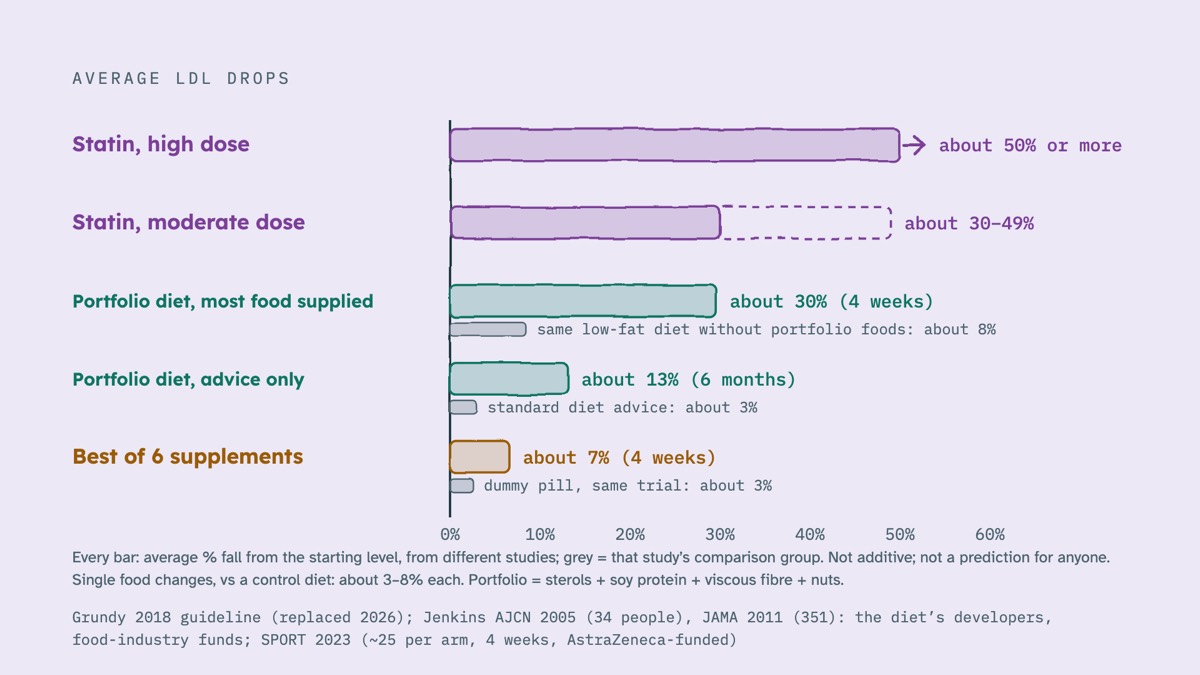
On average, a moderate statin dose lowers LDL by about 30 to 49 percent; a high dose, by half or more. A combined portfolio diet lowered LDL about 30 percent in a month when most food was supplied, but about 13 percent over six months of advice alone.
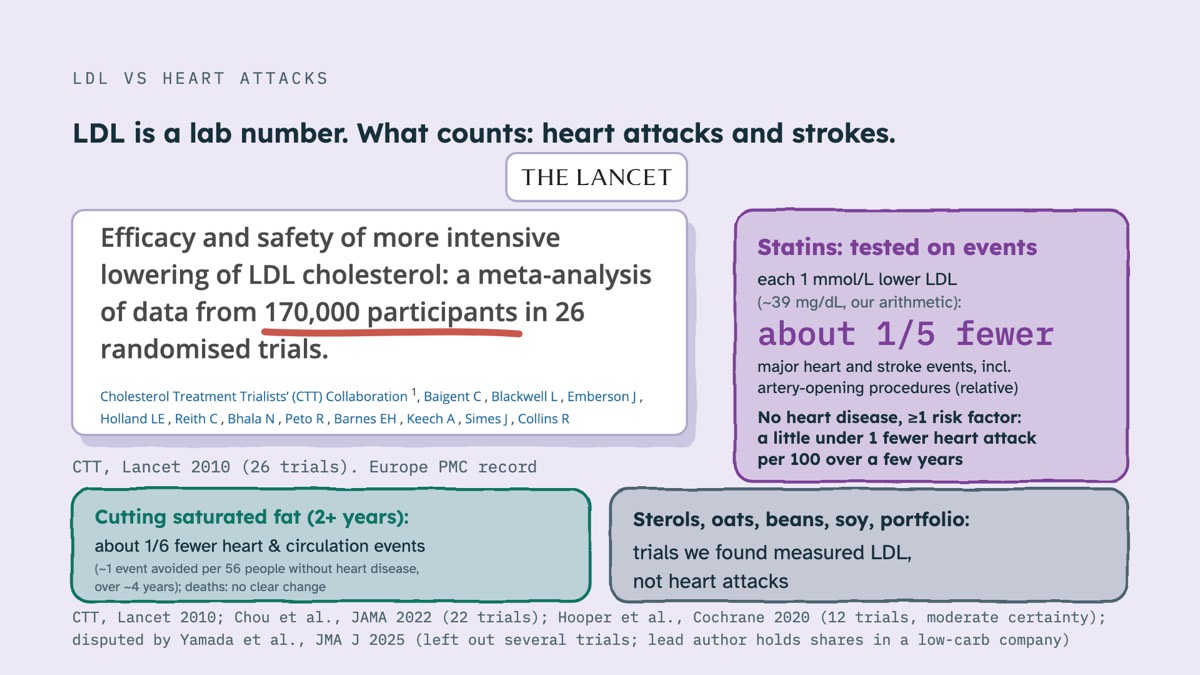
In statin trials of about 170,000 people, each 39-point LDL drop cut major heart and stroke events by about a fifth. In people without heart disease but with risk factors, statins meant a little under one fewer heart attack per 100 over a few years. In trials of two years or more, cutting saturated fat cut heart and circulation problems by about a sixth, without clearly changing deaths. For plant sterols, oats, beans and soy, the trials we found measured LDL, not heart attacks.
Which food changes work best?
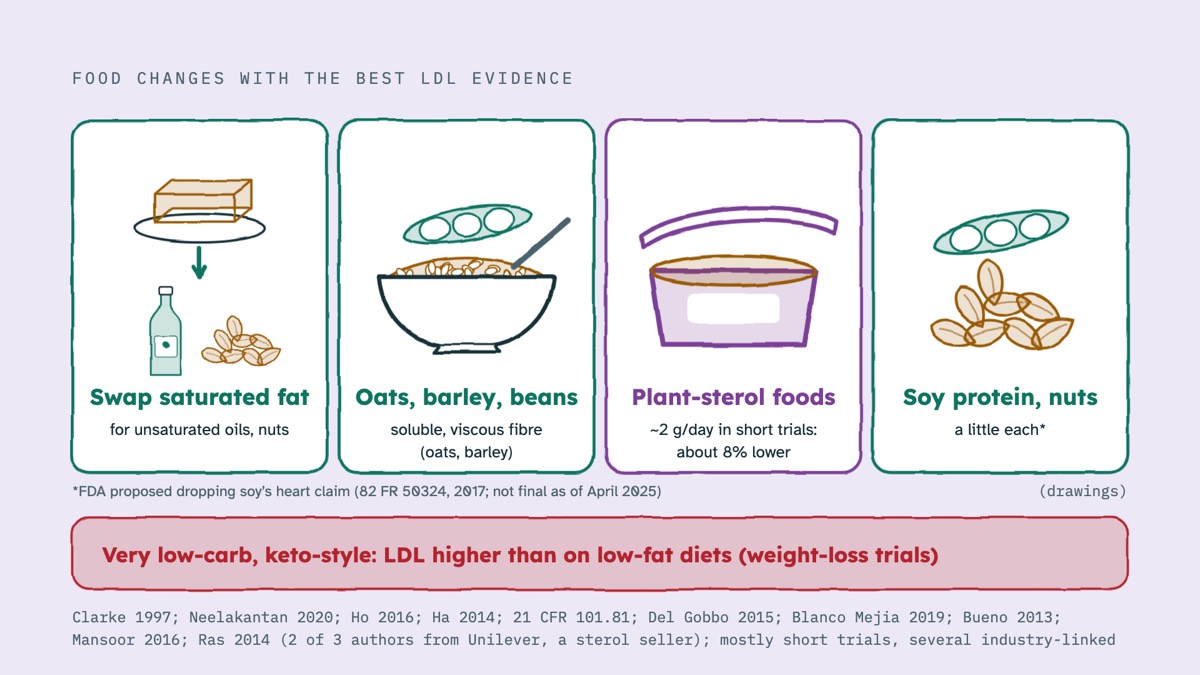
The changes with the best LDL evidence: swap saturated fat, from butter, fatty meat and coconut oil, for unsaturated oils and nuts. Add oats, barley and beans. In trials, foods with added plant sterols, about 2 grams a day, lowered LDL about 8 percent. Keto-style diets tend to leave LDL higher than low-fat diets do.
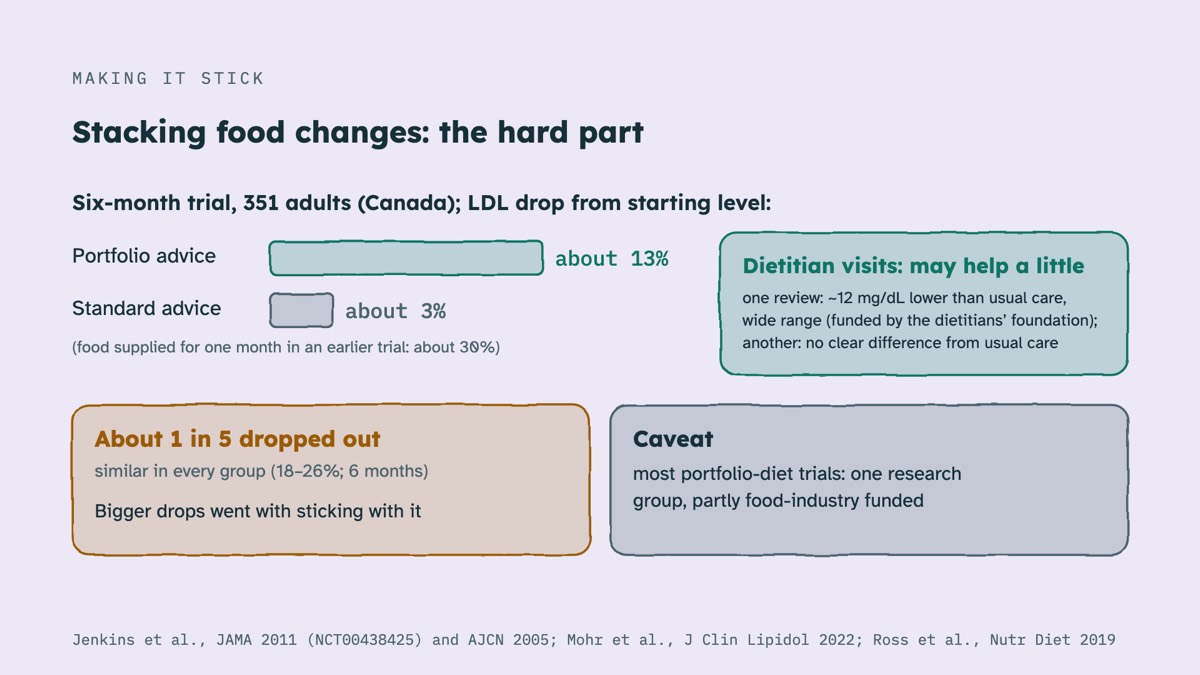
Stacking food changes is the hard part. In that six-month trial of 351 adults, about a fifth dropped out, as many as with standard advice, and people who stuck more closely to the diet tended to get bigger LDL drops.
Which supplements work?
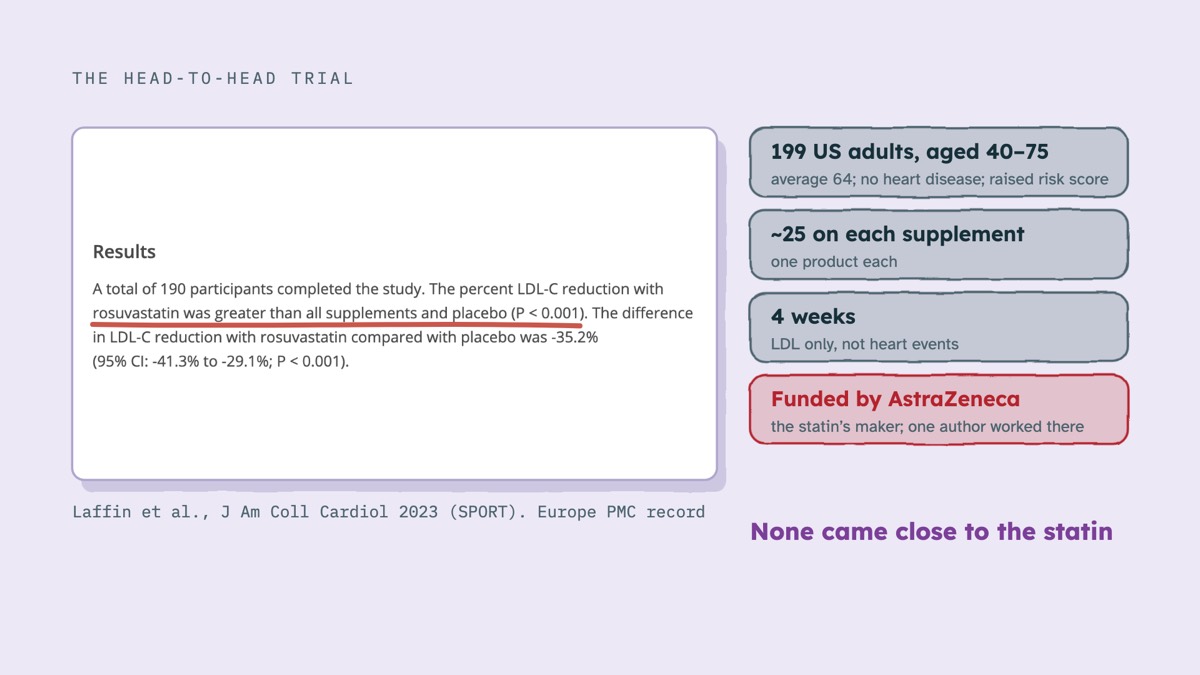
The opening trial had 199 adults, about 25 per supplement, one product each, for four weeks, and the statin's maker funded it. So it can't prove the supplements are useless, but none came close to the statin.
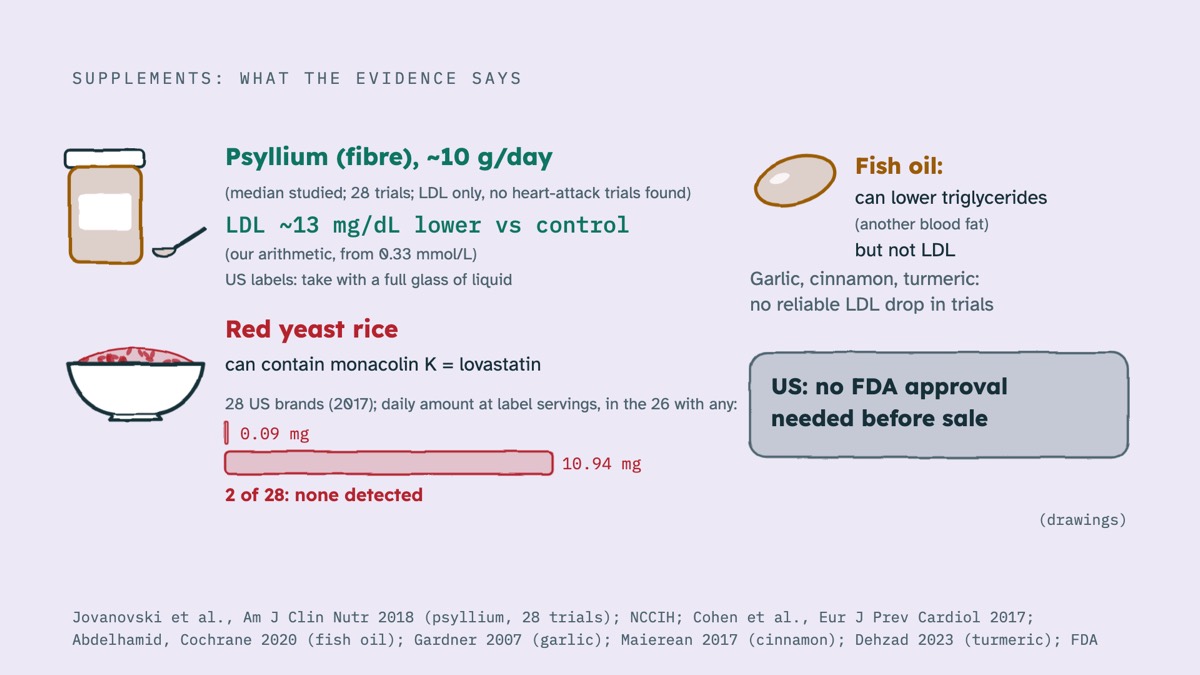
Psyllium fibre, about 10 grams a day, lowered LDL about 13 points more than comparison groups in trials. Red yeast rice can contain the same compound as the statin lovastatin; across 28 US brands, the daily amount varied over 120-fold, and two had none detectable.
When is medicine considered?
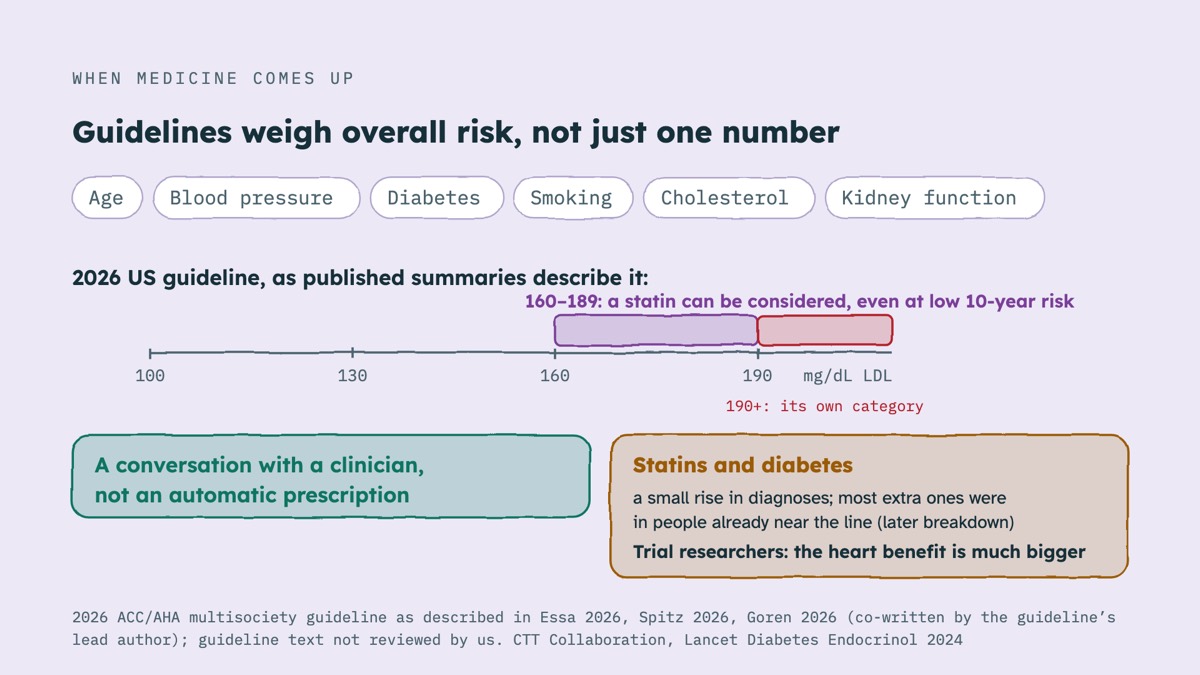
In summaries of the 2026 US guideline, an LDL of 160 to 189 can be a reason to consider a statin, even when short-term risk is low: a conversation, not an automatic prescription. Statins slightly raise the chance of a diabetes diagnosis, mostly in people already near the line; trial researchers judged the heart benefit much bigger.
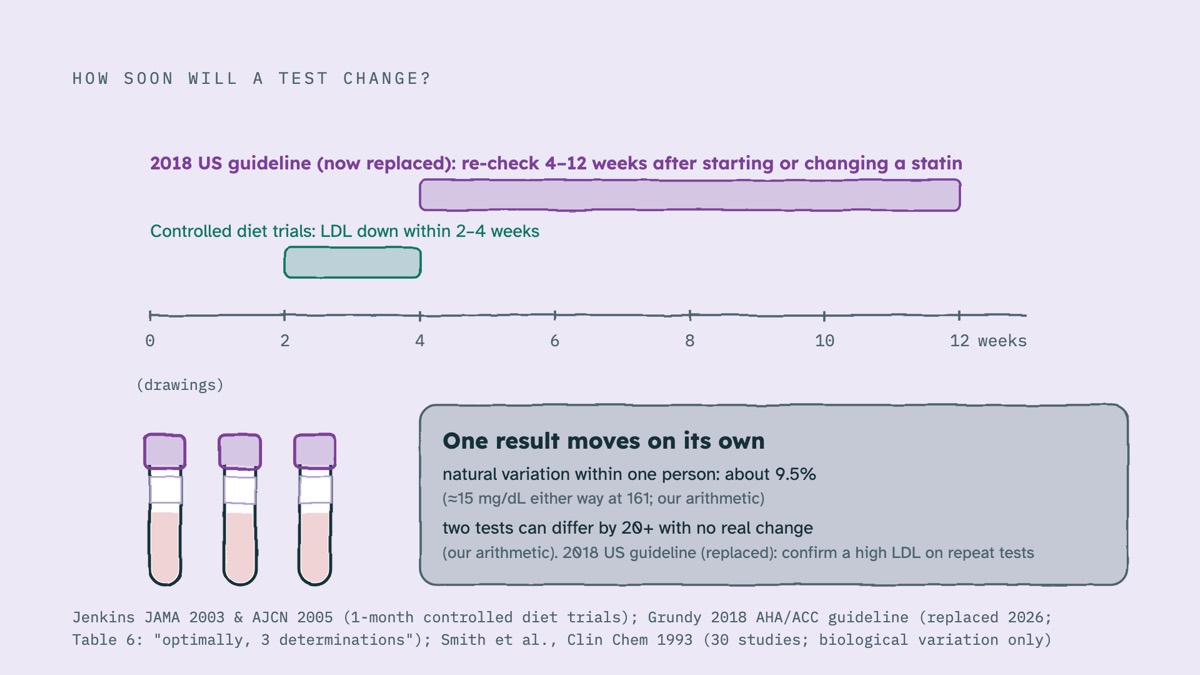
In tightly controlled diet trials, LDL dropped within two to four weeks, and the 2018 US guideline, since replaced, suggested re-testing 4 to 12 weeks after starting a statin.
Before you go: check with your clinician or pharmacist before taking any supplement; some can interact with medicines. Red yeast rice can contain a statin's chemical and isn't recommended in pregnancy or breastfeeding. With it or a statin, unexplained muscle pain or weakness, dark urine, or yellowing skin or eyes: call your clinician right away.
Sources
29 sources cited in the video, in the order they come up.
- SPORT trial, low-dose statin vs six supplements (4 weeks): Laffin LJ et al., J Am Coll Cardiol 2023 [link 2]
- 2018 AHA/ACC multisociety cholesterol guideline (replaced in 2026): Grundy SM et al., Circulation 2019
- Portfolio diet vs lovastatin (1 month): Jenkins DJA et al., JAMA 2003
- Portfolio diet vs statin, food supplied (1 month): Jenkins DJA et al., Am J Clin Nutr 2005
- Portfolio diet advice, 6 months: Jenkins DJA et al., JAMA 2011. (NCT00438425)
- Statin trials, about 170,000 people: Cholesterol Treatment Trialists' Collaboration, Lancet 2010
- Statins in people without heart disease: Chou R et al., JAMA 2022
- Cutting saturated fat: Hooper L et al., Cochrane Database Syst Rev 2020
- A dissenting 2025 review: Yamada S et al., JMA J 2025
- Dietary fats and LDL (metabolic ward studies): Clarke R et al., BMJ 1997
- Coconut oil: Neelakantan N et al., Circulation 2020
- Oat beta-glucan: Ho HV et al., Br J Nutr 2016
- Beans, lentils and other pulses: Ha V et al., CMAJ 2014
- Tree nuts: Del Gobbo LC et al., Am J Clin Nutr 2015
- Soy protein: Blanco Mejia S et al., J Nutr 2019
- Very-low-carbohydrate vs low-fat diets: Bueno NB et al., Br J Nutr 2013. and Mansoor N et al., Br J Nutr 2016 [link 2]
- Plant sterols and stanols, dose-response: Ras RT et al., Br J Nutr 2014
- Dietitian-led nutrition therapy: Mohr AE et al., J Clin Lipidol 2022. and Ross LJ et al., Nutr Diet 2019 [link 2]
- Psyllium: Jovanovski E et al., Am J Clin Nutr 2018
- Red yeast rice product testing (28 US brands): Cohen PA et al., Eur J Prev Cardiol 2017
- Fish oil (omega-3): Abdelhamid AS et al., Cochrane Database Syst Rev 2020
- Garlic: Gardner CD et al., Arch Intern Med 2007
- Cinnamon: Maierean SM et al., J Clin Lipidol 2017
- Turmeric/curcumin: Dehzad MJ et al., Complement Ther Med 2023
- FDA, Questions and Answers on Dietary Supplements
- 2026 ACC/AHA multisociety dyslipidemia guideline (described from published summaries; we did not review its full text)
- Summaries of the 2026 guideline: Essa M et al., Am J Prev Cardiol 2026. Spitz JA et al., Am J Prev Cardiol 2026. Goren LR et al., Am J Prev Cardiol 2026 (co-written by the guideline's lead author) [link 2] [link 3]
- Statins and new diabetes diagnoses: Cholesterol Treatment Trialists' Collaboration, Lancet Diabetes Endocrinol 2024
- Natural variation in LDL within one person: Smith SJ et al., Clin Chem 1993


