
Can Your LDL Cholesterol Be Too Low?
Inside this episode
The video’s narration, chapter by chapter, with stills from the video and every source at the end.
The short version
It's understandable that a number that low feels unsettling. Here's the short version. In studies of up to about eight years, very low LDL on these drugs hasn't shown a clear safety problem, though there's no lifetime data, and a lab's 10 may not be exact. On average, the doctor's plan gives back part of the drop; stopping both pills gives back much more. We found no outcome trial of evolocumab used instead of a statin.
Is an LDL of 10 too low?
In the trial's open extension, some people stayed on evolocumab over eight years; about a quarter averaged below 20 early on. Lower LDL wasn't linked to more cancer, cataracts, diabetes, memory problems or brain bleeds, and a memory-testing study matched placebo. The limits: these were mostly men around 60 with heart or artery disease, also on statins, and there's no lifetime data.
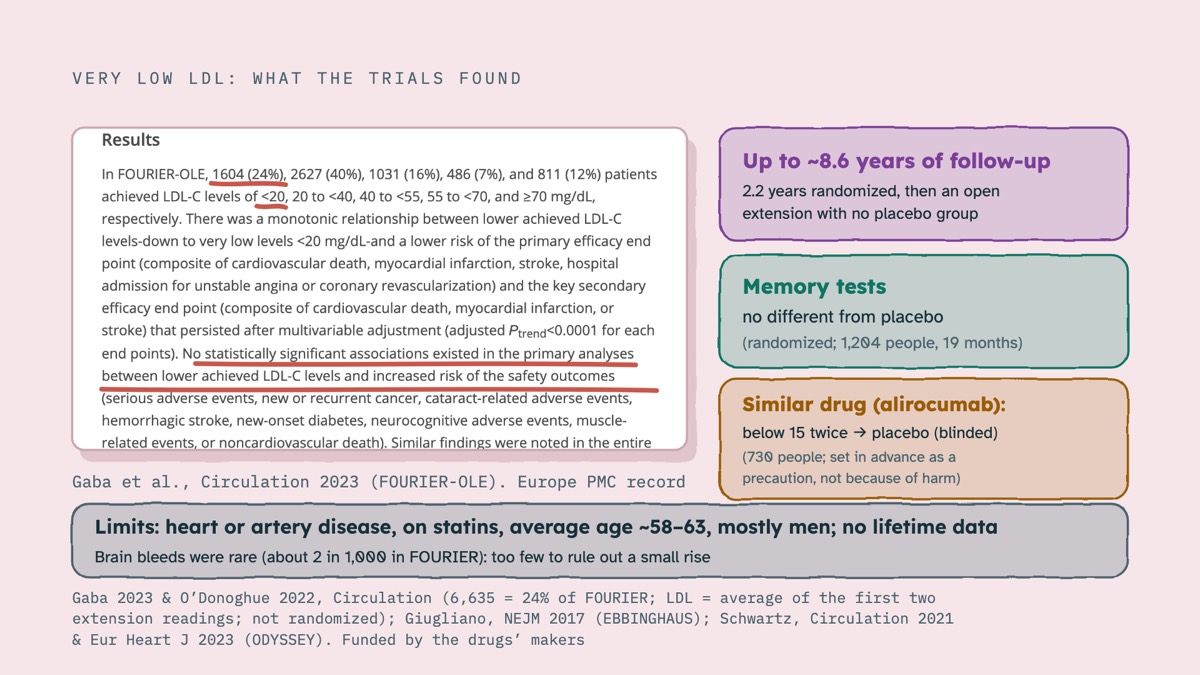
And the 10 itself may not be exact. Labs usually calculate LDL with a formula. In US lab data, when it read under 15, an ultracentrifuge test found a median of 29 points more, mostly with high triglycerides. In trial samples with normal triglycerides, it was only a few points off. And with high Lp(a), a mostly inherited cousin of LDL, part of the reported LDL is really Lp(a) cholesterol.
Cut back, or stop the pills?
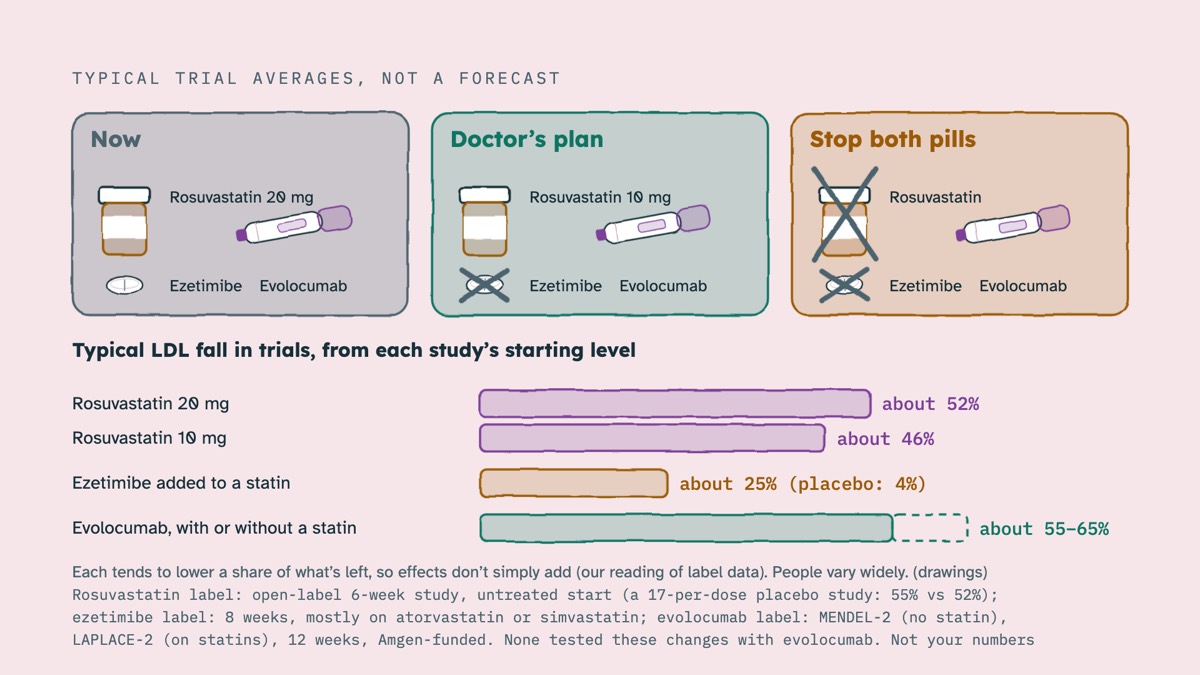
In trials, rosuvastatin 10 milligrams lowered LDL only a few percentage points less than 20. Ezetimibe added to a statin cut roughly another fifth, and evolocumab about 55 to 65 percent, with or without a statin. Each removes a share of what's left, so on average, stopping both pills gives back far more than the doctor's plan.
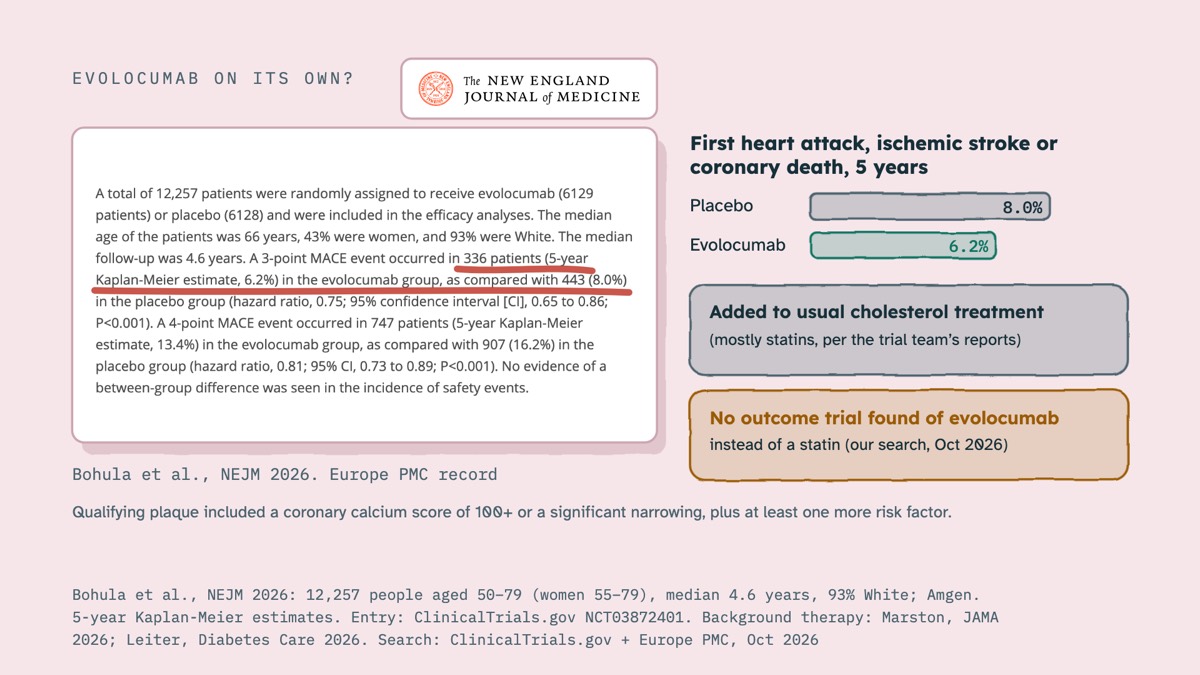
Does evolocumab protect on its own? Its outcome trials added it to other treatment. In VESALIUS-CV, in people with significant plaque or high-risk diabetes but no heart attack or stroke, mostly on statins, first major events fell from about 8 to 6 in 100 over five years. We found no outcome trial of evolocumab used instead of a statin.
And statins? Across many trials, benefit tracked how far LDL fell, for statins and similar-acting treatments. Statins also lower an inflammation marker, but whether that adds protection is unproven: evolocumab didn't lower it and still cut events. Statins don't lower Lp(a); studies disagree on whether they nudge it up; evolocumab cut it by about a quarter.
How do doctors set a target?
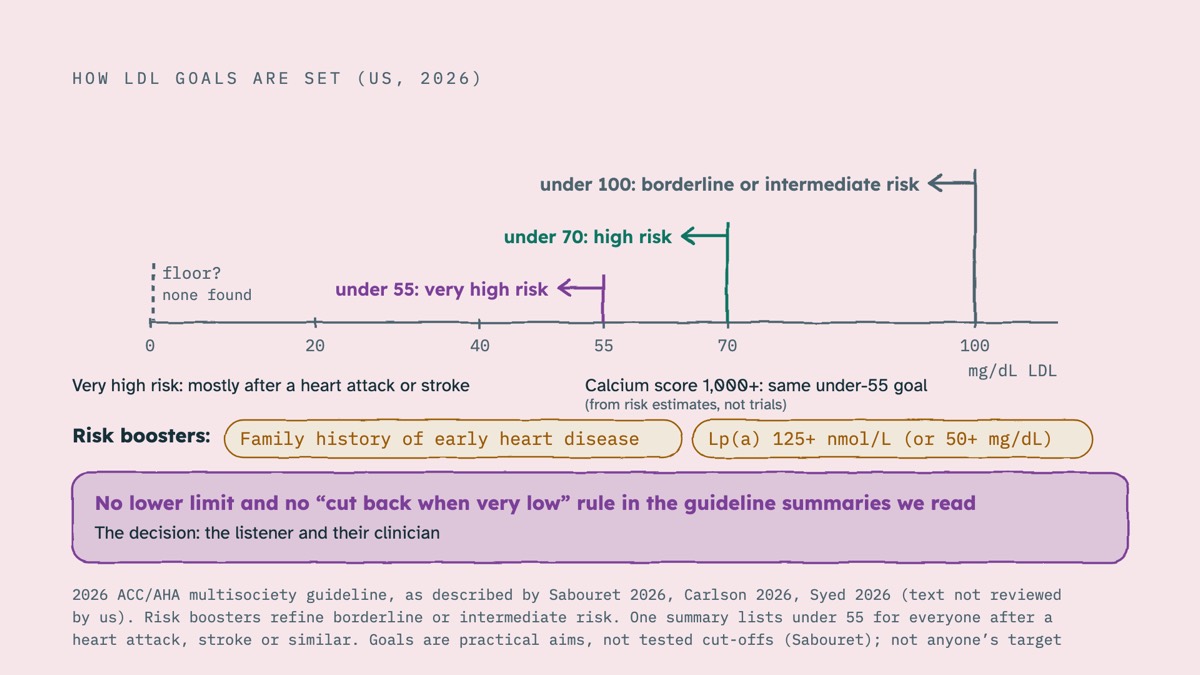
Summaries of the 2026 US guideline describe goals under 70 for high risk, and under 55 for very high risk, mostly after a heart attack or stroke, and for a heart-artery calcium score of 1,000 or more. An early family history and high Lp(a) count as risk boosters in borderline or intermediate cases. None of those summaries mention a lower limit, or cutting back because LDL is very low. The decision is theirs and their clinician's.
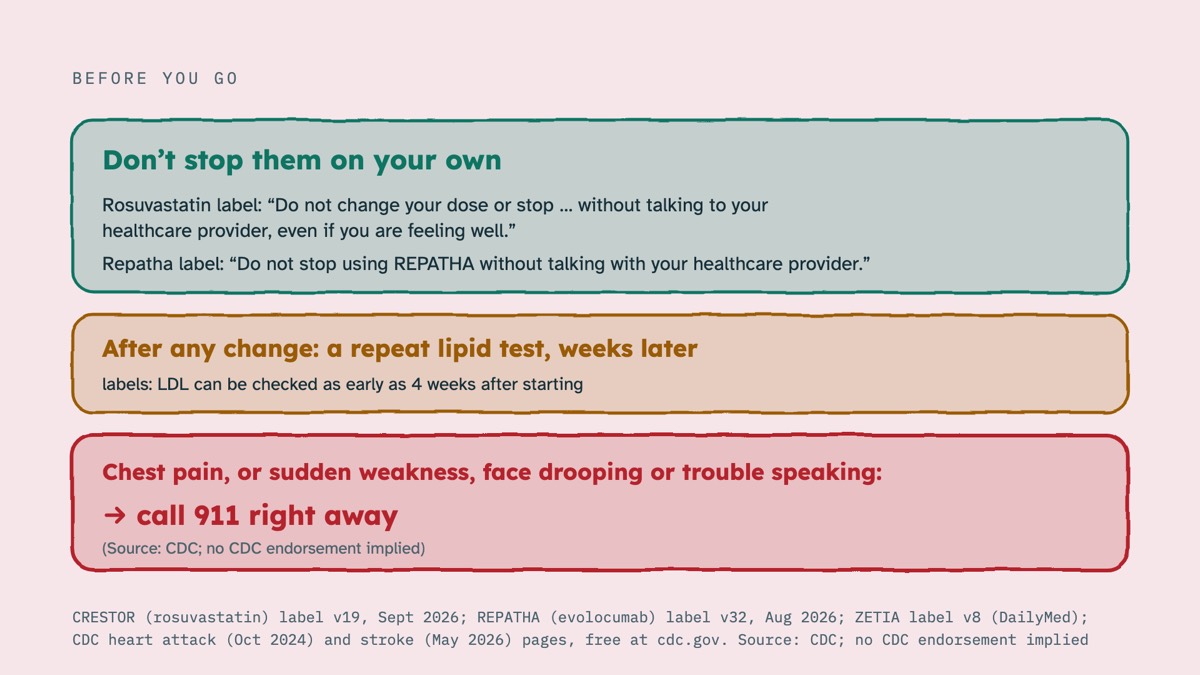
Before you go: the rosuvastatin and Repatha labels say not to stop them without talking to your prescriber, and after any change, a repeat test weeks later helps show where LDL lands. Chest pain, or sudden weakness or trouble speaking: call nine-one-one right away.
Sources
32 sources cited in the video, in the order they come up.
- Giugliano 2017, Lancet: FOURIER, very low LDL on evolocumab (achieved LDL, not randomized; Amgen-funded)
- Gaba 2023, Circulation: FOURIER open-label extension, achieved LDL (no placebo group)
- O'Donoghue 2022, Circulation: FOURIER open-label extension
- Giugliano 2017, NEJM: EBBINGHAUS memory study
- Schwartz 2021, Circulation: ODYSSEY OUTCOMES (alirocumab), very low LDL
- Schwartz 2023, Eur Heart J: ODYSSEY OUTCOMES, switch to placebo below 15 mg/dL
- Quispe 2017, BMC Medicine: accuracy of calculated LDL at very low levels
- Ginsberg 2022, J Lipid Res: LDL formulas vs reference method in alirocumab trials
- Martin 2018, JAMA Cardiology: LDL estimation in FOURIER
- Yeang 2021, J Lipid Res: Lp(a) cholesterol inside reported LDL
- Rosuvastatin (CRESTOR) US label, DailyMed
- Ezetimibe (ZETIA) US label, DailyMed
- Evolocumab (REPATHA) US label, DailyMed (MENDEL-2 and LAPLACE-2 tables)
- Koren 2014, J Am Coll Cardiol: MENDEL-2 (evolocumab without a statin)
- Robinson 2014, JAMA: LAPLACE-2 (evolocumab with statins)
- Bohula 2026, NEJM: VESALIUS-CV (no prior heart attack or stroke; Amgen-funded)
- VESALIUS-CV entry criteria, ClinicalTrials.gov
- Marston 2026, JAMA: VESALIUS-CV, people with diabetes and no known significant atherosclerosis
- Leiter 2026, Diabetes Care: VESALIUS-CV, people with diabetes
- Silverman 2016, JAMA: benefit per unit of LDL lowered, across therapies
- Ridker 2008, NEJM: JUPITER (rosuvastatin; stopped early; AstraZeneca-funded)
- Bohula 2018, Circulation: FOURIER, inflammation marker (hsCRP)
- O'Donoghue 2019, Circulation: FOURIER, Lp(a)
- Tsimikas 2020, Eur Heart J: statins and Lp(a)
- Willeit 2018, Lancet: Lp(a) in statin trials (Novartis-funded)
- de Boer 2022, Eur J Prev Cardiol: statins and Lp(a)
- Sabouret 2026, Life: a summary of the 2026 US guideline
- Carlson 2026, Cardiology and Therapy: lipid management review describing the 2026 US guideline
- Syed 2026, J Clin Med: Lp(a) and coronary calcium review describing the 2026 US guideline
- 2026 ACC/AHA multisociety dyslipidemia guideline (we read only its abstract)
- CDC, heart attack symptoms (free at cdc.gov; no CDC endorsement implied)
- CDC, stroke signs and symptoms (free at cdc.gov; no CDC endorsement implied)


