
Swapping Anti-Rejection Pills for an Infusion?
Inside this episode
The video’s narration, chapter by chapter, with stills from the video and every source at the end.
The short version
Only your team can say which infusion they mean, so ask its name. If it's a long-term infusion to replace a pill, the only one approved in the US is belatacept, given every four weeks once it's established. It blocks a "go" signal immune cells need. It usually takes tacrolimus's place, while other pills such as mycophenolate and a steroid continue. And in the two largest belatacept switching trials, kidney function was better on average, but rejection was more common.
Which infusion could it be?
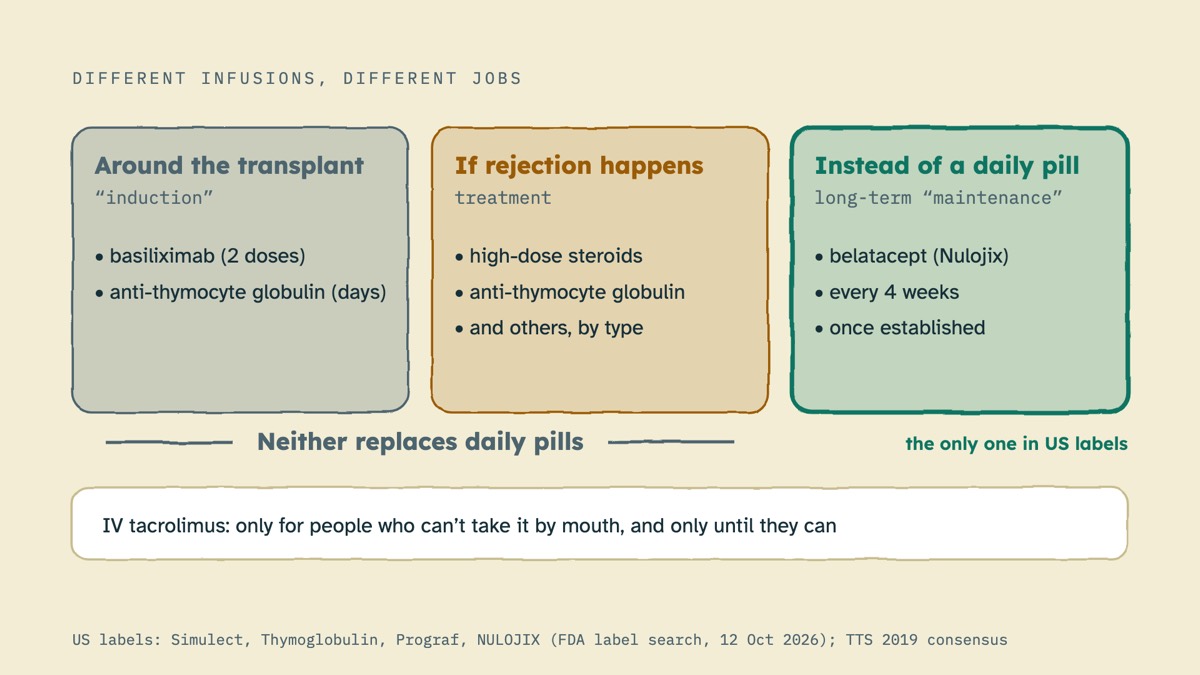
Transplant teams use infusions for different jobs. Induction medicines, such as basiliximab or anti-thymocyte globulin, are given around the time of the transplant. Others treat a rejection episode if one happens, such as high-dose steroids. Neither kind takes the place of daily pills. Tacrolimus also comes as an IV drip, but only for people who can't take it by mouth, and only until they can. An infusion that stands in for a daily pill long term is different. In US drug labels, there's one: belatacept, sold as Nulojix.
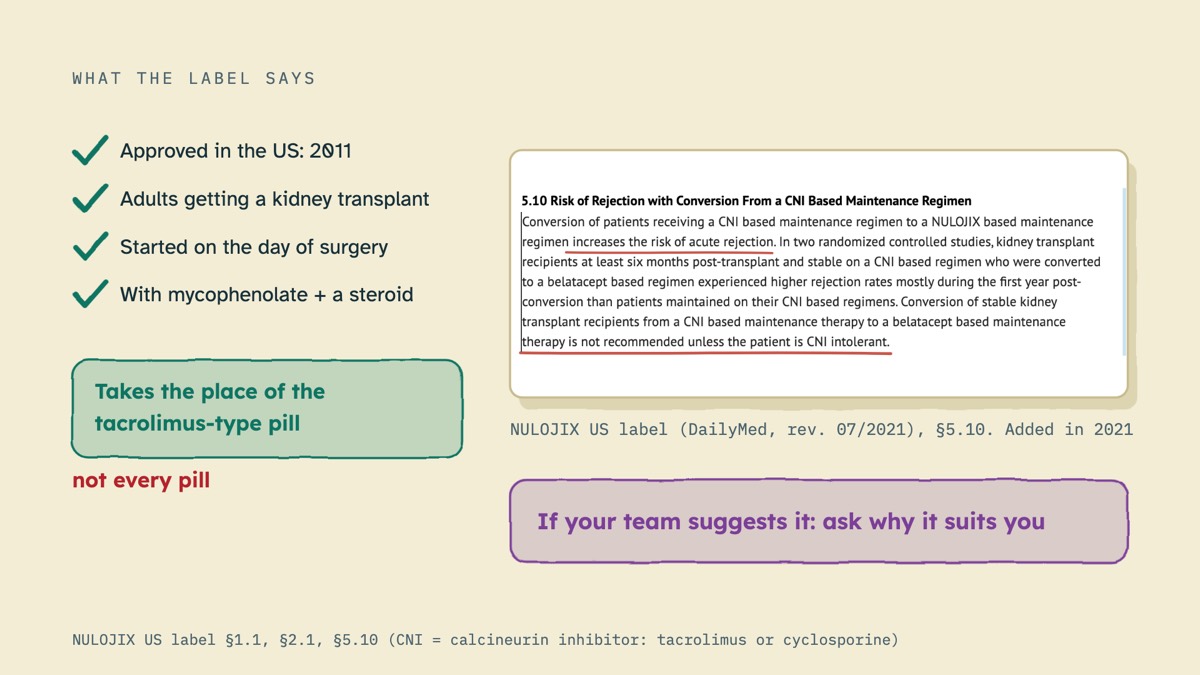
Belatacept was approved in 2011 for adults getting a kidney transplant, started on the day of surgery, together with mycophenolate and a steroid. So it takes the place of the tacrolimus-type pill, not every pill. Switching months later is different. In 2021, its label added a warning: in two randomized trials of people at least six months after transplant, switching raised the risk of rejection, mostly in the first year. So switching stable patients isn't recommended unless they can't tolerate that pill. If your team suggests it, it's fair to ask why it suits you.
How does it work?
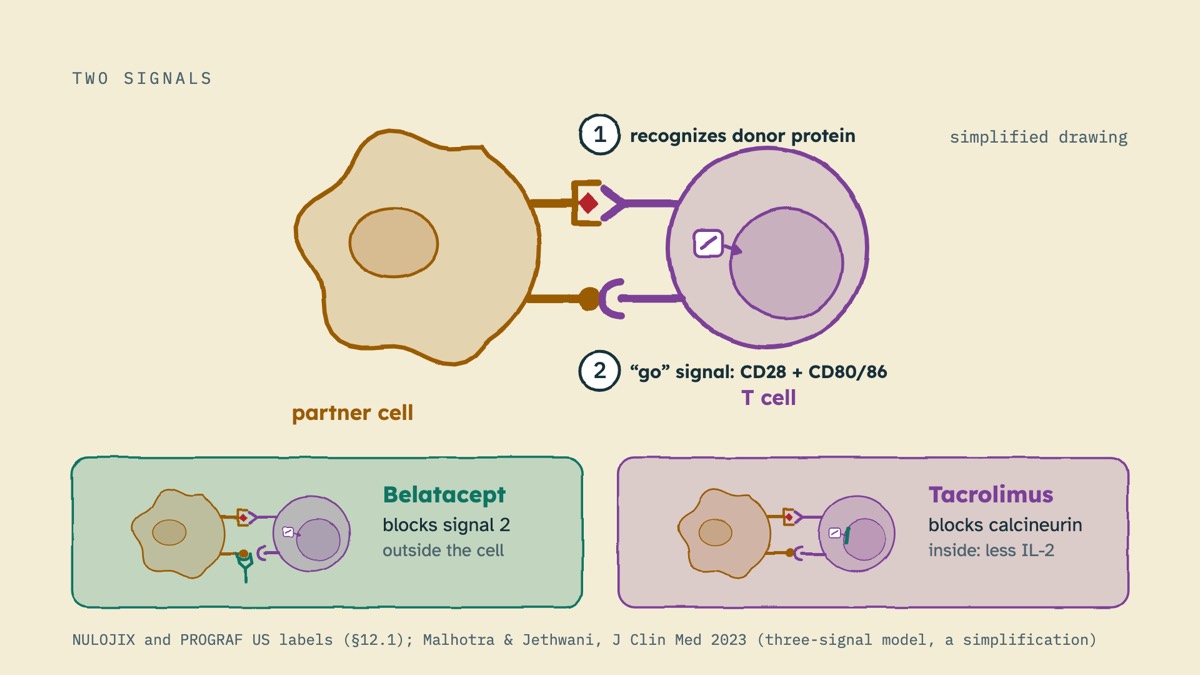
Rejection is driven mainly by T cells, immune cells that can see the donor kidney as foreign. To switch on fully, a T cell needs two signals from a partner cell. Signal one: it recognizes a piece of the donor's protein. Signal two: a "go" signal, when a molecule called CD-28 on the T cell docks with CD-80 or CD-86 on the partner cell. Belatacept sticks to CD-80 and CD-86, so the go signal can't land. Tacrolimus works later, inside the T cell. It blocks calcineurin, a switch the cell needs to make IL-2, a signal that drives T cells to multiply. This is a simplified picture.
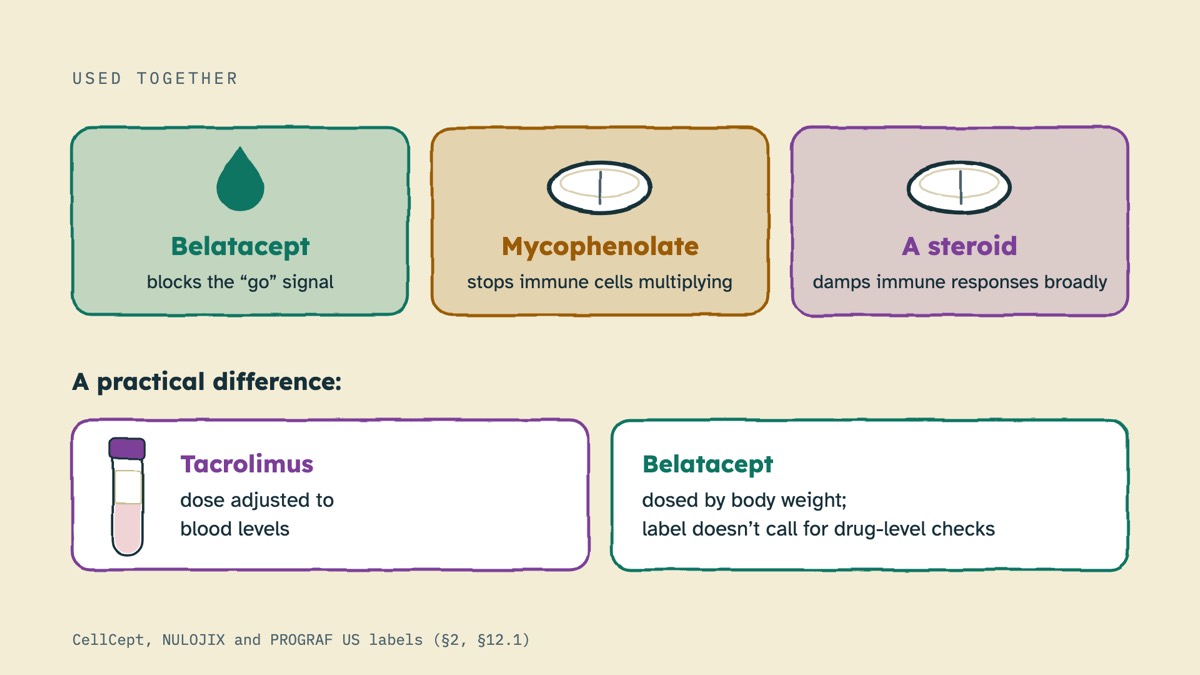
Belatacept isn't used alone. Mycophenolate stops immune cells from making the DNA building blocks they need to multiply, and a steroid damps down immune responses broadly. There's a practical difference too. Tacrolimus doses are adjusted to blood levels. Belatacept is dosed by body weight, and its label doesn't call for checking blood levels of the drug.
Why switch at all? Tacrolimus works well, but its label lists problems that can lead to a change: kidney damage from the drug itself, tremor, new diabetes, high blood pressure, and many drug interactions. When belatacept was started at transplant and compared with cyclosporine, an older pill in the same family, there was less tremor, less new diabetes in the first year, and slightly lower blood pressure, though those trials weren't built to compare side effects. Against tacrolimus, the evidence on these side effects is thinner.
What does switching involve?
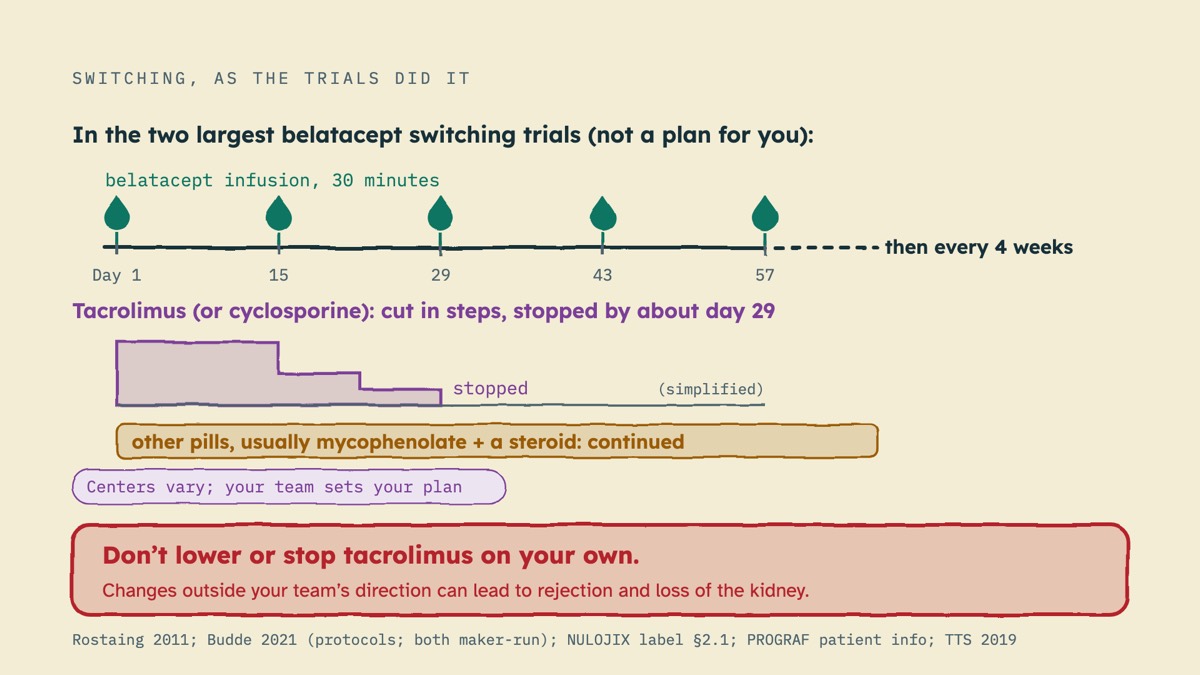
The label's schedule starts on the day of transplant, so switching schedules come from trials and each center's own protocol. In the two largest trials of switching to belatacept, it went into a vein over 30 minutes on days 1, 15, 29, 43 and 57, then every four weeks. Tacrolimus, or cyclosporine for some, was cut down step by step and stopped by about day 29, while their other anti-rejection pills, usually mycophenolate and a steroid, continued. Your team sets your plan. Don't lower or stop tacrolimus on your own: changing anti-rejection medicine outside your team's direction can lead to rejection and loss of the kidney.
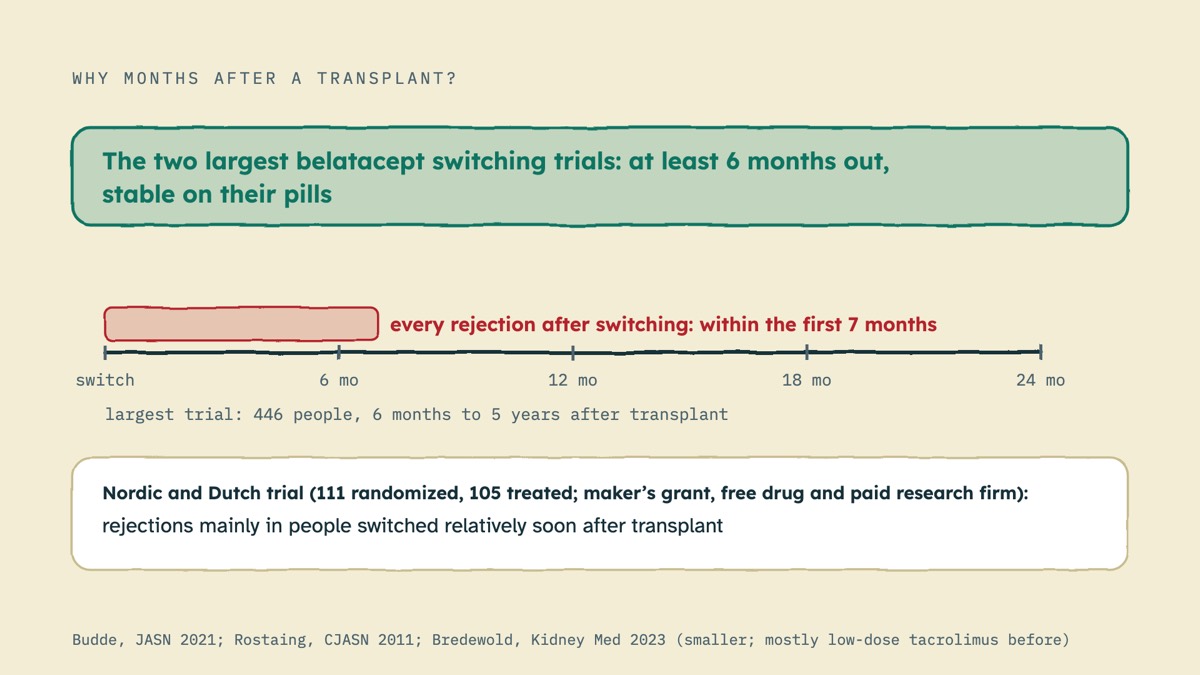
Why months after a transplant? The two largest belatacept switching trials enrolled people at least six months out who were stable on their pills. In the largest, every rejection after switching came within the first seven months. And in a smaller Nordic and Dutch trial, the rejections were mainly in people switched relatively soon after their transplant.
What did the trials find?
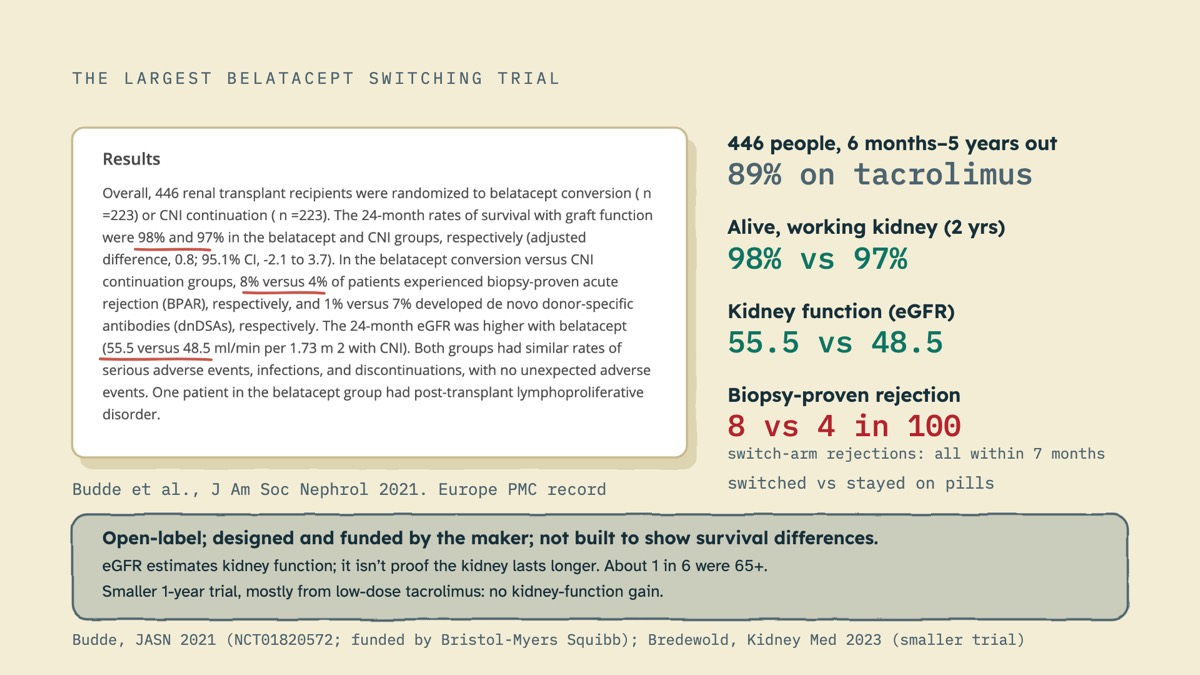
The largest trial of switching to belatacept randomly assigned 446 people, most of them on tacrolimus, to switch or to stay on their pills. After two years, about the same share were alive with a working kidney: 98 versus 97 percent, though the trial wasn't built to show survival differences. Kidney function, measured as eGFR, was better after switching: 55.5 versus 48.5 on average. But biopsy-proven rejection was more common: 8 in 100 people versus 4 in 100. In this trial, rejections after switching were mostly moderate or severe on biopsy, though all were treated and none cost a kidney. The trial was open-label, and designed and funded by the drug's maker. A smaller one-year trial, mostly switching from low-dose tacrolimus, saw no kidney-function gain.
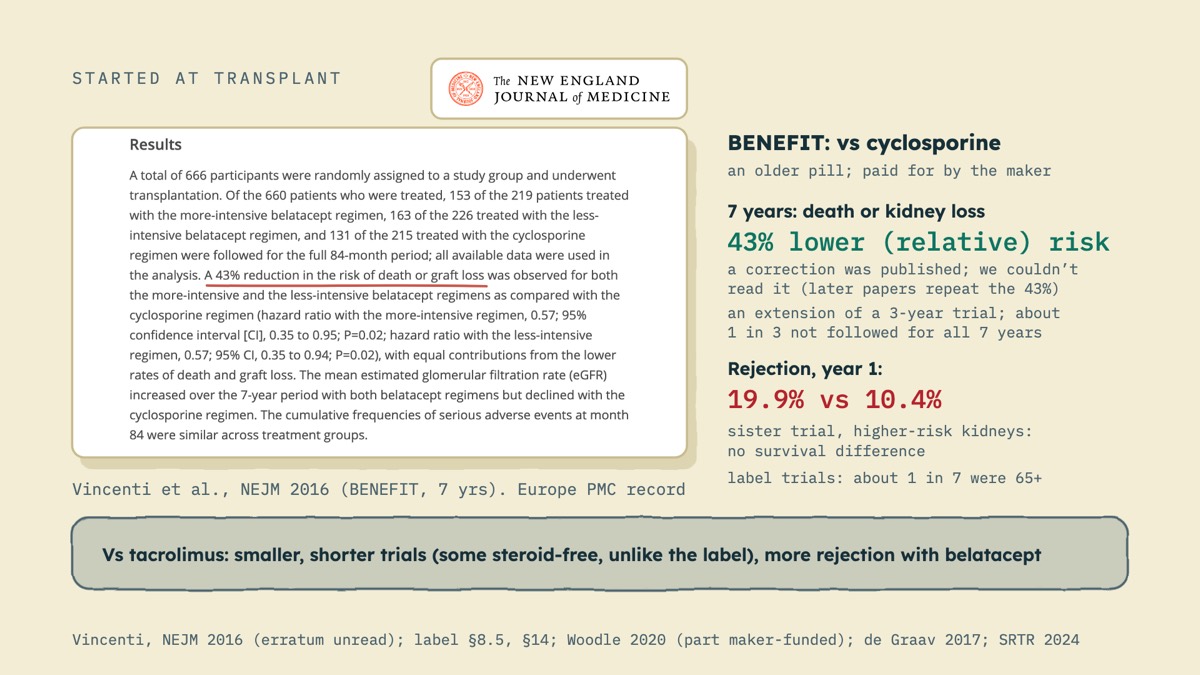
When belatacept is started at transplant instead, the main long-term results come from the BENEFIT trial, paid for by its maker, against cyclosporine, an older pill. Over seven years, the risk of death or losing the kidney was 43 percent lower with belatacept, though rejection in the first year was more common, and about a third of people weren't followed for all seven years. A sister trial, with higher-risk donor kidneys, found no survival difference. Trials against tacrolimus, today's usual pill, are smaller and shorter, and found more rejection with belatacept.
Risks and checks
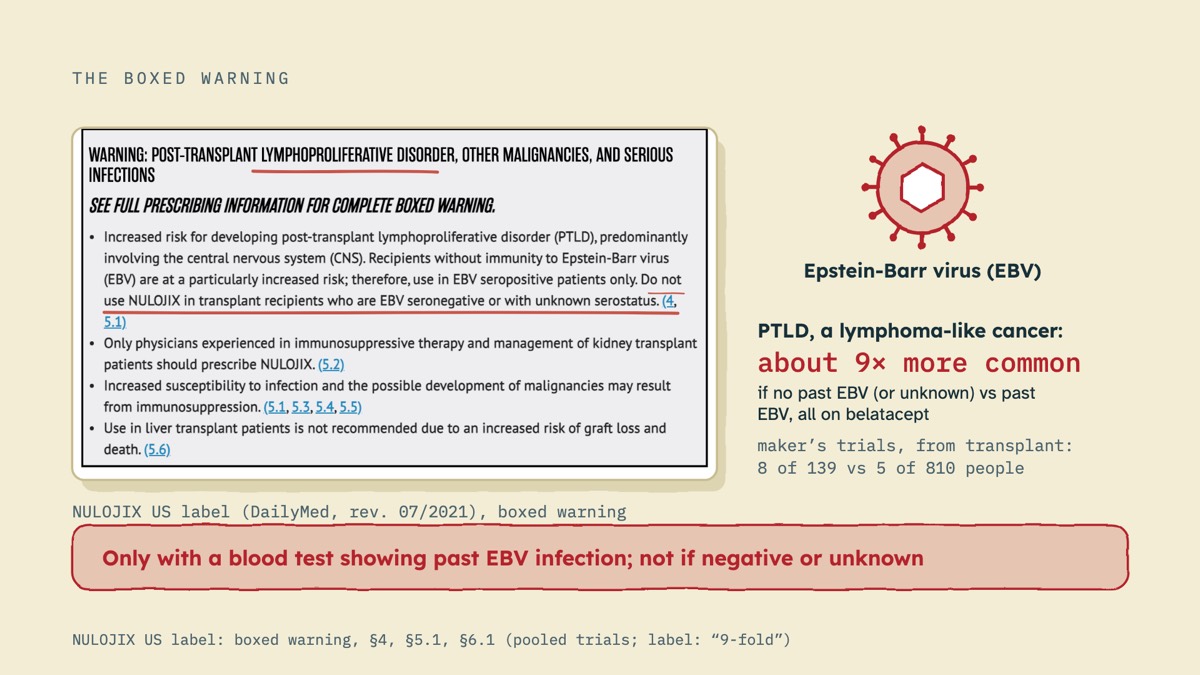
Belatacept's label carries a boxed warning. The headline risk is post-transplant lymphoproliferative disorder, a lymphoma-like cancer, often in the brain. In the trials, among people on belatacept, it was about nine times more common in those who hadn't had the Epstein-Barr virus, a very common virus, or whose status was unknown. So belatacept is only for people whose blood test shows past infection, and it isn't used if that result is negative or unknown.
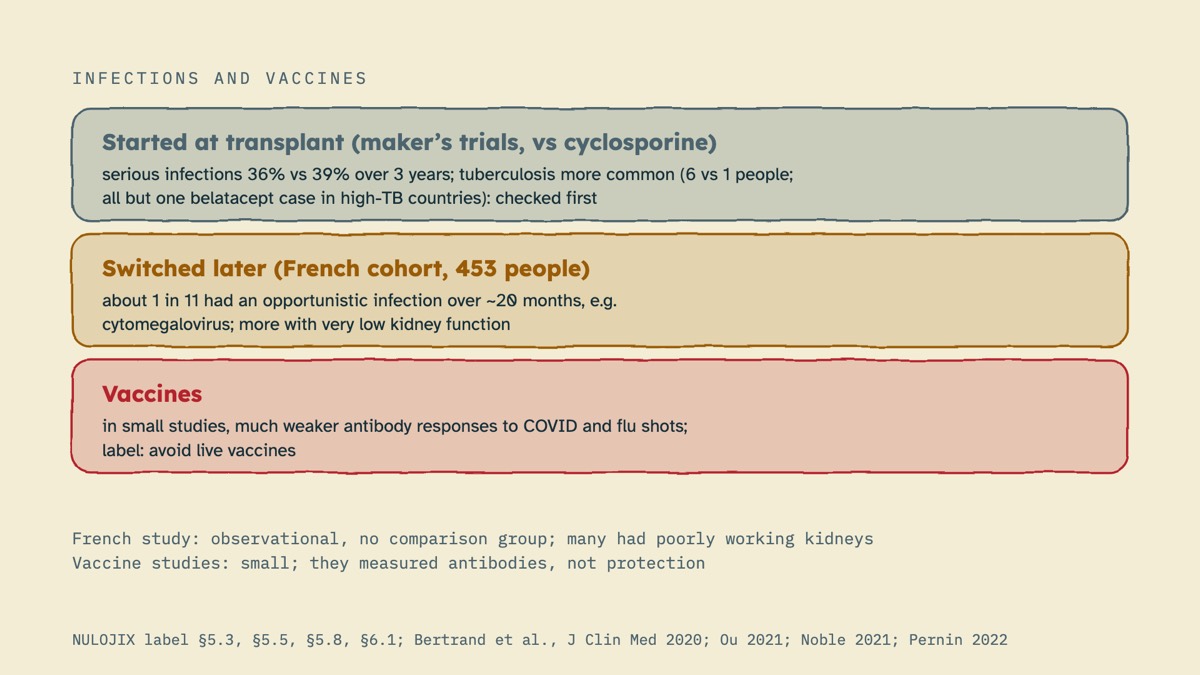
Like all anti-rejection medicines, it raises the risk of infections and some cancers. In the trials that started it at transplant, serious infections were about as common as with cyclosporine, but tuberculosis was more common, so the label says to check for it first. In a French study of 453 people switched to belatacept, about one in eleven had an opportunistic infection over roughly 20 months, an infection that takes advantage of weakened immunity, such as cytomegalovirus, more often when kidney function was very low. Vaccines may work less well, too: in small studies, antibody responses to COVID and flu shots were much weaker on belatacept. And its label says to avoid live vaccines.
So the checks matter. Before starting: the Epstein-Barr virus test and a tuberculosis check. Afterwards: regular blood and urine tests of kidney function, watching for rejection especially in the first months, and keeping every infusion appointment.
Questions for your team
What is the infusion's name, and is it standard care or part of a study? Is it replacing tacrolimus, and which pills will I keep taking? Why now, and why for me? What's my Epstein-Barr virus status? How will you watch for rejection, and what signs should I report? Do I need infection-prevention medicines or vaccines before starting? And how often are the infusions, where, and what if I miss one? Until your team tells you otherwise, keep taking every medicine exactly as prescribed.
So: if an infusion is replacing a pill long term, the only one approved in the US is belatacept. It blocks a go signal T cells need, needs an Epstein-Barr virus test first, usually replaces tacrolimus while other pills continue, and in the largest belatacept switching trials traded better kidney function for more early rejection. Ask your team its name and their reason, and don't change any medicine on your own.
Sources
10 sources cited in the video, in the order they come up.
Key sources
- NULOJIX (belatacept) US prescribing information (DailyMed)
- PROGRAF (tacrolimus) US prescribing information (DailyMed)
- Budde 2021, phase 3b switching trial (J Am Soc Nephrol)
- Vincenti 2016, BENEFIT 7-year results (N Engl J Med)
- Woodle 2020, BEST trial (Am J Transplant)
- de Graav 2017, belatacept vs tacrolimus (Transplantation)
- Bertrand 2020, French switching cohort (J Clin Med)
- Ou 2021, COVID-19 vaccine antibodies (Transplantation)
- Malhotra 2023, how anti-rejection medicines work (J Clin Med)


