
What's the Best Weekly Workout Mix for Your Health?
Inside this episode
The video’s narration, chapter by chapter, with stills from the video and every source at the end.
The short version
His week is already at or past the point where the big longevity curves flatten, so more volume buys little. The clearest gap the evidence points to is structure: a second full-body strength session, an injury-prevention warm-up before soccer, easy days that are actually easy, and long runs that grow in steps. Too much running rarely shows up as early death; its usual price is injury. Exercise reliably helps mood, and feeling unsettled after a few days off is common and reversible. And cholesterol and sleep apnea are where training does least on its own. This is a longer episode, so here's the map.
Where his week stands
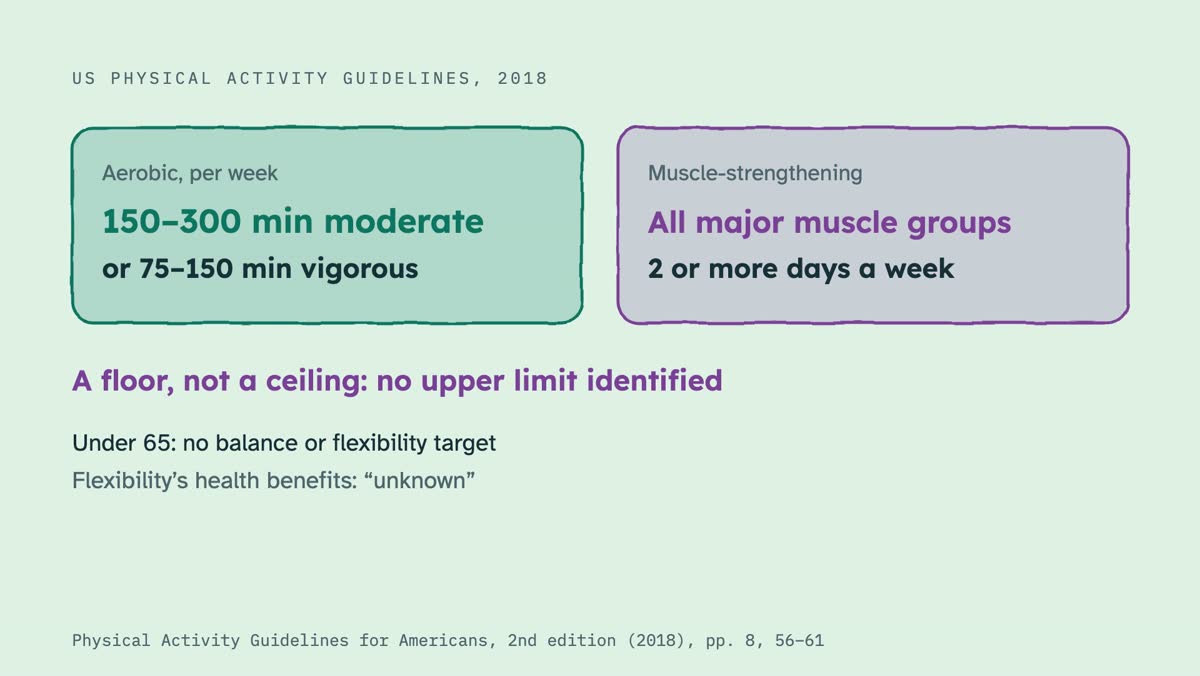
The U.S. guidelines ask adults for 150 to 300 minutes a week of moderate activity, or 75 to 150 minutes of vigorous activity, plus muscle-strengthening that works all major muscle groups on two or more days a week. They set a floor, not a ceiling: research hasn't identified an upper limit. And for adults under 65, there's no balance or flexibility target. The guidelines say flexibility's health benefits are unknown.
The World Health Organization's 2020 guidelines set the same targets, and strongly advise limiting time spent sitting. Only the American College of Sports Medicine's older position stand, a professional rather than government document, adds balance and coordination work, plus stretching, for all adults.
So how does his week count? It depends on how you count intensity. Running at about four miles an hour or faster counts as vigorous by the guidelines' energy-based measure, though on their effort-based scale, easy running can count as moderate. By our math, his running, soccer and climbing come to roughly three and a half to six times the guideline minimum, depending on the counting method. That's before walking and personal training.
Here's why that matters. In the largest pooled analysis, over 660,000 adults, death rates were 31 percent lower than in inactive people at one to two times the minimum, and 39 percent lower at three to five times, which the authors called the upper threshold of benefit. Beyond that, the curve stays flat. A 30-year study of over 116,000 health professionals found the same shape: the association with lower mortality was nearly maximum at about 150 to 300 vigorous minutes a week. By our math, his vigorous minutes already sit in that band, so on our reading, more running is unlikely to buy much more longevity, and nothing here marks his volume as harmful.
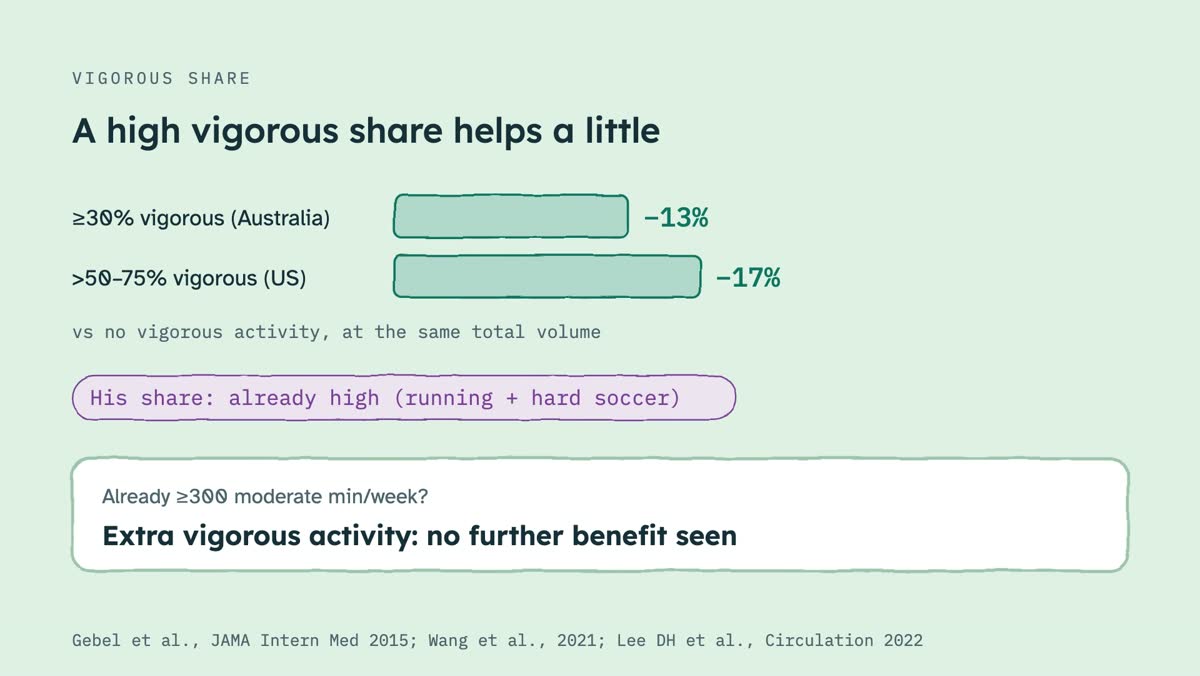
At the same total, a bigger vigorous share was linked to modestly lower mortality, and with running and hard soccer making up most of his week, his share is already high. But among people already doing at least 300 moderate minutes a week, extra vigorous activity wasn't linked to further benefit.
What tracks survival most closely isn't minutes; it's fitness. In pooled cohorts, high versus low cardiorespiratory fitness was linked to roughly half the mortality, and in a large clinic study, no upper limit of benefit was found. In over 750,000 U.S. veterans, risk was lowest at high fitness, with no sign of rising risk at extremely high fitness. Interval training raises fitness a little more than steady training, about 1.4 points of VO-two max in a 2026 Cochrane review, but no trial has shown it lowers mortality. And recreational soccer already works like intervals, at about 80 to 85 percent of maximum heart rate. So, on our reading, a structured interval session is an option for performance in a week like his, not a missing pillar.
What about his sports? Running has the best evidence: any running was linked to about 27 percent lower mortality, with no clear dose-response. In one cohort averaging 44 years old, his roughly three hours a week falls, by our math, in the top fifth of running time, where the benefit was slightly smaller and less certain. Soccer trials, mostly in untrained men, show gains in fitness and blood pressure. Climbing has no mortality or heart studies at all. And variety itself may matter: in two large U.S. cohorts, people doing the widest range of activities had 19 percent lower mortality. With four or five activities, variety isn't his gap.
One more reassurance: when total weekly volume was the same, people who packed their activity into a day or two had death rates not significantly different from those who spread it out. And at activity levels like his, the extra risk linked to long sitting largely disappeared, though heavy TV watching still carried some.
Strength: the likely gap
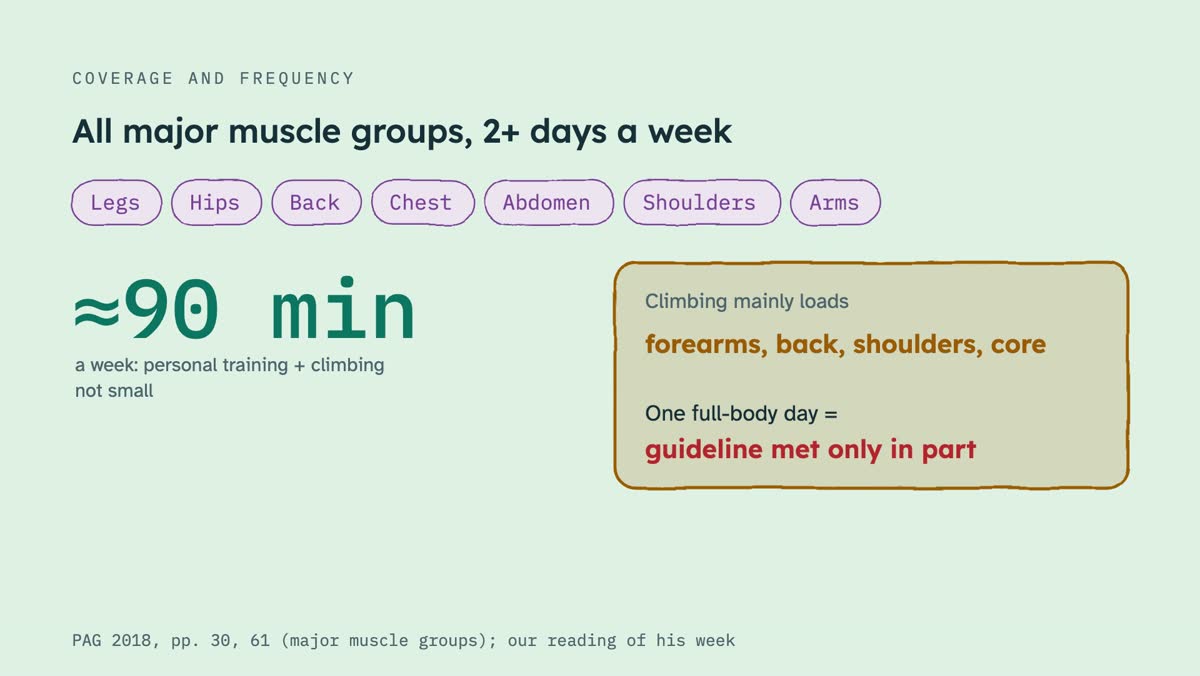
The guidelines ask for strength work covering all major muscle groups: legs, hips, back, chest, abdomen, shoulders and arms, on at least two days a week. By our count, his personal training plus climbing comes to about 90 minutes a week, which isn't small. On our reading, the gap is more likely frequency and coverage: climbing mainly loads the forearms, back, shoulders and core, so if personal training is his only full-body session, he meets the two-day, full-body guideline only in part.
How much strength work does health require? In a meta-analysis of 16 cohort studies, any muscle-strengthening was linked to about 15 percent lower mortality, with the lowest risk at about 40 minutes a week. People who did both aerobic and strength training had about 40 percent lower mortality than those who did neither, though the authors rated that certainty very low. The newest data, from about 147,000 U.S. health professionals followed for up to 30 years, put the lowest risk at 90 to 119 minutes a week, with a plateau beyond that, not harm. Among the most aerobically active people in that study, extra strength work showed no further trend, but they already had among the lowest risks in the study, so that doesn't make strength work pointless for very active people.
How to train it? The American College of Sports Medicine's 2026 position stand, built on 137 reviews of randomized trials, found strength gains were enhanced by at least two sessions a week and heavier loads, at least 80 percent of the most you can lift once. Two to three sets, full range of motion, and doing the key exercise early in the session also helped. Muscle size was enhanced by at least 10 sets per muscle group per week. Training to failure isn't necessary. The panel suggests stopping two or three reps short, and adds that a program you'll keep doing matters more than hitting exact numbers.
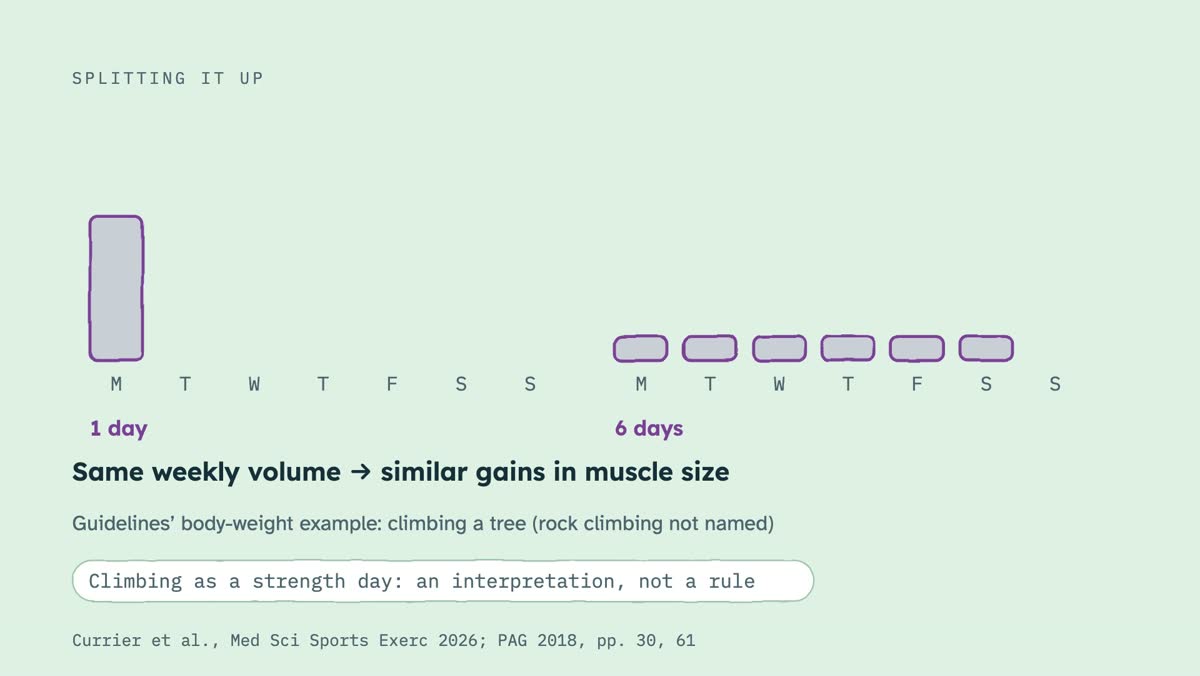
Does it matter how you split it? For muscle size, the same review found training one day a week or more than five gave similar gains when weekly volume was equal. And the guidelines' own example of body-weight strength work is climbing a tree; they don't name rock climbing, so counting a climbing session as a strength day is an interpretation, not a rule.
Will his running undercut strength gains? Mostly no. A meta-analysis of 43 studies found adding aerobic training didn't meaningfully reduce gains in maximal strength or muscle size. It did blunt explosive strength, but significantly only when both were done in the same session, not when sessions were at least three hours apart. And in one small trial, a full day between sessions gave the best aerobic gains.
And for a soccer player, the best-supported mobility work is injury prevention. Across 25 trials, stretching didn't prevent sports injuries, while strength training cut them to about a third. The FIFA eleven-plus warm-up cut injuries by 39 percent in recreational and sub-elite football, and programs with the Nordic hamstring exercise roughly halved hamstring injuries. Most of those trials enrolled younger athletes, but the pattern is consistent.
Can you overdo it?
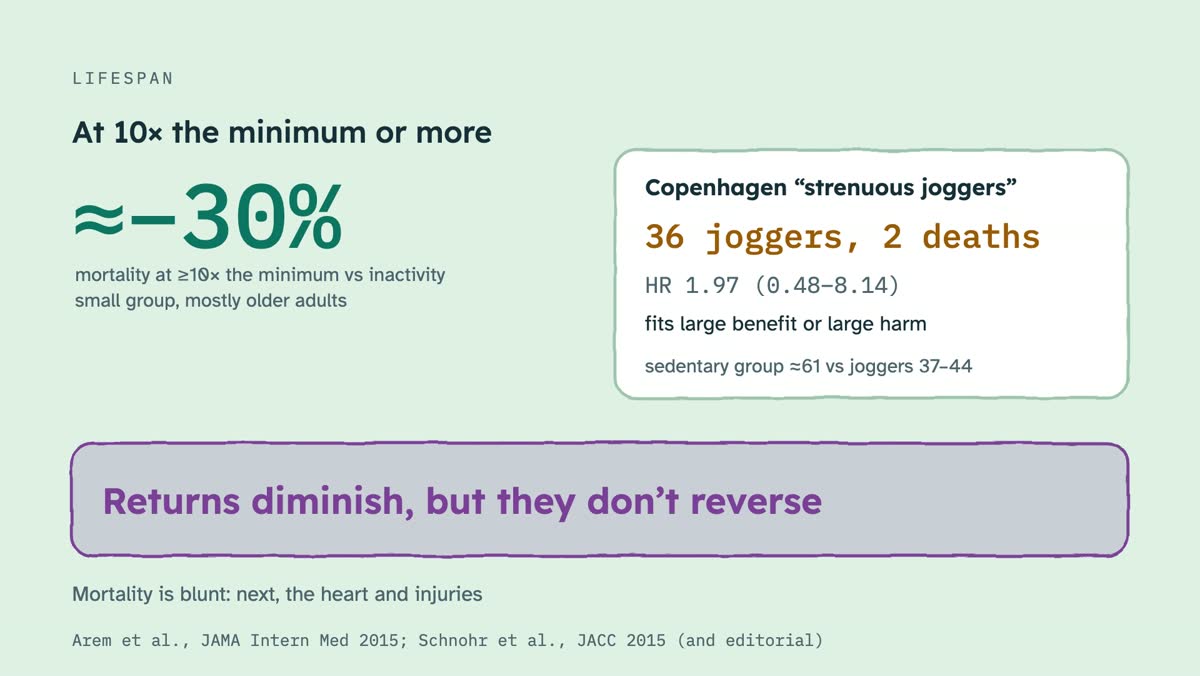
Start with lifespan. At ten or more times the minimum, the big pooled analysis still found about 30 percent lower mortality than inactivity, though that group was small and mostly older adults. The famous headline that strenuous joggers lived no longer than sedentary people came from a Copenhagen study with 36 strenuous joggers, two of whom died. Its uncertainty was wide enough to fit large benefit or large harm, and the sedentary group averaged 61 years old, against 37 to 44 for the joggers. The fair summary: returns diminish, but they don't reverse. Mortality is a blunt measure, though, so let's look at the heart and at injuries.
Very high endurance volume is linked to more coronary plaque. Across several cohorts, middle-aged men with very high lifelong training had more coronary calcium and plaque than less active peers, often, but not always, the more calcified kind. In a 2026 study with wearable data, plaque was found in 71 percent of men in the top quarter of training time, about nine to 26 hours a week, versus 40 percent in the bottom quarter. What that means for heart attacks is unsettled. High-volume men with calcium haven't shown higher death rates, but very high volume hasn't shown extra heart-attack protection either.
Some detail. In one study of men around 55, those reporting the highest lifelong training had coronary calcium 68 percent of the time, against 43 percent in the least active. In about 22,000 men followed for a decade, the most active had high calcium scores a bit more often, but with such a score their death rates weren't higher. And in a Medicare-linked study, the most active had the lowest overall mortality, but no fewer heart attacks than the least active.
The most consistent too-much signal is atrial fibrillation, or A-fib, an irregular heart rhythm. A 2020 heart association statement describes a J-shaped curve: moderate amounts were linked to lower risk, higher amounts to about the same risk as inactivity, and a trend toward higher risk appeared above a weekly training load that, by our math, equals roughly six hours of running. By our math, his running and soccer come to about two-thirds of that, and with climbing, roughly three-quarters. A marathon peak week could go past it, but only for those weeks. At the extreme, among former world-class rowers, about one in five had A-fib, against one in 30 of matched controls. Those are decades of elite training, not recreational running. The same guidance lists sleep apnea as an A-fib risk factor, a general fact, not a prediction for anyone.
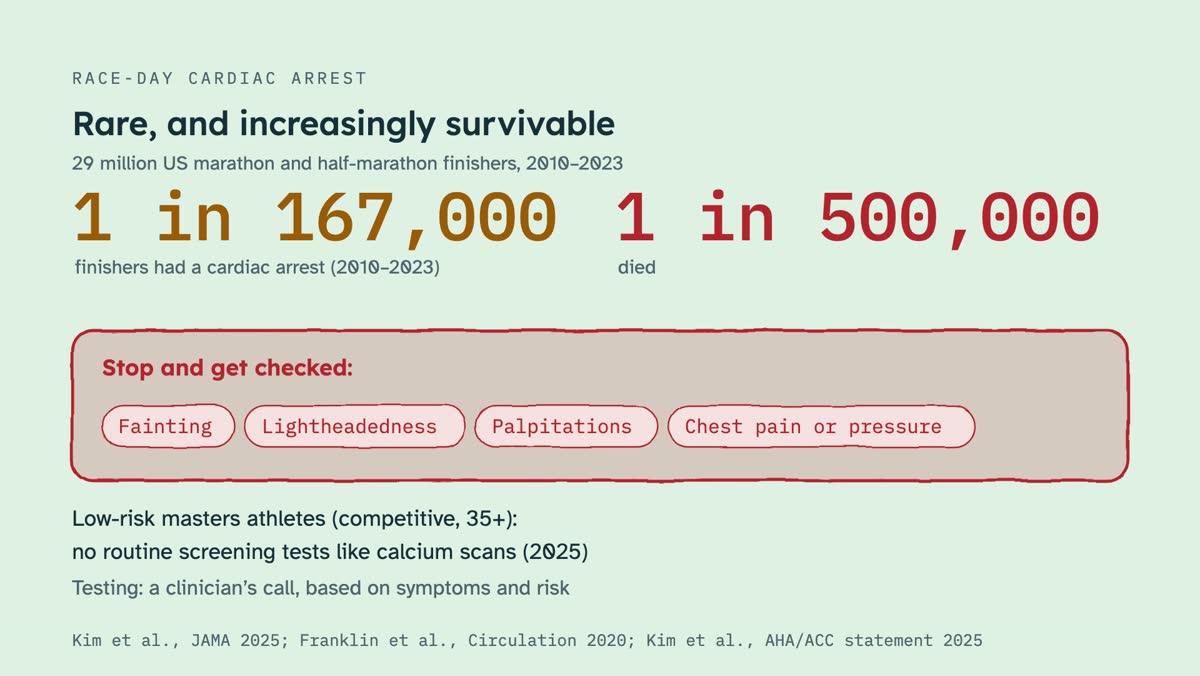
Race-day cardiac arrest is rare and increasingly survivable. From 2010 to 2023, among 29 million U.S. marathon and half-marathon finishers, about one in 167,000 had a cardiac arrest, and about one in 500,000 died. The heart association says warning signs like fainting, lightheadedness, palpitations, or chest pain or pressure with exertion mean stop and get checked before exercising again. And for low-risk masters athletes, meaning competitive athletes 35 and older, a 2025 heart statement advises against routine screening tests like calcium scans; testing is a clinician's call, based on symptoms and risk.
It also helps to know who's most at risk during exertion. In one heart association summary, the risk of sudden cardiac death during vigorous exertion was about 50 to 74 times baseline in the least active men, but only 2 to 11 times in regular exercisers. Exertion is mainly a trigger for the unaccustomed, and the absolute risk is tiny: in one large study of men, about one sudden death per 1.5 million bouts of vigorous exertion.
So what is the usual cost of overdoing it? Injury. Recreational runners average about 7.7 injuries per 1,000 hours of running. And among runners registered for races, about 41 percent of marathon and half-marathon entrants reported a new running injury between registering and a month after the race.
The best new evidence on load comes from over 5,000 runners with GPS watches, averaging 46 years old. About a quarter of them reported an overuse injury over 18 months. A single run 10 to 30 percent longer than the longest run of the previous 30 days was linked to a 64 percent higher overuse-injury rate. Even a one to ten percent bump showed a small, non-significant rise, so small increases aren't automatically safe. Weekly mileage ratios didn't flag risk, and the classic ten percent rule had no effect in its one trial. Too little base matters too: marathon finishers running under 30 kilometers a week beforehand had about twice the injury risk of those running 30 to 60. And in long-distance runners, a previous running injury is rated the strongest risk factor.
Marathon side effects are mostly short-lived or debated. The classic finding that racers report more colds afterward rests on self-reports, and whether hard exercise itself raises infection risk is still argued. Kidney markers often spike right after a marathon and settle within days. And under-fuelling, not eating enough for the training, affects men as well as women, and overlaps with overtraining.
Mood, energy, anxiety
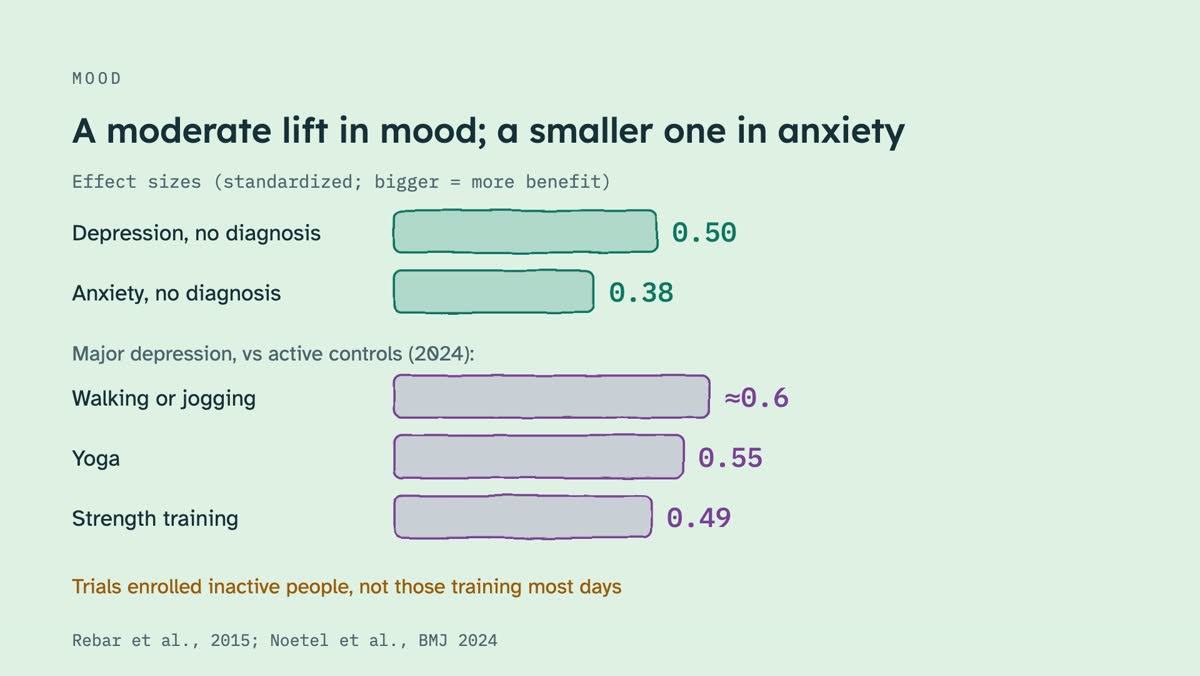
In randomized trials in adults without depression, exercise moderately reduced depressive symptoms, and reduced anxiety by a smaller amount. In people with major depression, a 2024 network analysis found walking or jogging, yoga and strength training all helped, with effects in the moderate range. Nearly all of these trials enrolled previously inactive people, though, and none tested people already training most days.
For anxiety specifically, aerobic programs beat waiting lists in people with raised anxiety, and higher-intensity programs did somewhat better than lower-intensity ones. In a Swedish trial of people with anxiety disorders, both lower- and higher-intensity exercise helped compared with none. A single session, though, lowers anxiety only slightly. And pooling 15 cohorts, compared with no activity, even half the recommended amount was linked to 18 percent lower risk of developing depression, and the full amount to 25 percent, with smaller gains beyond.
Does more help more? Not reliably. Across reviews, programs prescribing 150 minutes a week or less had larger average effects on depressive symptoms than programs prescribing more, and four to five sessions a week showed the largest effects. In a survey of 1.2 million Americans, the largest associations with fewer poor-mental-health days were for 45-minute sessions, three to five times a week. That's observational; people who feel well may simply exercise more.
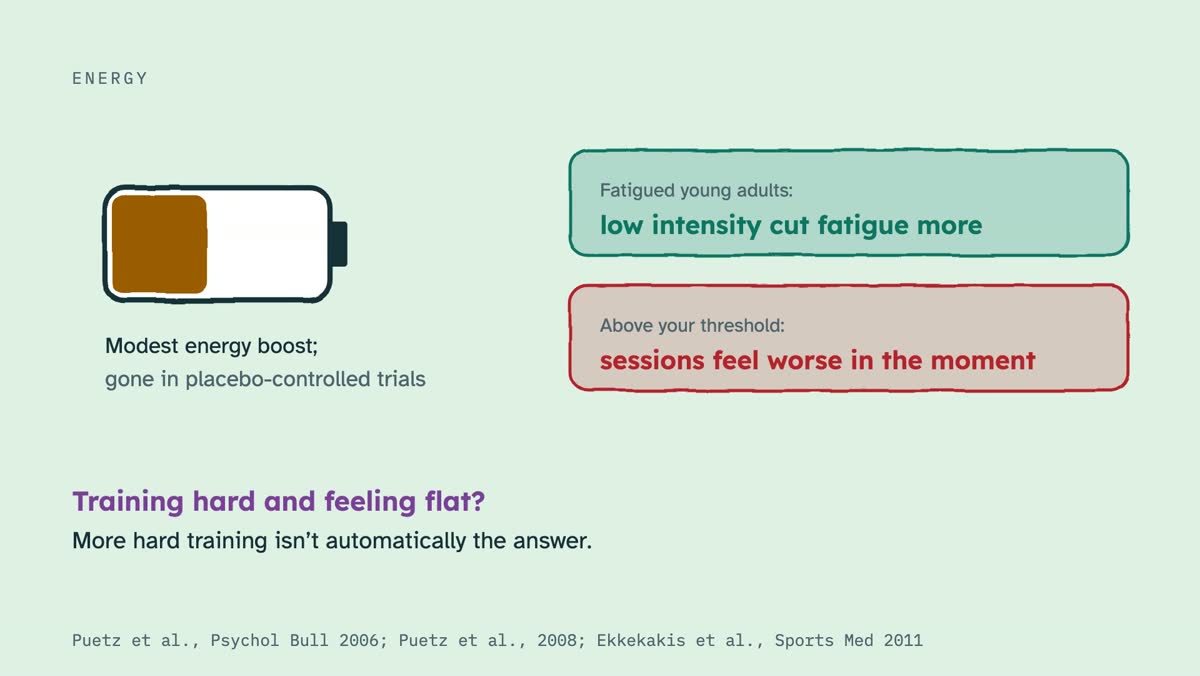
Energy works similarly. Regular exercise modestly raised feelings of energy, though the effect disappeared in placebo-controlled trials. In fatigued young adults, low-intensity training reduced fatigue more than moderate training. And sessions above your threshold, where breathing gets hard, feel worse in the moment. For someone training hard who feels flat, more hard training isn't automatically the answer.
Now, the anxiety on rest days. Experiments that ask regular exercisers to stop show a consistent pattern. When people who usually exercised six or seven days a week skipped three days, mood disturbance rose within 24 to 48 hours, including anxiety and tension, and returned to baseline once they resumed. In a randomized study, two weeks off brought fatigue within a week and low mood by two weeks. A review of 19 such experiments found the effect consistent, and serious problems rare. A 2025 analysis, possibly from the same group of volunteers, found two weeks off also blunted the usual easing of blood-pressure and heart-rate responses across repeated mental stress tests. Why it happens is unproven; losing a well-practiced way to manage stress is one idea.
Does that mean exercise addiction? It isn't a recognized diagnosis, and screening tools look for several features, not a rest-day dip alone. Researchers screen for it with questionnaires, and screening rates run around 3 to 9 percent, higher in endurance athletes, but those are risk flags, not diagnoses. In one 2026 study, training hours didn't separate those who met interview criteria from those who didn't, and the authors warned against over-pathologizing dedicated athletes. The general guidance: if low mood or anxiety persists, worsens, or gets in the way of work, sleep or relationships, talk to a clinician. Keeping some light movement on rest days may soften the dip, though no trial has tested it.
And climbing has an unusual mental-health literature: several trials of bouldering combined with psychotherapy helped people with depression. Those were therapist-led programs, though, so they don't show that recreational climbing treats or prevents depression.
Cholesterol
The largest meta-analysis, 148 trials, found exercise training lowered LDL cholesterol by about seven points on average, raised HDL by about two, and lowered triglycerides by about eight. Aerobic and combined training lowered LDL; strength training alone mainly improved HDL. In men specifically, aerobic training changed LDL by about three points, which wasn't statistically significant. And most trials ran about 12 weeks in sedentary adults. Soccer trials in untrained adults found LDL falls of roughly 8 to 13 points, while a 2026 analysis, mostly in children and teens, found only a non-significant trend.
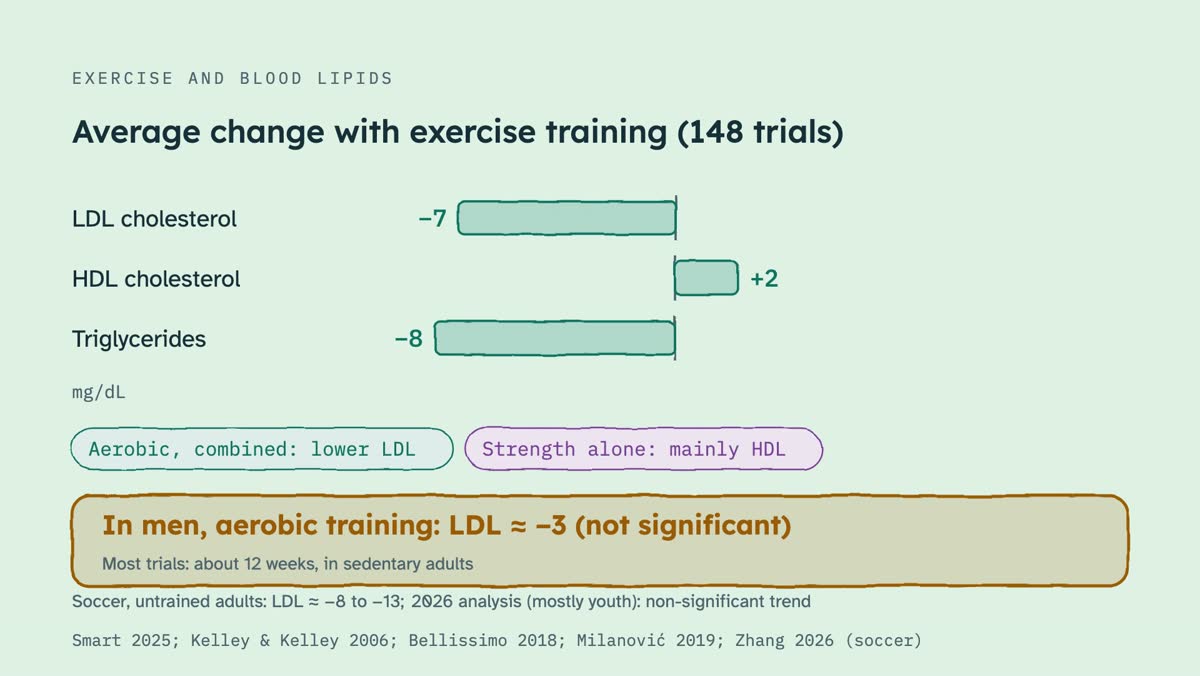
What drives it is amount more than intensity. In the STRRIDE trial, improvements were related to the amount of activity and not to the intensity, and in a meta-analysis, interval training lowered LDL no more than steady training. No trial has given men who already train most days still more exercise and measured LDL, so extra training probably adds less for him than those averages suggest.
Exercise and cholesterol medicine do different jobs. Guidelines class statins by expected LDL reduction, and moderate intensity lowers it by 30 to 49 percent. At an example LDL of 130, chosen for illustration, that's roughly five to nine times the average exercise effect, by our math. Fitness still matters beyond LDL: in a large study of men, higher fitness was linked to lower coronary death risk within every LDL category. That's observational, and nothing here supports swapping exercise for medicine a clinician judges necessary. Lipoprotein little-a, a largely inherited particle, barely moves with lifestyle at all.
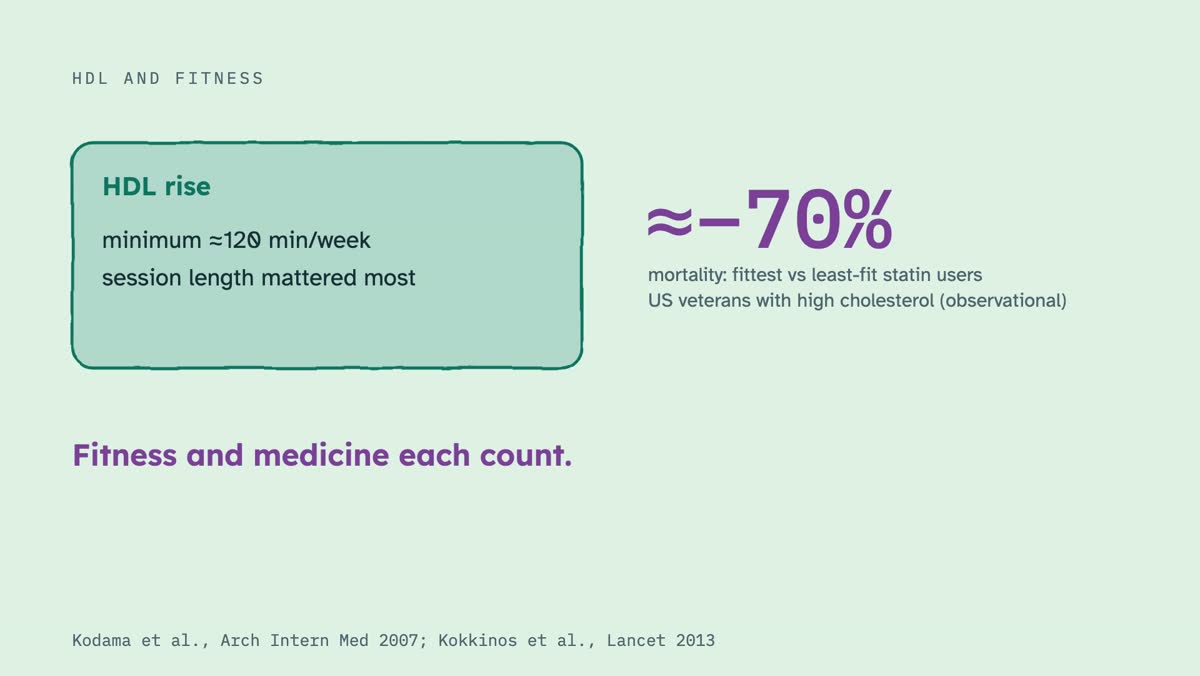
Two more pieces. For HDL, a meta-analysis found a minimum of about 120 minutes a week, and session length mattered more than how often or how hard. And among U.S. veterans with high cholesterol, the fittest statin users had about 70 percent lower mortality than the least fit statin users. That's observational, but it suggests fitness and medicine each count.
If you take a statin and train hard, here's what the evidence shows in general. In blinded trials, muscle pain or weakness was reported by 27.1 percent of people on a statin and 26.6 percent on placebo, so more than 90 percent of muscle complaints in statin users weren't caused by the drug. In a marathon study and a downhill-walking trial, a muscle-damage marker called CK rose somewhat more in statin users, though four days of long walking didn't. The 2026 cholesterol guideline lists vigorous exercise among factors linked to statin muscle symptoms, without a size, and says risk rises with the statin dose. Whether statins blunt fitness gains is unresolved: small studies disagree, and a placebo-controlled trial finished in early 2026 but hasn't reported yet.
One practical note: a long or hard session can shift a lipid panel for a day or two, nudging HDL up and triglycerides down, and CK can jump. A European and Latin American laboratory recommendation advises avoiding intense activity for 24 hours before blood is drawn. Comparing panels drawn under similar conditions makes changes easier to read.
Sleep and sleep apnea
Regular exercise modestly improves sleep, most clearly self-rated sleep quality, and most types of exercise help. He already sleeps seven to eight hours, the range that earns full marks for sleep duration on the heart association's score, so he has less room to gain than the poor sleepers in most trials.
Timing matters for very hard sessions. In experiments, evening exercise didn't hurt sleep, but vigorous exercise ending within an hour of bed may. In wearable data from nearly 15,000 people, a maximal session ending two hours before usual sleep, compared with a light one, was linked to falling asleep 36 minutes later and sleeping 22 minutes less, while sessions ending at least four hours before showed no link. So finishing a late soccer match or another very hard session at least four hours before bed fits every source; two to four hours fits the lab studies.
Sleep also tracks with overreaching and injury. Triathletes pushed into overreaching slept about eight percent less. And in endurance athletes averaging 42, sleeping under seven hours was linked to about a 50 percent higher risk of a new injury two weeks later. That's an association, not proof.
Now sleep apnea, measured by the apnea-hypopnea index, or AHI: breathing pauses per hour of sleep. In randomized trials, exercise lowered it by about six to seven events an hour, with little weight loss. C-PAP lowered it by about 25. Benefits plateaued at about 70 to 100 minutes of aerobic exercise a week, and in two small trials of patients already on C-PAP, adding exercise didn't lower it further. Nearly every trial enrolled sedentary, mostly obese, untreated patients. In the general population, people exercising more than seven hours a week had lower index values than non-exercisers, about 3 versus 5, but that's a snapshot, not proof. He already trains far beyond that plateau, so the evidence can't say more training would lower his. Weight is a lever mainly for people with weight to lose: a 10 percent weight loss predicted about a 26 percent fall in the index. And mouth and throat exercises roughly halved it in mostly uncontrolled studies.
The key trial shows both the benefit and its limits. In 43 sedentary, overweight or obese adults with untreated sleep apnea, 12 weeks of aerobic and strength training lowered the index from about 32 to 25, with almost no weight loss, while the stretching group got slightly worse. But only a quarter of the exercisers met the trial's definition of treatment success.
That's why every guideline treats exercise as an add-on, not a substitute. The sleep medicine academy strongly recommends positive airway pressure for sleep apnea with excessive sleepiness, and doesn't list exercise as an alternative. About one in ten U.S. men in their 30s and 40s has moderate-to-severe sleep apnea. C-PAP's proven benefits are mainly on symptoms: in a large trial in people with heart or blood-vessel disease, it didn't prevent cardiovascular events, but it reduced snoring and sleepiness and improved mood and quality of life. Exercise is good for people with sleep apnea; treatment is a decision for a sleep clinician.
Overtraining and recovery
A 2013 consensus from European and American sports-medicine bodies defines these states by recovery time. Overreaching is a short-term dip in performance that takes several days to several weeks to recover from. When it rebounds into better performance, it's called functional. When performance stays down for weeks or months, it's non-functional overreaching or, rarely, overtraining syndrome, which can only be diagnosed by ruling out other causes. A 2022 review found zero studies that objectively documented overtraining syndrome.
Short-term overreaching is common: in two controlled overload studies, about half the triathletes given extra training became functionally overreached. But digging that hole isn't required to peak. Athletes who got tired but not overreached gained more after their taper than those who did overreach.
How to spot it? Start with persistent fatigue, unexplained underperformance, a greater sense of effort, and poor sleep. Simple self-ratings of mood, stress, fatigue and recovery tracked training load more consistently than objective markers in a 56-study review. Heart-rate variability is harder to read; in overreached triathletes, it actually rose. And in a small trial of recreational runners, adjusting training by a daily stress questionnaire did at least as well as HRV guidance. Across trials, HRV-guided training improved fitness only slightly, and not significantly, compared with fixed plans.
The consensus checklist also asks about training errors, like weekly volume jumping more than five percent, a sharp rise in intensity, or monotony, and about life outside training: work, relationships, finances, travel. In a survey of young athletes, training load didn't predict who reported long-lasting overreaching; other factors mattered too.
Most training should be easy, with some hard. The 80/20 rule comes from elite athletes, and a 2025 analysis found no difference between polarized and pyramidal training, with a hint that recreational athletes may do better with pyramidal. An hour of hard soccer is one of the week's hard sessions. On our reading, the bigger risk is every run drifting into a moderately hard middle zone.
Before a race, the evidence favors a taper of about two weeks, cutting volume by 41 to 60 percent while keeping intensity. Routine lighter weeks every few weeks are a practice some athletes use, though untested in recreational endurance athletes. Regular ice baths after strength training blunted strength gains. And under-fuelling overlaps with overtraining: in 18 of 21 studies of training overload that measured food intake, energy or carbohydrate availability fell or differed between groups.
What about age? Reviews suggest the effect of age on recovery may be smaller than often assumed. In one small study, older cyclists recovered physically as fast as younger ones after hard intervals, but felt less recovered. None of these data come from men around 40, and persistent fatigue has many non-training causes, from anemia and infections to thyroid problems, so fatigue or stalled performance that lasts despite rest is worth a clinical check.
Before you go
So, on our reading of the evidence, what might a week like his be missing? Structure, not more volume. A second full-body, progressively loaded strength session, so every major muscle group gets two days. An injury-prevention warm-up like FIFA eleven-plus, with Nordic hamstrings, before soccer. Easy runs that are actually easy, with soccer counted as a hard session. Long runs that grow in steps, not leaps. A lighter week every few weeks, and a real taper before races. And a short daily check-in on mood, fatigue and sleep.
Here's one illustrative way to arrange it, not a prescription. Monday, full-body strength and a walk. Tuesday, an easy run. Wednesday, the warm-up, then soccer, finishing a few hours before bed. Thursday, an easy run and climbing. Friday, the second full-body strength session, at least three hours from any hard running. Saturday, a long easy run, no more than about ten percent beyond the longest run of the past month. Sunday, rest or a walk. By our math, that keeps his total close to where it is now. And on our reading of the evidence, a marathon build would grow the long run in steps rather than leaps, keep weekly running above about 30 kilometers, and count soccer as one of the week's hard sessions, not an extra.
If you're in a similar spot, here are questions worth bringing to a clinician or coach. One: what's the best plan for my sleep apnea? Two: what's the plan for my cholesterol, and how much should exercise contribute? Three: should I avoid hard sessions before blood tests? Four: which symptoms should make me stop and get checked? Five: how should I build long runs and fit soccer into a race block? And six: if anxiety or low mood persists on rest days, who should I talk to?
To sum up: on every big dose-response curve, a week like his already sits on the plateau. So the instincts that come naturally to a committed exerciser, to add another run, push another block, or feel uneasy on a rest day, aim at the part of the curve that pays least. On our reading, the evidence instead favors rearranging what's already there, and treating cholesterol and sleep apnea as clinical questions, not training ones. The same logic applies to mood: exercise reliably lifts it, the benefit flattens at a few sessions a week, and a mild dip after a few days off is an expected, reversible response, and on our reading not a sign that more is needed. Several questions remain open, including whether athletes' extra plaque matters for heart attacks and whether statins blunt fitness gains, and almost no trial has studied men around 40 who already train most days.
Sources
122 sources cited in the video, in the order they come up.
Where his week stands
- Physical Activity Guidelines for Americans, 2nd ed
- Bull et al. 2020
- Garber et al. 2011
- 2024 Adult Compendium of Physical Activities
- Arem et al. 2015
- Lee DH et al. 2022
- Gebel et al. 2015
- Wang et al. 2021
- Lang et al. 2024
- Mandsager et al. 2018
- Kokkinos et al. 2022
- Strauss et al. 2026
- Randers et al. 2014
- Pedisic et al. 2020
- Lee DC et al. 2014
- Milanović et al. 2015
- Milanović et al. 2019
- Han et al. 2026
- dos Santos et al. 2022
- Ekelund et al. 2016
Strength: the likely gap
- Momma et al. 2022
- Zhang et al. 2026
- Currier et al. 2026
- Schumann et al. 2022
- Robineau et al. 2016
- Lauersen et al. 2014
- Thorborg et al. 2017
- van Dyk et al. 2019
Can you overdo it?
- Schnohr et al. 2015
- Aengevaeren et al. 2017
- Merghani et al. 2017
- De Bosscher et al. 2023
- Pauwels et al. 2026
- DeFina et al. 2019
- Berry et al. 2025
- Franklin et al. 2020
- Kim et al. 2025
- Kim et al. 2025
- Videbæk et al. 2015
- Fokkema et al. 2019
- Frandsen et al. 2025
- Buist et al. 2008
- Rasmussen et al. 2013
- van Poppel et al. 2021
- Nieman et al. 1990
- Campbell & Turner 2018
- Simpson et al. 2020
- Mansour et al. 2017
- Mountjoy et al. 2023
- Stellingwerff et al. 2021
Mood, energy, anxiety
- Rebar et al. 2015
- Noetel et al. 2024
- Aylett et al. 2018
- Henriksson et al. 2022
- Ensari et al. 2015
- Pearce et al. 2022
- Singh et al. 2023
- Chekroud et al. 2018
- Puetz et al. 2006
- Puetz et al. 2008
- Ekkekakis et al. 2011
- Mondin et al. 1996
- Berlin et al. 2006
- Weinstein et al. 2017
- Weinstein et al. 2025
- Marques et al. 2019
- Di Lodovico et al. 2019
- Geisler et al. 2026
- Luttenberger et al. 2015
- Karg et al. 2020
- Luttenberger et al. 2022
- Kornhuber et al. 2026
Cholesterol
- Smart et al. 2025
- Kelley & Kelley 2006
- Bellissimo et al. 2018
- Zhang et al. 2026
- Kraus et al. 2002
- Wood et al. 2019
- 2026 ACC/AHA multisociety cholesterol guideline
- Farrell et al. 2012
- Kodama et al. 2007
- Kokkinos et al. 2013
- Cholesterol Treatment Trialists 2022
- Parker et al. 2012
- Thompson et al. 1997
- Allard et al. 2021
- Allard et al. 2023
- NCT06841536, exercise with statin or placebo (results pending)
- Ferguson et al. 1998
- Kantor et al. 1987
- Simundic et al. 2018
Sleep and sleep apnea
- Kredlow et al. 2015
- Wang et al. 2025
- Lloyd-Jones et al. 2022
- Stutz et al. 2019
- Frimpong et al. 2021
- Leota et al. 2025
- Hausswirth et al. 2014
- Johnston et al. 2020
- Lin et al. 2024
- Iftikhar et al. 2017
- Iftikhar et al. 2024
- Peppard et al. 2000
- Camacho et al. 2015
- Kline et al. 2011
- Patil et al. 2019
- Peppard et al. 2013
- McEvoy et al. 2016


