
No Thyroid, Stubborn Weight: Is Your Dose to Blame?
Inside this episode
The video’s narration, chapter by chapter, with stills from the video and every source at the end.
The short version
Welcome to Health Loom. Our best reading: at a TSH near 4, thyroid levels likely explain only a small part of the weight, if any. Age-related changes probably matter more, but in trials, diet plus exercise still helps. TSH, not T3, guides the dose.
Reading the numbers
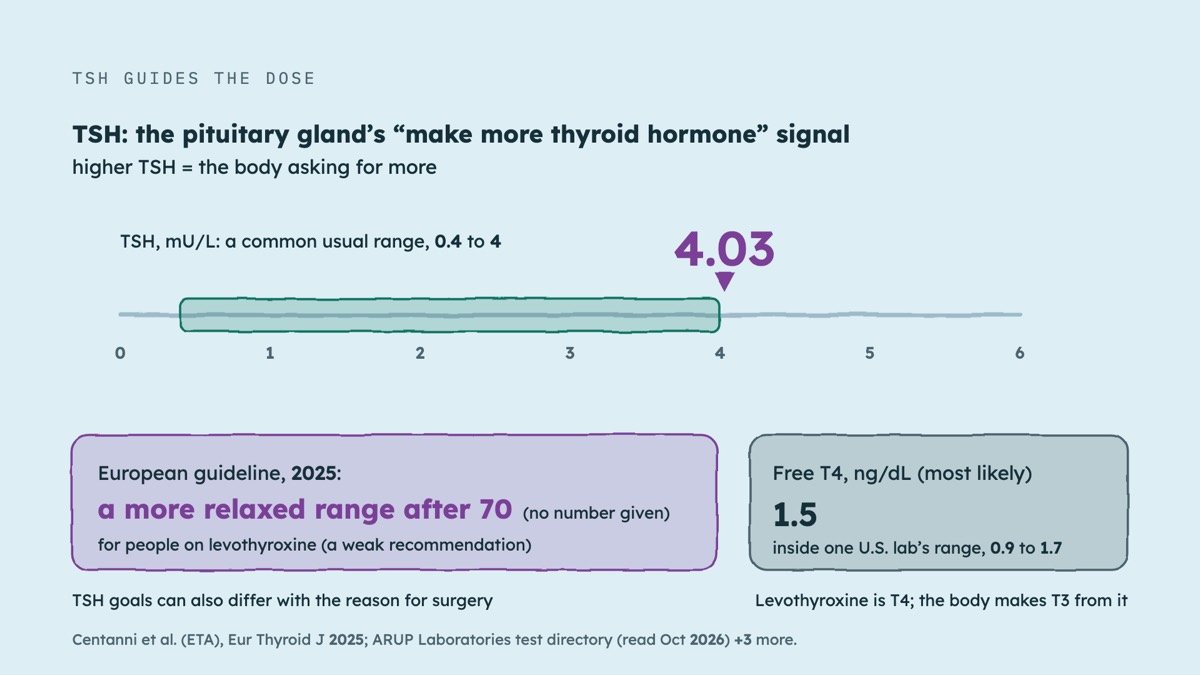
TSH is the pituitary gland's "make more thyroid hormone" signal. 4.03 sits right at the top edge of many usual ranges, roughly 0.4 to 4, and a 2025 European guideline suggests a more relaxed range after 70. Levothyroxine is T4; the body makes T3 from it. A T4 of 1.5 most likely is free T4, the usable part, inside one U.S. lab's range.
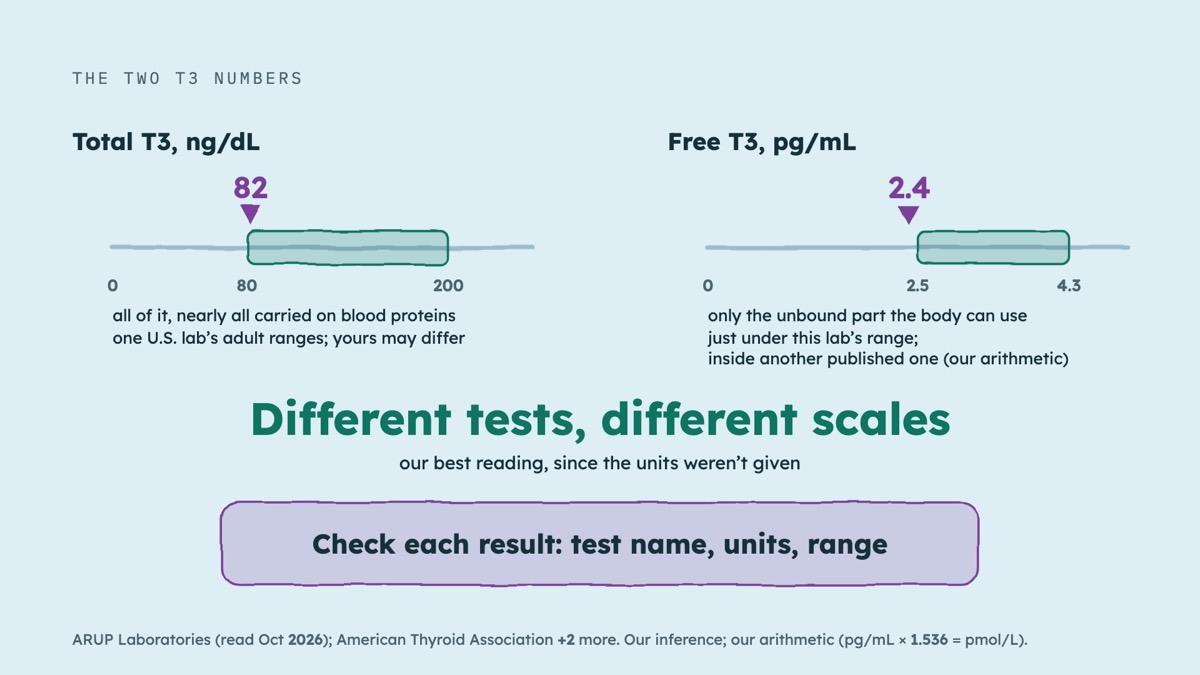
Now the two T3s. Total T3 measures all of it. 82 fits total T3, in nanograms per deciliter; one U.S. lab lists 80 to 200. 2.4 most likely is free T3, in picograms per milliliter: 2.5 to 4.3 there. Different tests, on different scales.
The dose
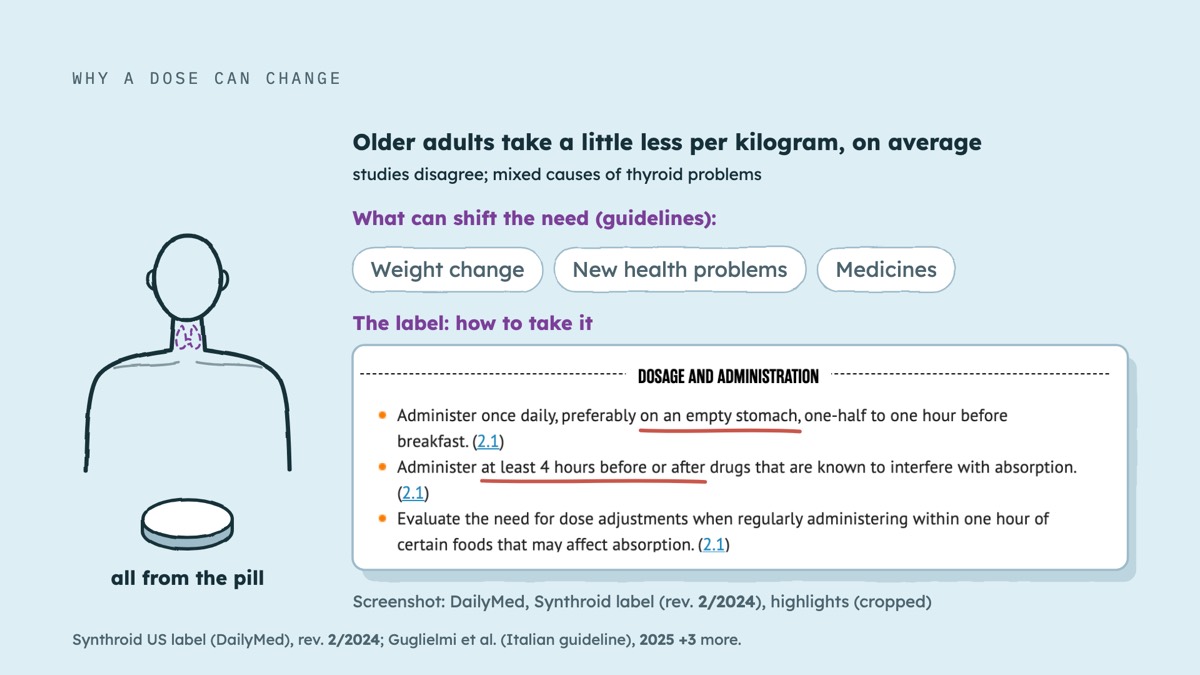
With no thyroid, all thyroid hormone comes from the pill. On average, older adults take a little less per kilogram, though studies disagree, and guidelines say weight change, new health problems or medicines can shift the need. The label: take it on an empty stomach, before breakfast, and at least 4 hours from medicines like calcium or iron.
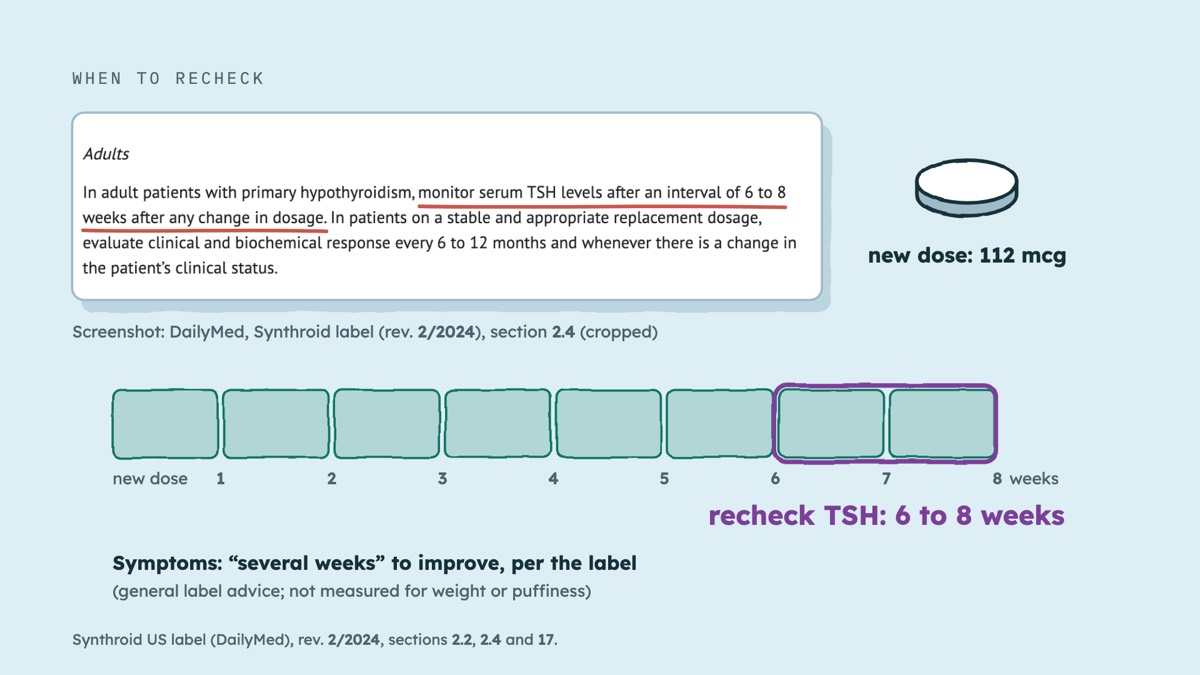
The label's timing: recheck TSH 6 to 8 weeks after any dose change, and symptoms can take several weeks to improve. So a TSH test 6 to 8 weeks into 112 shows what the new dose did.
What about adding a T3 pill, liothyronine? In some studies, lowish T3 is common without a thyroid. But pooled studies found no clear benefit for symptoms or weight on average, though more people said they preferred it. Guidelines favor levothyroxine alone, allowing at most a supervised trial period.
Weight and puffiness
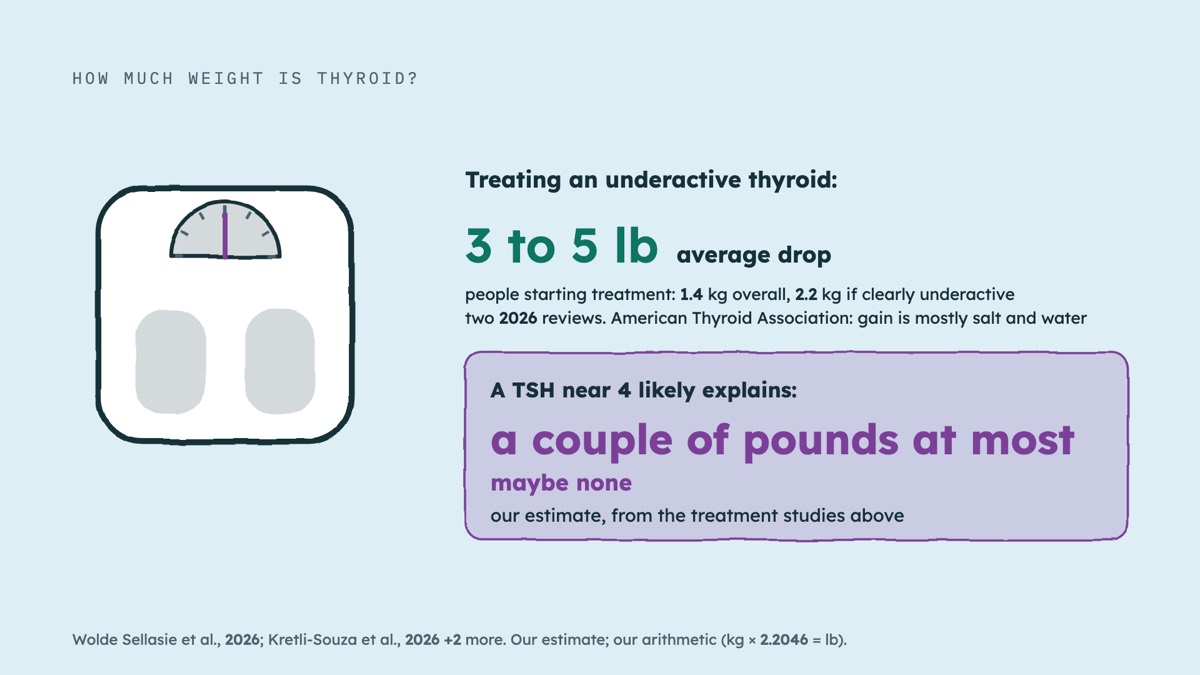
How much weight can the thyroid explain? Treating an underactive thyroid takes off only about 3 to 5 pounds on average. So a TSH near 4 likely accounts for a couple of pounds at most, maybe none: our estimate.
More pill isn't a weight tool: levothyroxine's label carries a boxed warning against using it for weight loss. In older adults, too much, with TSH below the range, can bring an irregular heartbeat and bone loss, so doses rise in small steps.
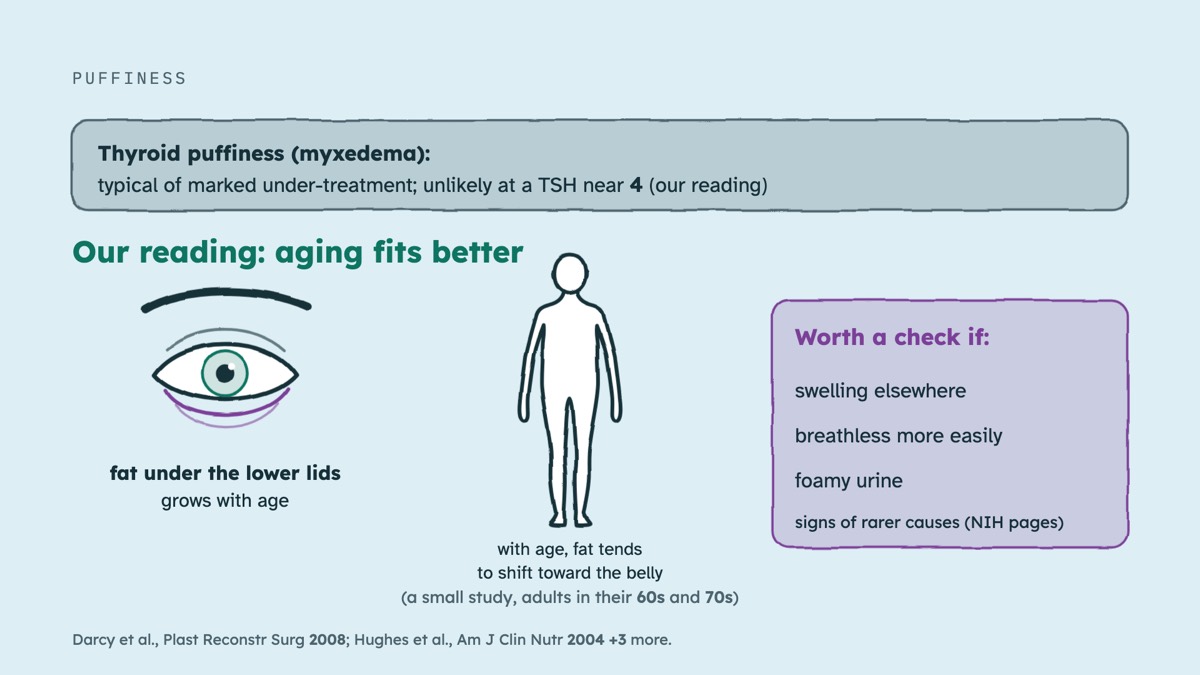
Thyroid puffiness, called myxedema, is typical of marked under-treatment. Our reading: it's unlikely at a TSH near 4, and aging fits better. The fat under the lower eyelids grows with age, and fat tends to shift toward the belly. Swelling elsewhere, getting breathless more easily, or foamy urine are reasons to get checked.
Our best reading: mostly age-related changes, with thyroid levels a small part, if any. If TSH settles on the new dose but nothing budges for months, thyroid levels probably weren't the main cause.
What helps after 70
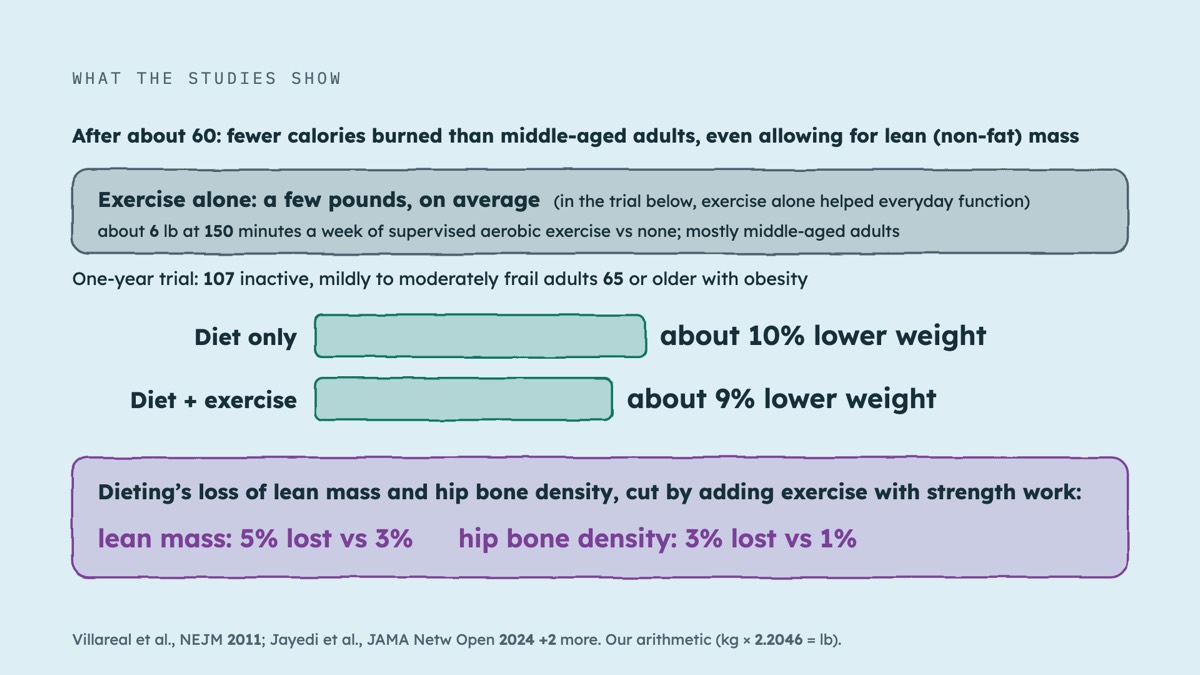
After about 60, people burn fewer calories than middle-aged adults, even allowing for lean mass. On average, exercise alone takes off only a few pounds. In one year-long trial, a dietitian-led diet took off about a tenth, and adding exercise cut dieting's loss of muscle and hip bone density.
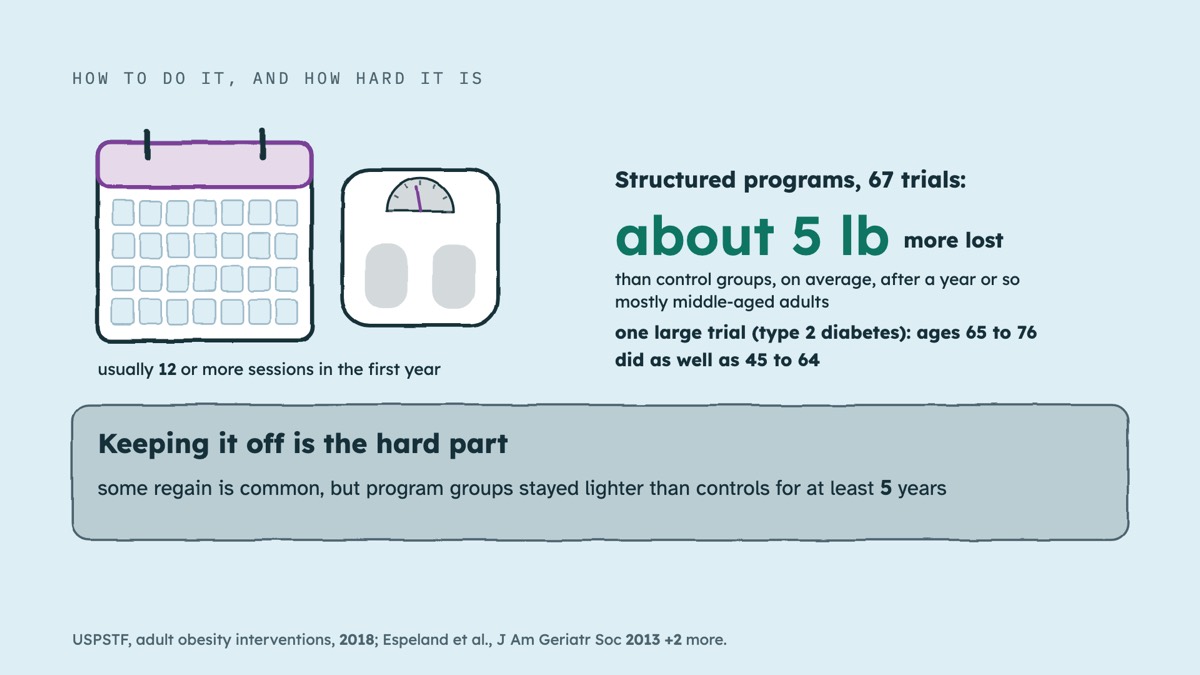
Structured programs with regular sessions and tracking take off about 5 pounds more than control groups, on average, mostly in middle-aged adults; in one large trial, people 65 to 76 did as well as younger adults. Keeping weight off is the hard part.
Questions to ask. Which T3 test was each, and in what units? When should TSH be rechecked on 112? Could anything I take explain the puffiness or block absorption? And would a dietitian-led plan with strength training suit me?
Sources
37 sources cited in the video, in the order they come up.
Opening
- ARUP Laboratories test directory, total T3, free T3, free T4 and TSH (one U.S. lab's adult reference ranges; read Oct 2026) [link 2] [link 3] [link 4]
- Wolde Sellasie 2026, Int J Obes (pooled before-and-after studies of people starting treatment; one author has consulted for a levothyroxine maker)
- Synthroid (levothyroxine) US label, AbbVie, DailyMed, rev. 2/2024 (also shown on screen in chapters 2 and 3)
- Villareal 2017, NEJM (160 adults 65 and over with obesity, all dieting, with different kinds of exercise; one research group; NIH-funded)
1 reading the numbers
- Centanni 2025 (ETA), Eur Thyroid J (European levothyroxine guideline; its over-70 advice is a weak recommendation with no number given; some authors have ties to levothyroxine makers)
- American Thyroid Association, patient pages "Thyroid Function Tests" and "Hypothyroidism" (read Oct 2026) [link 2]
- Yeap 2017 (Health In Men Study), J Gerontol A (older men; uses the conventional 0.4 to 4 range)
- Van Uytfanghe 2023, Thyroid (a review of thyroid tests commissioned by the American Thyroid Association)
- Gullo 2011, PLoS One (people whose thyroid was removed for cancer, one Italian lab; its free T3 range, converted by us, is the "other published" range)
2 the dose
- Screenshot, shown on screen for what it said: Synthroid label, highlights (Dosage and Administration), DailyMed, rev. 2/2024. Source: National Library of Medicine
- Guglielmi 2025 (Italian guideline), J Endocrinol Invest (adults with an underactive thyroid; some points are ungraded expert advice)
- Gavigan 2023, Endocr Pract (older U.S. volunteers on levothyroxine with normal tests; mixed causes of thyroid problems)
- Pustilnik 2021, Endocrinol Diabetes Nutr (a study in Argentina that found no link between dose and age; one of the studies that disagree)
- Screenshot, shown on screen for what it said: Synthroid label, section 2.4 (Monitoring TSH, Adults), DailyMed, rev. 2/2024. Source: National Library of Medicine
- Millan-Alanis 2021, Thyroid (pooled studies of adding T3; NIH support; the preference was stated, not a measured benefit)
- Ito 2012, Eur J Endocrinol (people treated for thyroid cancer)
- Wiersinga 2012 (ETA), Eur Thyroid J (European guidance on adding T3)
- Ahluwalia 2023 (British Thyroid Association and Society for Endocrinology), Clin Endocrinol (UK consensus on liothyronine)
- Cytomel (liothyronine) US label, Pfizer, DailyMed, May 2026 version
3 weight and puffiness
- Kretli-Souza 2026, Rev Endocr Metab Disord (clearly underactive thyroids starting treatment; overlaps with Wolde Sellasie, so not an independent check)
- American Thyroid Association, "Thyroid and Weight" (read Oct 2026; "mostly salt and water" is its wording, not a measurement)
- Kretli-Souza 2025, Rev Endocr Metab Disord (untreated people; no clear weight difference at a TSH of 4.0 to 4.9)
- Screenshot, shown on screen for what it said: Synthroid label, boxed warning, DailyMed, rev. 2/2024. Source: National Library of Medicine
- Darcy 2008, Plast Reconstr Surg (MRI scans comparing age groups, 40 people)
- Hughes 2004, Am J Clin Nutr (a small study, adults in their 60s and 70s)
- Sciacchitano 2024, Int J Mol Sci (body water in thyroid disease; a small study)
- NIDDK, Nephrotic Syndrome in Adults (last reviewed Oct 2020)
- NHLBI, Heart Failure: Symptoms (last updated Mar 2022)
4 what helps after 70
- Villareal 2011, NEJM (107 inactive, mildly to moderately frail adults 65 and over with obesity; one year; NIH-funded)
- Jayedi 2024, JAMA Netw Open (trials of supervised aerobic exercise, mostly in middle-aged adults)
- Pontzer 2021, Science (daily energy use across the lifespan, comparing people of different ages)
- Bouchonville 2014, Int J Obes (methods of the Villareal 2011 trial: strength work in the diet-plus-exercise group; the exercise-only group was asked to keep its weight steady)
- USPSTF, Weight Loss to Prevent Obesity-Related Morbidity and Mortality in Adults: Behavioral Interventions (final Sept 2018; the page says an update is in progress; read Oct 2026; trials mostly of middle-aged adults). USPSTF recommendations are independent of the U.S. government; our summary is not endorsed by AHRQ or HHS
- Espeland 2013, J Am Geriatr Soc (Look AHEAD trial, type 2 diabetes: people 65 to 76 compared with 45 to 64)
- Look AHEAD Research Group 2014, Obesity (8-year results; type 2 diabetes)
- Hartmann-Boyce 2021, BMJ (regain after weight programs across 249 trials)


