
Is an LDL of 174 High Enough for a New Drug?
Inside this episode
The video’s narration, chapter by chapter, with stills from the video and every source at the end.
The short version
Welcome to Health Loom. Our reading of U.S. guidance: 174 at 74, with even minimal calcium in the heart's arteries, usually puts treatment on the table. Lipfendra lowers LDL a lot; long-term safety and heart benefits are still unknown.
Is 174 high enough?
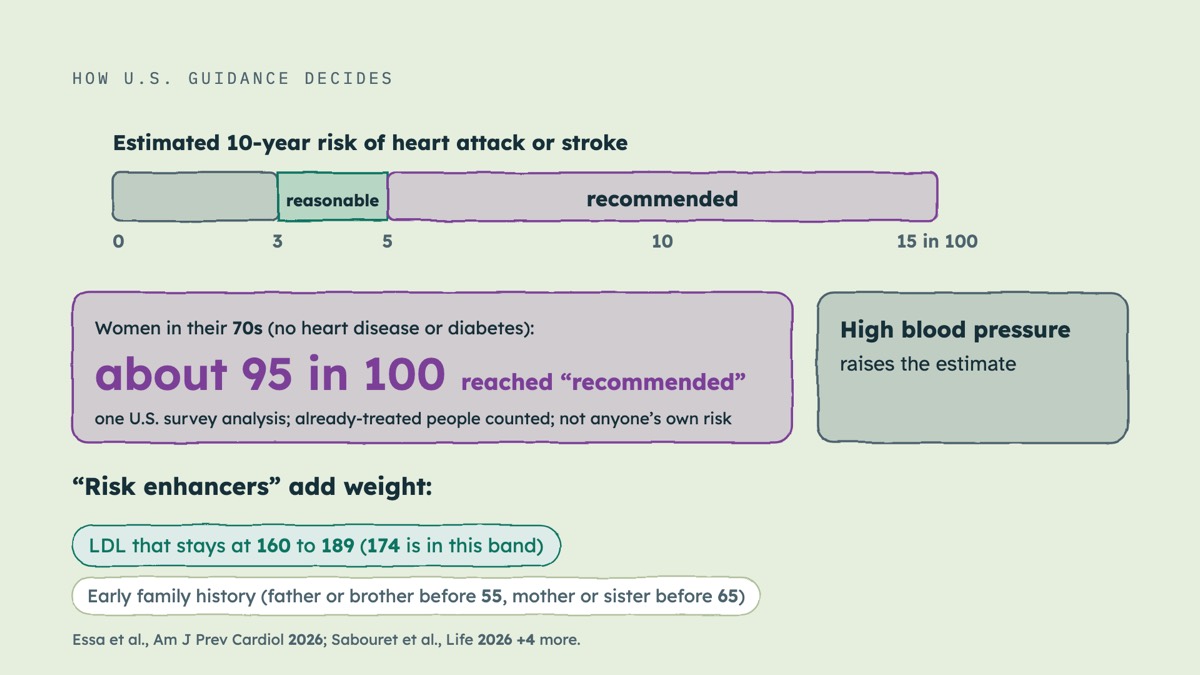
U.S. guidance starts with an estimated 10-year risk of heart attack or stroke: summaries of the 2026 guideline call treatment reasonable from 3 in 100, recommended from 5. Age weighs heavily: in one national analysis, about 95 in 100 women in their 70s without heart disease or diabetes reached "recommended". High blood pressure raises the estimate; an LDL that stays at 160 to 189, and an early family history, add weight.
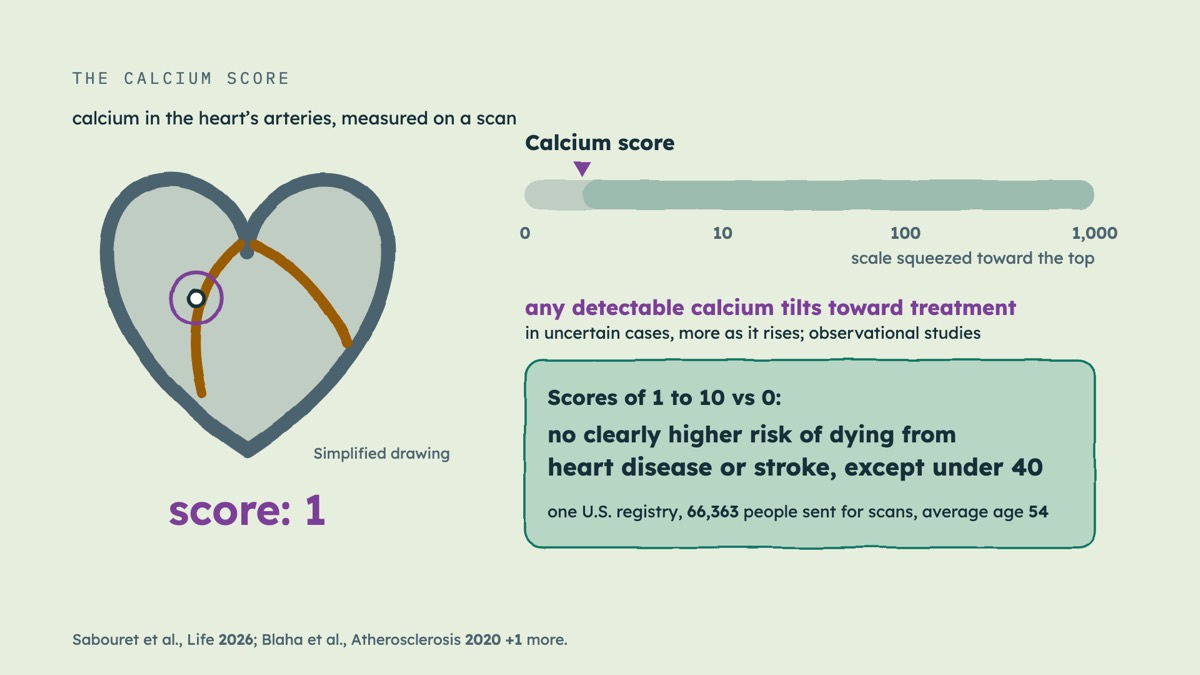
Then the calcium score. Summaries say any detectable calcium tilts an uncertain decision toward treatment, more as it rises. Scores of 1 to 10 count as minimal: in a U.S. registry of people sent for scans, mostly middle-aged, they showed no clearly higher risk of dying from heart disease or stroke than zero, except under 40.
Our reading, not a recommendation: treatment is usually on the table, but that guidance rests mostly on statins and predates Lipfendra. A later trial in people 70 and over: a statin meant fewer heart and stroke events, not more disability-free years.
How it works, and the muscles
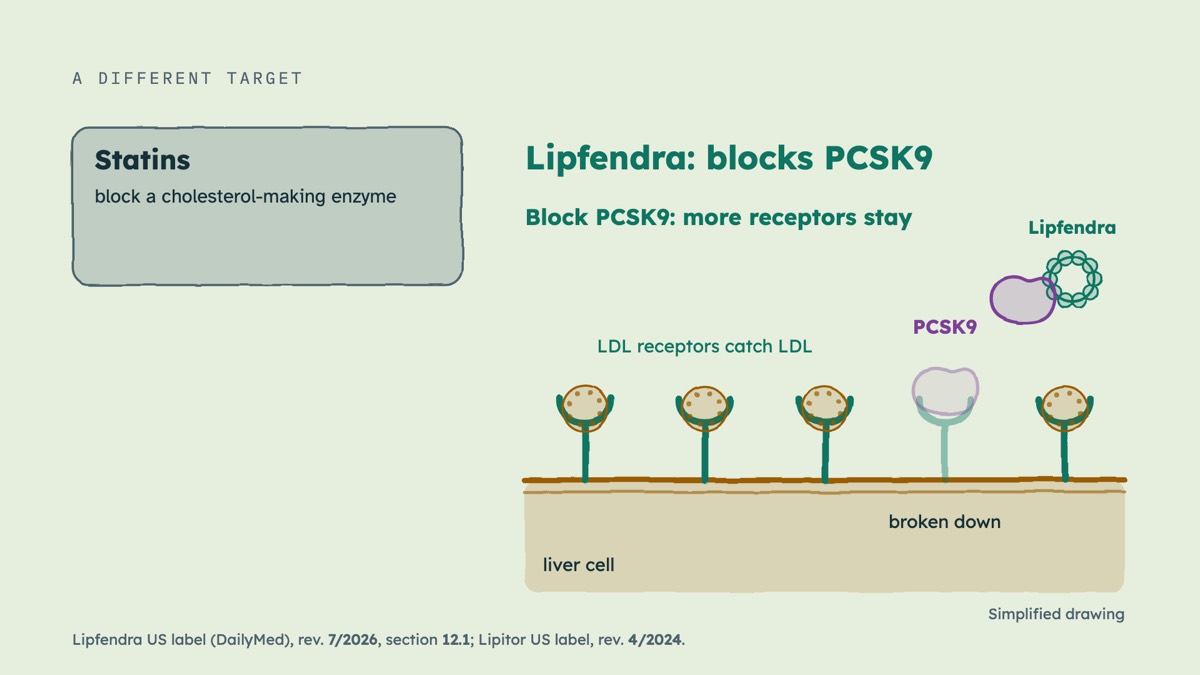
Statins block an enzyme that helps make cholesterol. Lipfendra blocks PCSK9, a protein that makes liver cells break down LDL receptors, which pull LDL from the blood. Block PCSK9, and more receptors stay.
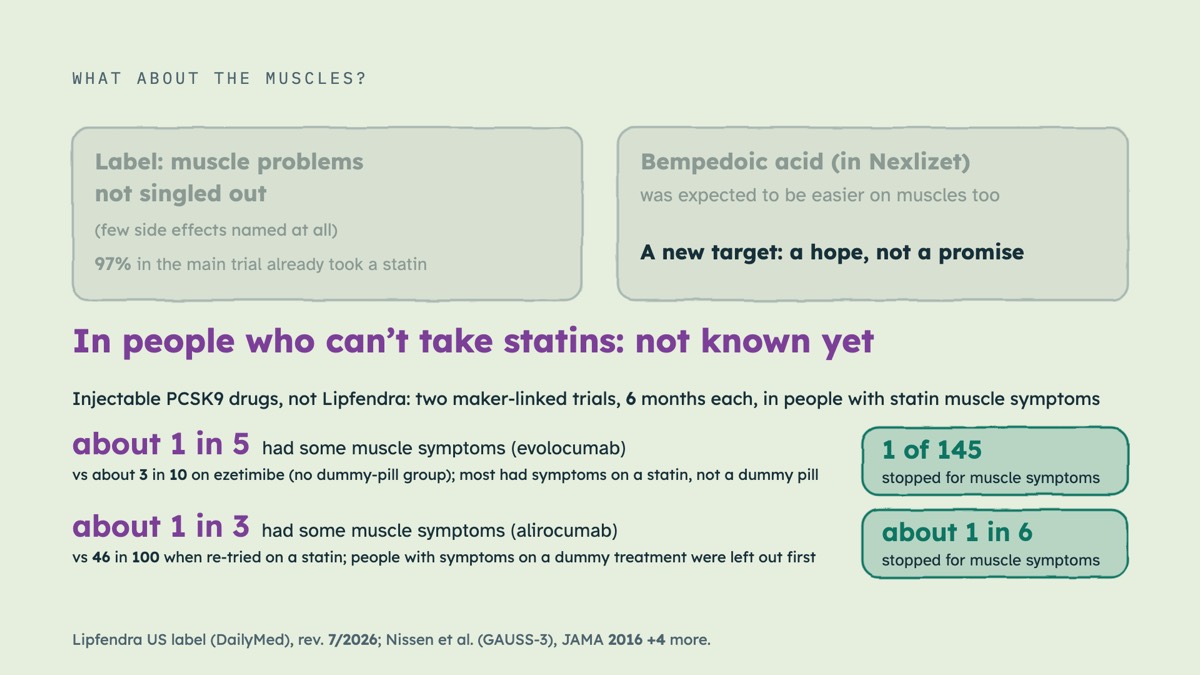
After severe cramps and weakness on several drugs, it's understandable to be wary. Lipfendra's label doesn't single out muscle problems, but it names few side effects at all, and nearly everyone in its main trials took a statin. For people who can't take statins, its muscle effects aren't known yet. Nexlizet's bempedoic acid was also expected to be easier on muscles: a new target is a hope, not a promise. In two trials of injectable PCSK9 drugs in people with statin muscle symptoms, between 1 in 5 and 1 in 3 still had some.
Long-term safety
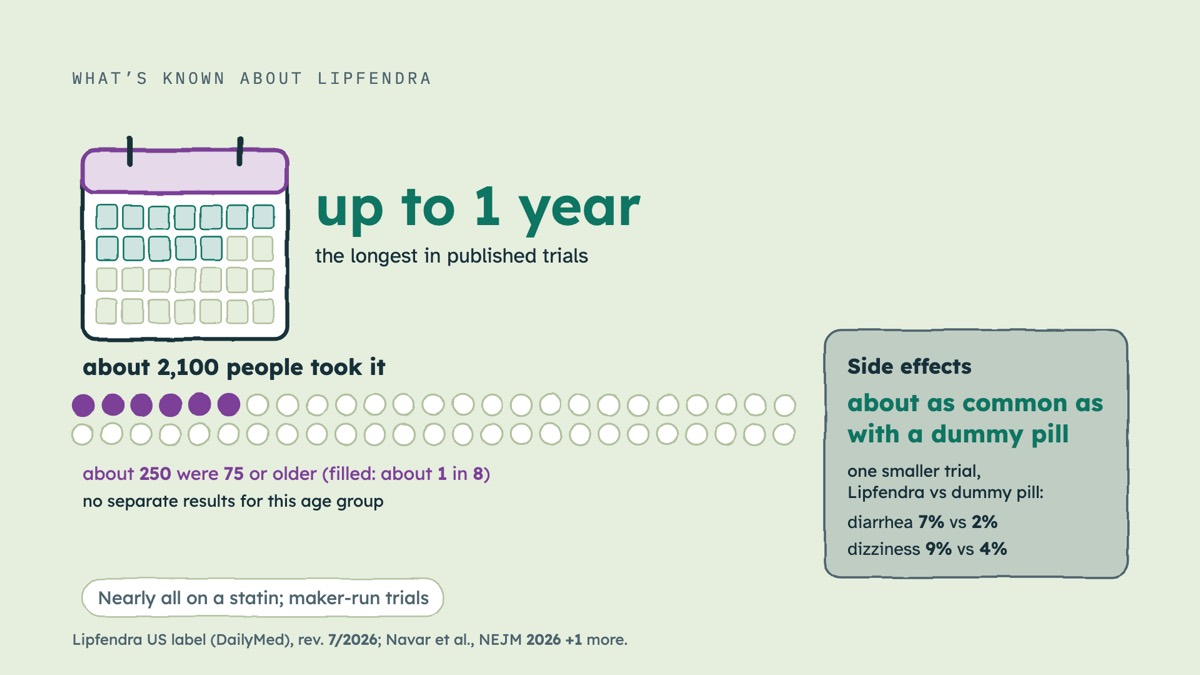
In the maker's published trials, about 2,100 people took Lipfendra for up to a year, about 250 of them 75 or older, nearly all on a statin. Side effects were about as common as with a dummy pill, though one smaller trial saw more diarrhea and dizziness.
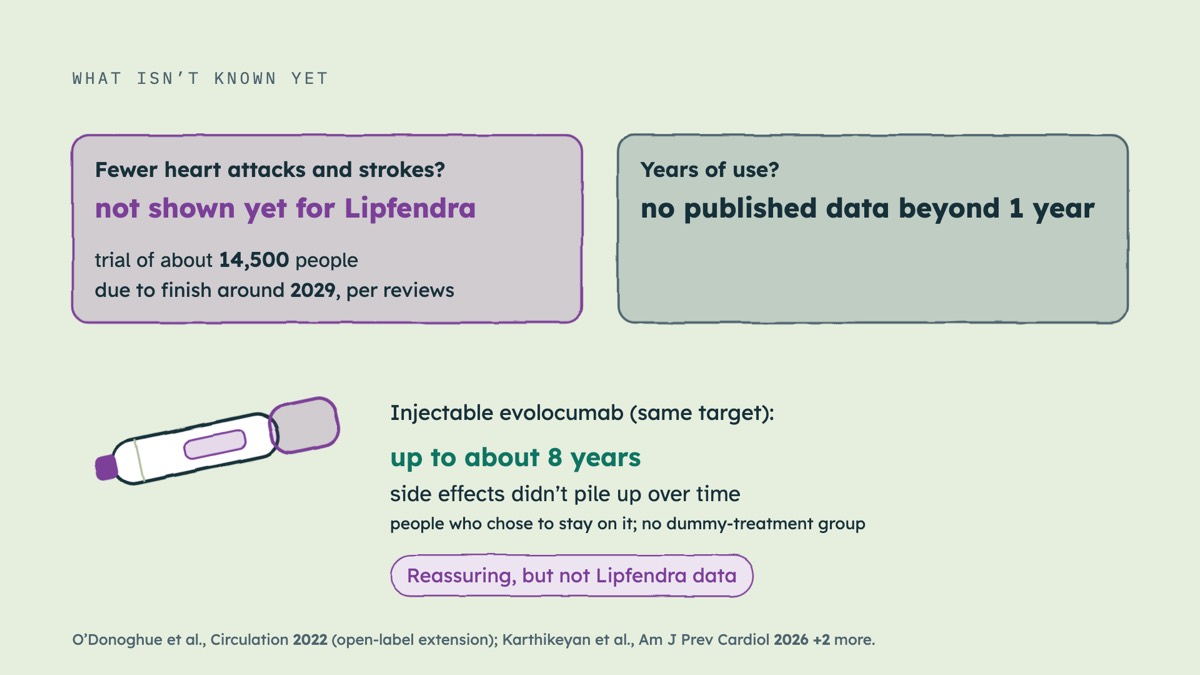
Not known yet: whether it prevents heart attacks and strokes, which a large trial is testing, due to finish around 2029, or its safety beyond a year. Evolocumab, an injectable PCSK9 drug, was followed for up to about 8 years in people who chose to stay on it, without a dummy-treatment group, and side effects didn't pile up: reassuring, but not Lipfendra data.
Interactions and cost
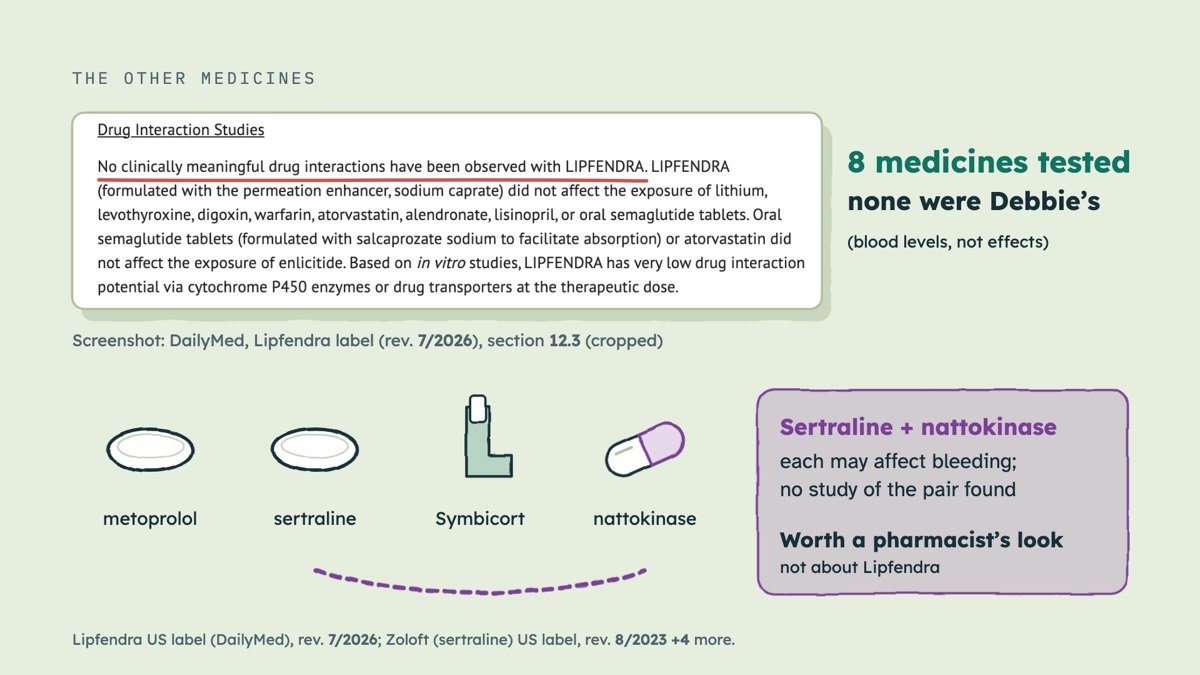
Lipfendra's label lists no drug interactions; the maker tested eight medicines, none of Debbie's. One pairing, not involving Lipfendra, is worth a pharmacist's look: sertraline's label warns bleeding risk may rise with aspirin, anti-inflammatories or blood thinners, and nattokinase is an enzyme measured by its clot-dissolving activity. We found no study of the two together.
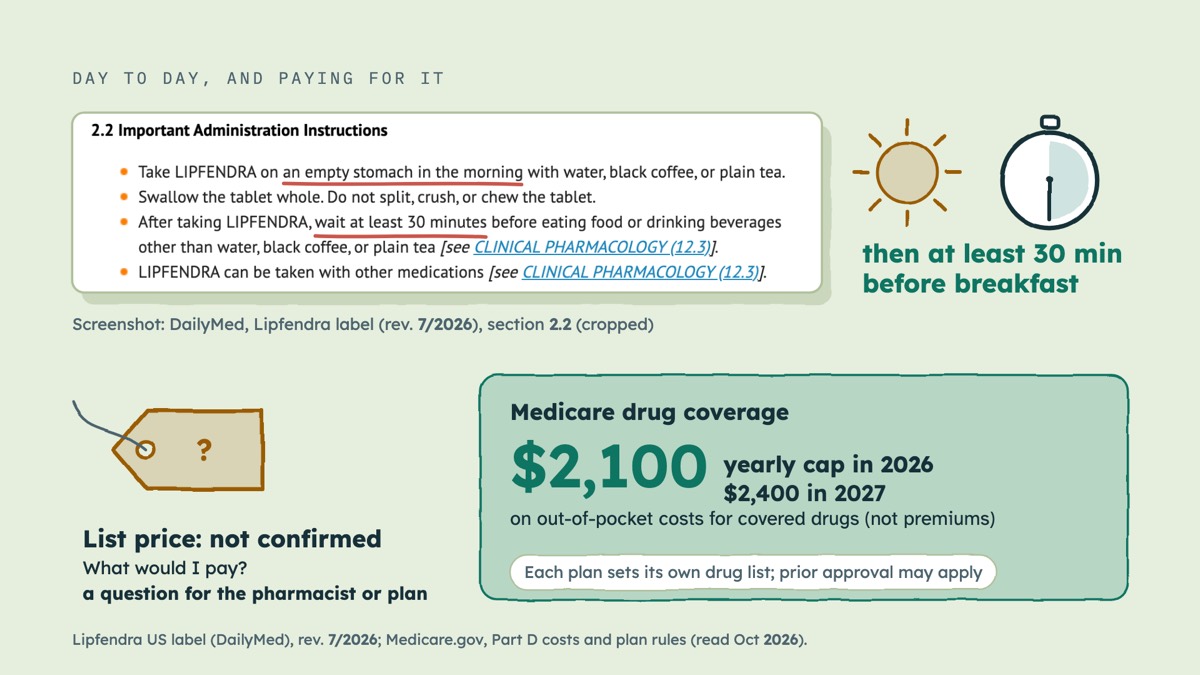
Lipfendra's label: one pill each morning on an empty stomach, then wait at least 30 minutes before breakfast. We couldn't confirm the price. Medicare drug coverage caps yearly out-of-pocket costs for covered drugs at $2,100 in 2026 and $2,400 in 2027; plans set their own drug lists and may want prior approval.
Questions to ask. Was my family history early? Would a repeat LDL test help? How does Lipfendra compare with drugs that have outcome results? For the pharmacist: anything to watch with sertraline and nattokinase?
Sources
35 sources cited in the video, in the order they come up.
Opening
- Lipfendra (enlicitide) US label, Merck Sharp & Dohme, DailyMed, rev. 7/2026 (its trials were run by the maker; nearly all took a statin)
- Navar 2026, NEJM (main trial, 52 weeks; funded by MSD (Merck); 97% already on a statin)
- Ballantyne 2026, JAMA (smaller maker-run trial in inherited high cholesterol; all on a statin)
- Sabouret 2026, Life (a summary of the 2026 U.S. cholesterol guideline)
1 is 174 high enough?
- Essa 2026, Am J Prev Cardiol (one U.S. survey analysis; already-treated people counted)
- NHLBI, Coronary heart disease risk factors (read Oct 2026)
- Goren 2026, Am J Prev Cardiol (review from the guideline lead author's group)
- Minutolo 2026, Curr Atheroscler Rep (review; authors list drug-maker advisory roles)
- USPSTF 2022, statins for preventing heart disease (before the newest trial in older adults)
- Blaha 2020, Atherosclerosis (66,363 people sent for scans, average age 54, mostly men; deaths only)
- Blaha 2017, J Cardiovasc Comput Tomogr (the registry's design: four U.S. centers)
- Zoungas 2026 (STAREE), NEJM (9,971 people 70 and over, no heart disease or diabetes; publicly funded)
- Zoungas 2023, BMJ Open (STAREE's published plan; heart procedures joined the count later)
- Blumenthal 2026, Circulation (the 2026 ACC/AHA multisociety cholesterol guideline, first published March 2026; read only through the summaries listed here)
2 how it works, and the muscles
- Lipitor (atorvastatin) US label, Viatris, DailyMed, rev. 4/2024
- Nissen 2016 (GAUSS-3), JAMA (evolocumab shots, not Lipfendra; 5 authors employed by its maker, Amgen; 6 months)
- Nexlizet (bempedoic acid and ezetimibe) US label, Esperion, DailyMed, rev. 1/2026
- Pinkosky 2016, Nat Commun (lab study partly funded by bempedoic acid's maker)
- Moriarty 2015, J Clin Lipidol (ODYSSEY ALTERNATIVE, alirocumab shots; run by the drug's makers; people with symptoms on dummy shots and pills left out first)
- Moriarty 2020, J Clin Lipidol (same trial team; source of 32.5%, 46.0% and 15.9%; Sanofi and Regeneron grant)
3 long-term safety
- Karthikeyan 2026, Am J Prev Cardiol (meta-analysis of short trials of several PCSK9 pills; no funding declared)
- O'Donoghue 2022 (FOURIER-OLE), Circulation (evolocumab shots; people who chose to stay on it; no dummy-treatment group; its parent trial was Amgen-funded)
- Ahlers 2025, Am J Prev Cardiol (review; outcome trial of about 14,550 people)
- Shear 2026, Am Heart J Plus (review funded by a competing drug maker; used only for the trial registry's 2029 completion date)
4 interactions and cost
- Screenshot, shown on screen for what it said: Lipfendra label, section 12.3 (Drug Interaction Studies), DailyMed, rev. 7/2026. Source: National Library of Medicine
- Zoloft (sertraline) US label, Viatris, DailyMed, rev. 8/2023
- Li 2023, Rev Cardiovasc Med (meta-analysis of small, short nattokinase trials)
- Weng 2017, Int J Mol Sci (review; what nattokinase is)
- Kurosawa 2015, Sci Rep (12 healthy young men, one dose; lab tests stayed in the normal range)
- Yoo 2019, Food Funct (100 adults, 8 weeks; lab tests, not bleeding)
- Screenshot, shown on screen for what it said: Lipfendra label, section 2.2 (Important Administration Instructions), DailyMed, rev. 7/2026. Source: National Library of Medicine
- Medicare.gov, How much does Medicare drug coverage cost? (read Oct 2026)
- Medicare.gov, Part D plan rules and how drug plans work (read Oct 2026) [link 2]
- Repatha (evolocumab) US label, Amgen, DailyMed, rev. 10/2026
- Praluent (alirocumab) US label, Sanofi and Regeneron, DailyMed, updated Jul 2026


