
Is an HbA1c of 6.8 Good Enough?
Inside this episode
The video’s narration, chapter by chapter, with stills from the video and every source at the end.
The short version
Welcome to Health Loom. Here's the short version. 6.8 is under 7, a common general goal for adults with type 2 diabetes. But groups differ, and your own goal is one you and your clinician set together. And one result can't show a trend.
What the number measures
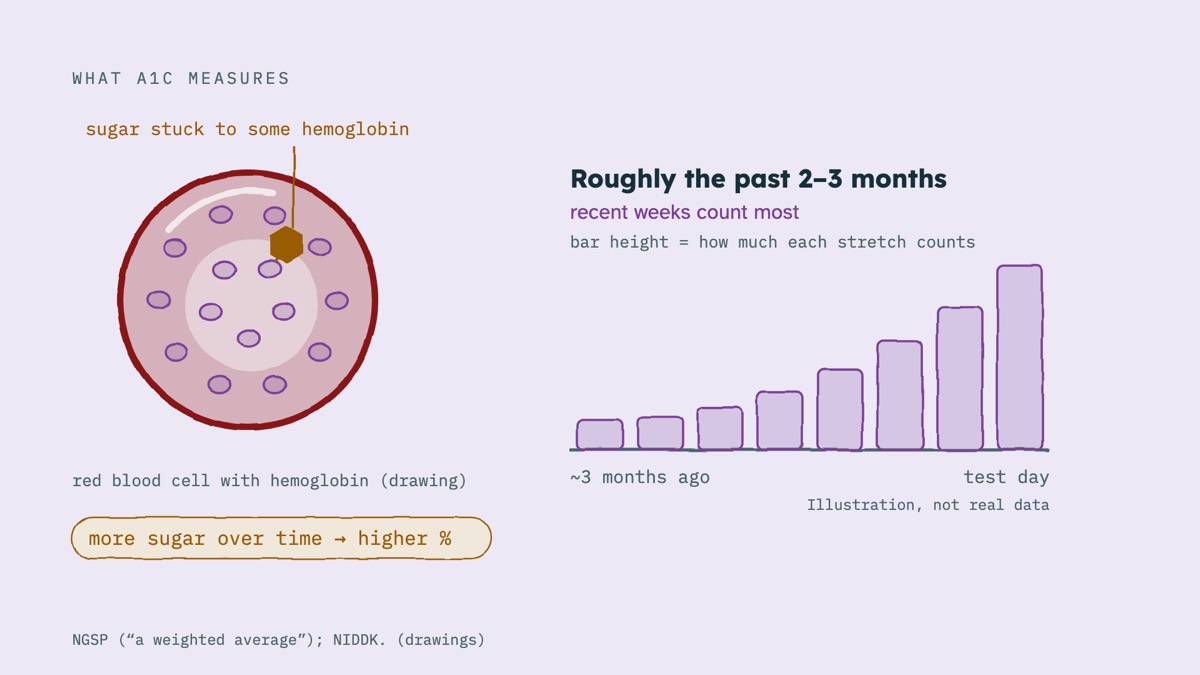
HbA1c, or A1c, is the share of hemoglobin, the oxygen carrier in red blood cells, that has sugar stuck to it. More sugar in the blood over time means a higher share. Red cells last a few months, so A1c reflects roughly the past two to three months, weighted toward recent weeks.
Targets, and who sets yours
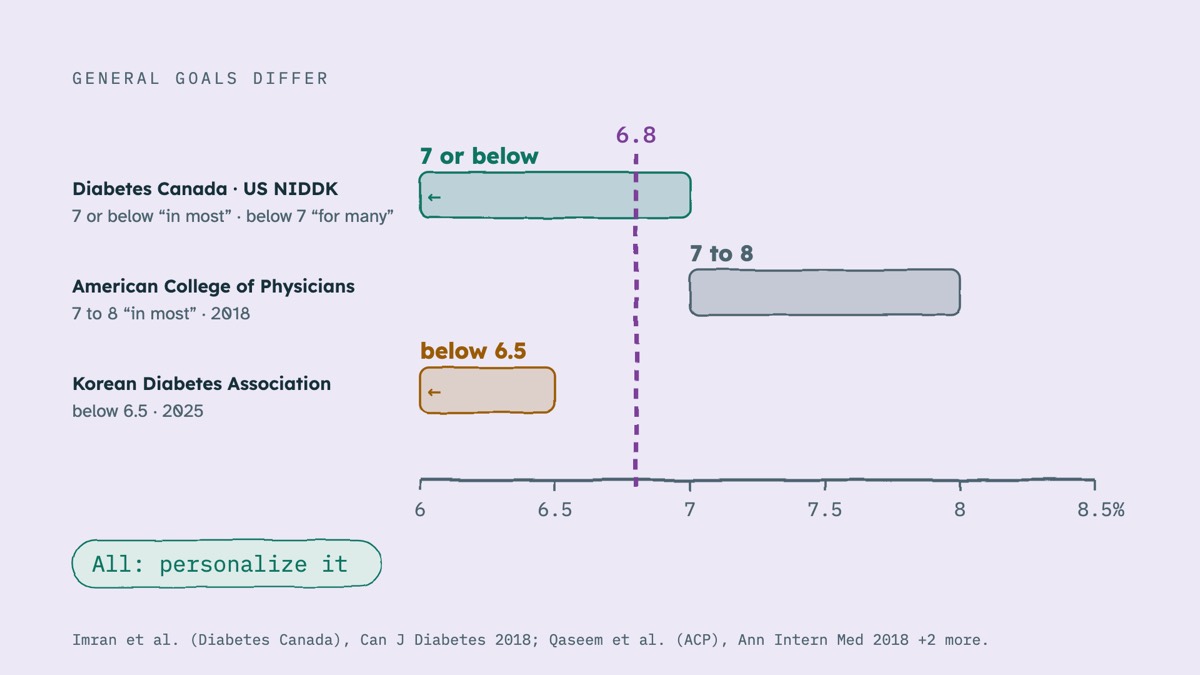
There's no single number every group agrees on. Diabetes Canada says 7 or below for most; a U.S. health institute, below 7 for many. The American College of Physicians suggests 7 to 8 for most. Korea's diabetes association, below 6.5. And all say to personalize it.
So how do clinicians personalize it? Some guidelines suggest tighter goals for some people early in diabetes, if reachable without low blood sugar. Looser goals may suit people with severe lows, limited life expectancy, serious illnesses or long-standing, hard-to-control diabetes. Preferences, treatment burden, your medicines and other conditions count too.
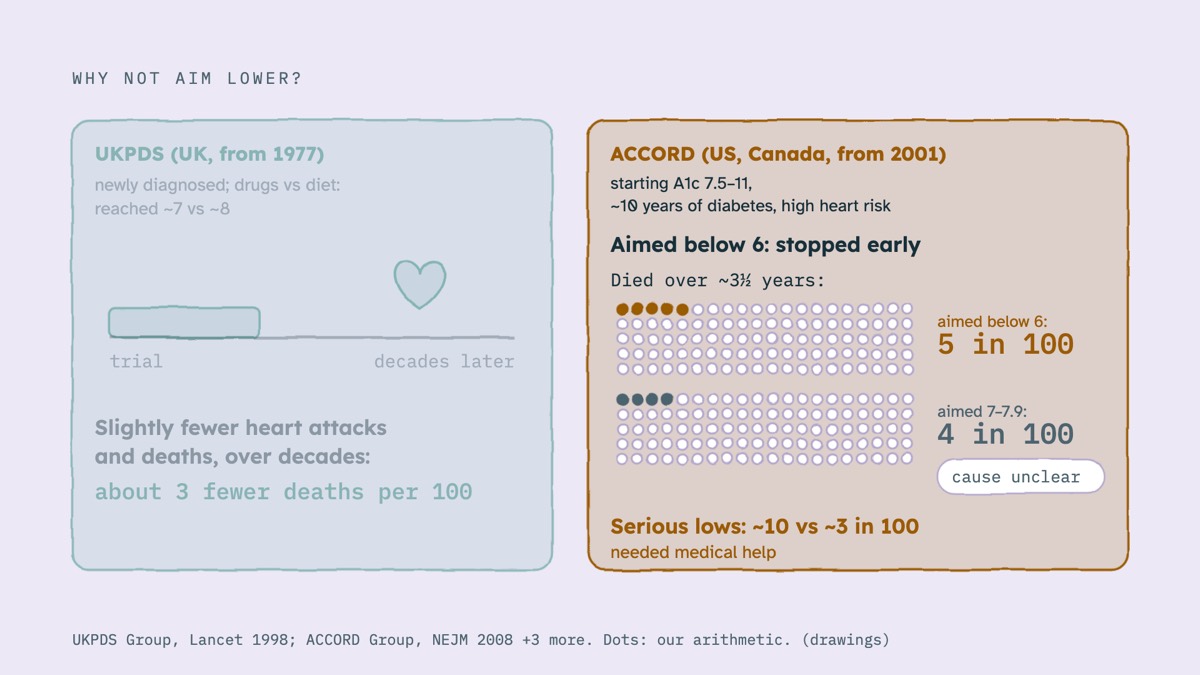
Why not aim lower? In the UKPDS trial, tighter control from diagnosis paid off slowly, with slightly fewer heart attacks and deaths. But in the ACCORD trial, aiming below 6 in people starting at 7.5 or higher, with about ten years of diabetes and high heart risk, was stopped early: over three and a half years, 5 in 100 died versus 4, cause unclear, and serious lows tripled.
Medicines matter too. On its own, metformin rarely causes low blood sugar, its label says, though it can happen if you don't eat enough, drink alcohol, or take other diabetes medicines. Insulin and diabetes pills called sulfonylureas carry more risk. Some guidelines allow lower goals only if reached safely, a call made with your clinician.
What one result can tell you
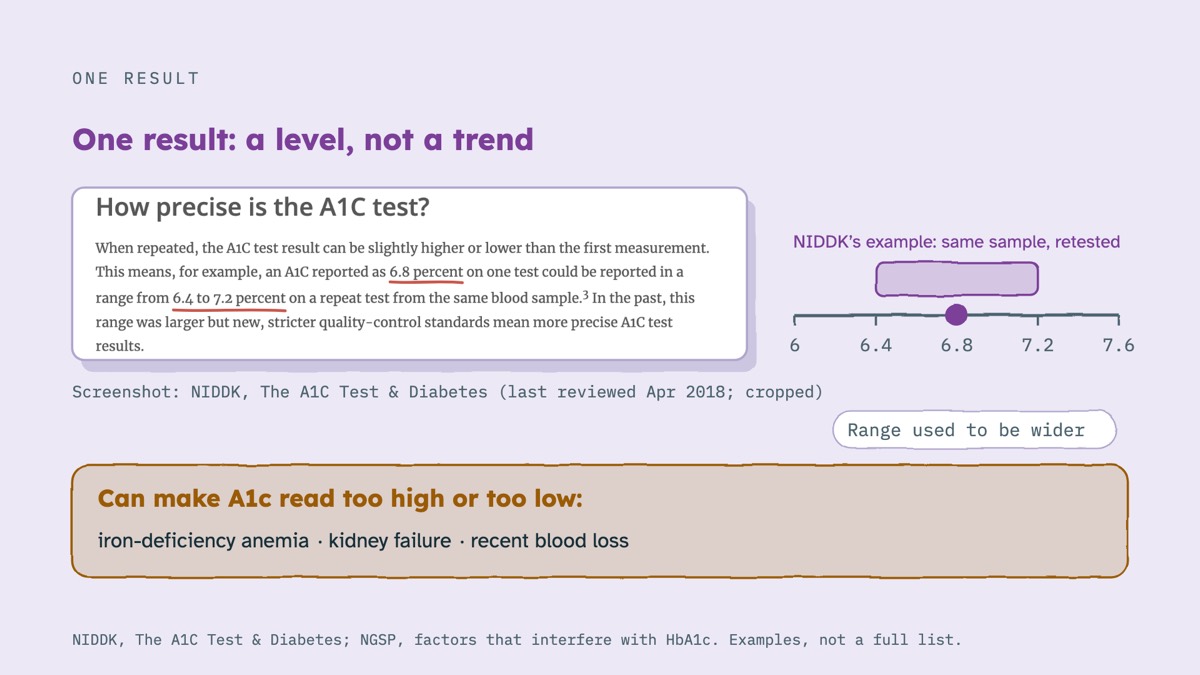
One result can't show a trend, and tests vary. A U.S. government health page happens to use 6.8 as its example: a repeat test on the same sample could read from about 6.4 to 7.2, a range it says used to be wider. And conditions like iron-deficiency anemia, kidney failure or recent blood loss can skew A1c.
And the new routine? Our listener started gym visits and evening walks three to six months ago. In trials, where people started near 7.7 on average, structured exercise, including walking programs, lowered A1c by about half a point. That's an average, not a prediction. By our arithmetic, a July test came anywhere from just before the routine to a few months in, so alone it can't show what exercise did; a later result will say more.
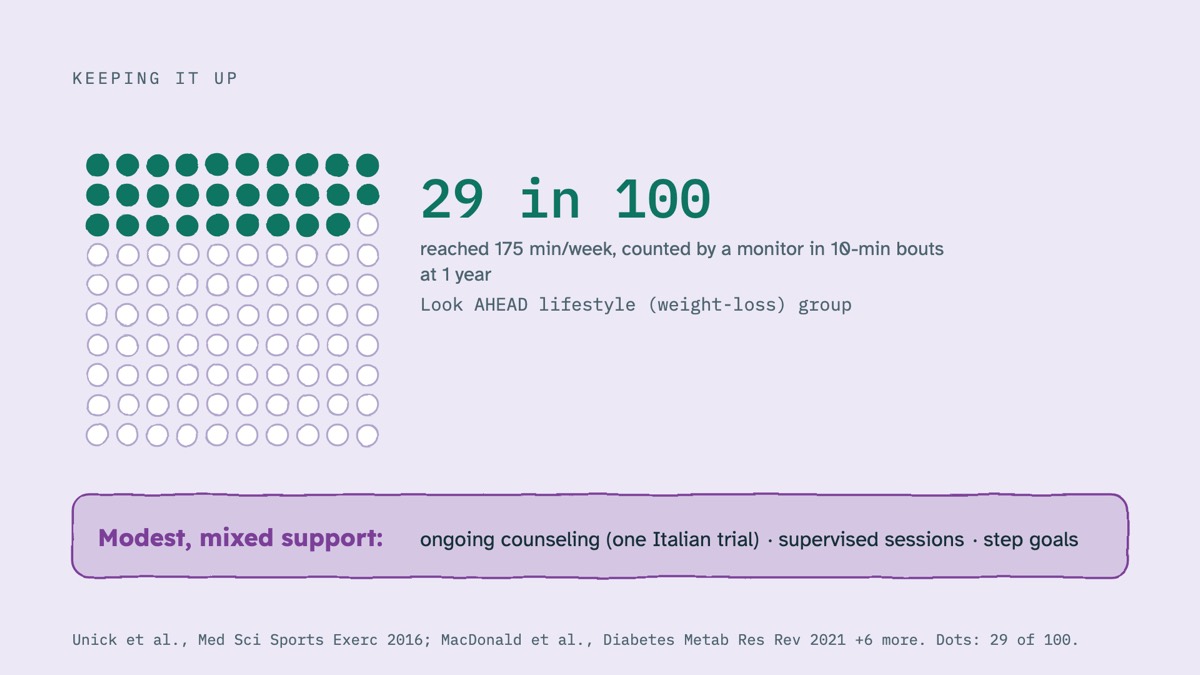
Keeping it up is the hard part. In the Look AHEAD weight-loss trial, fewer than 1 in 3 people met its strict activity goal after a year. Ongoing counseling, supervised sessions and step goals have modest, mixed support.
So 6.8 is under 7, a common general goal, but your goal is personal. Questions for your clinician: What goal fits me, and why? When should we recheck, and what change would matter? Could anything skew my result? And does my treatment carry any risk of low blood sugar, including with exercise?
Sources
31 sources cited in the video, in the order they come up.
Intro
- Qaseem 2018, Ann Intern Med: American College of Physicians guidance (7 to 8 "in most"; goals personalized "on the basis of a discussion"; funding and authors' declarations unread, no open full text)
- Kang 2025, Diabetes Metab J: Korean Diabetes Association guideline (below 6.5; funded by the KDA; authors include journal editors, declared)
- Imran 2018, Can J Diabetes: Diabetes Canada, Targets for Glycemic Control (7 or below "in most"; 2 of 4 authors report fees or grants from diabetes-drug makers): ; chapter page [link 2]
- NIDDK, The A1C Test & Diabetes (targets differ from person to person; last reviewed Apr 2018)
- NIDDK, Diabetes, Heart Disease, & Stroke (below 7 "for many"; last reviewed Apr 2021)
- Short-version footer "+2 more": "a common general goal" (under 7) also rests on Araki 2020 (Japan Diabetes Society, below) and Cheung 2009, Med J Aust: Australian Diabetes Society, a 2009 position statement (7.0 or below "for most"; old, not current Australian guidance)
What the number measures
Targets, and who sets yours
- UKPDS Group 1998, Lancet (UKPDS 33: newly diagnosed, drugs vs diet, reached about 7 vs about 8; funders not read)
- Holman 2008, NEJM (UKPDS 80: 10-year post-trial follow-up, observational; BHF, MRC, NIHR and Wellcome grants)
- Adler 2024, Lancet (UKPDS 91: about 3 fewer deaths per 100 over decades, compared with diet first; University of Oxford funding)
- ACCORD Study Group 2008, NEJM (abstract read; aiming below 6 was stopped early; 257 vs 203 deaths, about 5 vs 4 in 100 by our arithmetic; NIH and CDC funding, companies supplied drugs and equipment)
- ACCORD's "about ten years of diabetes" comes from Hemmingsen 2011, BMJ, Table 3 (mean or median; some authors had Novo Nordisk ties) and Boussageon 2011, BMJ, Table 1 (no specific funding) , not from the ACCORD abstract [link 2]
- Bonds 2010, BMJ (ACCORD: starting A1c 7.5 to 11; serious lows needing medical help 10.3% vs 3.4%; cause of the extra deaths unclear; authors include a full-time Lilly employee and others with industry ties; used here only for event counts from an NIH-funded trial)
- Paper shot, shown on screen: Metformin label (Zydus), Patient Information, DailyMed, updated 15 Jul 2026 (excerpts). Source: National Library of Medicine
- NIDDK, Low Blood Glucose (Hypoglycemia) (insulin and sulfonylurea pills; last reviewed Jul 2021)
- Araki 2020, J Diabetes Investig: Japan Diabetes Society guideline 2019 (a tighter goal only "without developing hypoglycemia"; many authors report industry fees or grants)
What ONE result can tell you
- Screenshot, shown on screen: NIDDK, The A1C Test & Diabetes, "How precise is the A1C test?" (last reviewed Apr 2018; cropped). Shown for what it said: its own 6.8 example could read 6.4 to 7.2 on a repeat test of the same sample, a range it says used to be wider
- NGSP, Factors that Interfere with HbA1c Test Results (updated Jun 2026; examples, not a full list)
- Paper shot, shown on screen: Qiu 2014, PLOS ONE (walking trials; title block and one abstract sentence; CC BY; −0.50 points pooled from 16 trials, 724 people; results varied widely; no competing interests): ; PubMed [link 2]
- Michielsen 2025, Cardiovasc Diabetol (100 trials; average start 7.7%, a mean of trial means, range 5.9 to 10.5; possible publication bias; FWO-funded, no competing interests)
- Umpierre 2011, JAMA (structured exercise programs; authors' declarations unread)
- Boulé 2001, JAMA (an older review, a similar average drop; authors' declarations unread)
- Unick 2016, Med Sci Sports Exerc (Look AHEAD: 29 in 100 in the lifestyle group reached 175 min a week, counted by a monitor in 10-min bouts, at 1 year; NIDDK-funded)
- Ryan 2003, Control Clin Trials (Look AHEAD design paper: a weight-loss trial; abstract read)
- Balducci 2019, JAMA, IDES_2: ongoing counseling kept 300 inactive adults a little more active over 3 years (one Italian trial; 3 clinics in Rome; conflicts of interest unread)
- MacDonald 2021, Diabetes Metab Res Rev (sticking with programs: median 58%, higher with supervised training; one study at low risk of bias; NIH and TrygFonden funding)
- Bullard 2019, BMC Public Health (home programs did about as well as clinic ones)
- Qiu 2014, BMC Med (step counters: more steps, mostly with a goal; A1c didn't change)
- Avery 2015, Diabet Med (supervision not linked to more activity; smaller effects with pedometers; MRC, NIHR and EU funding)
- Cradock 2017, Int J Behav Nutr Phys Act (diet-and-activity trials: the drop was largest early; Irish Research Council funding)


