
Are 1 in 8 Cancers Really Caused by Infections?
Inside this episode
The video’s narration, chapter by chapter, with stills from the video and every source at the end.
The short version
Welcome to Health Loom. Here's the short version. The headline's numbers match the study. Researchers at the World Health Organization's cancer agency estimate that about 2.3 million new cancers in 2024, around 12 percent, were put down to infections that are known causes of cancer. It's an estimate for the whole world, not anyone's personal risk. And most people who carry these infections never get cancer from them.
What the study found
The study is by researchers at IARC, the World Health Organization's cancer research agency, published online in The Lancet Oncology at the end of September 2026. It covers 2024, worldwide, all ages. Of about 19 and a half million new cancers, not counting non-melanoma skin cancer, about 2.3 million were attributable to infections. That's about 12 percent. One in eight would be 12 and a half, so "about one in eight" is a fair rounding.
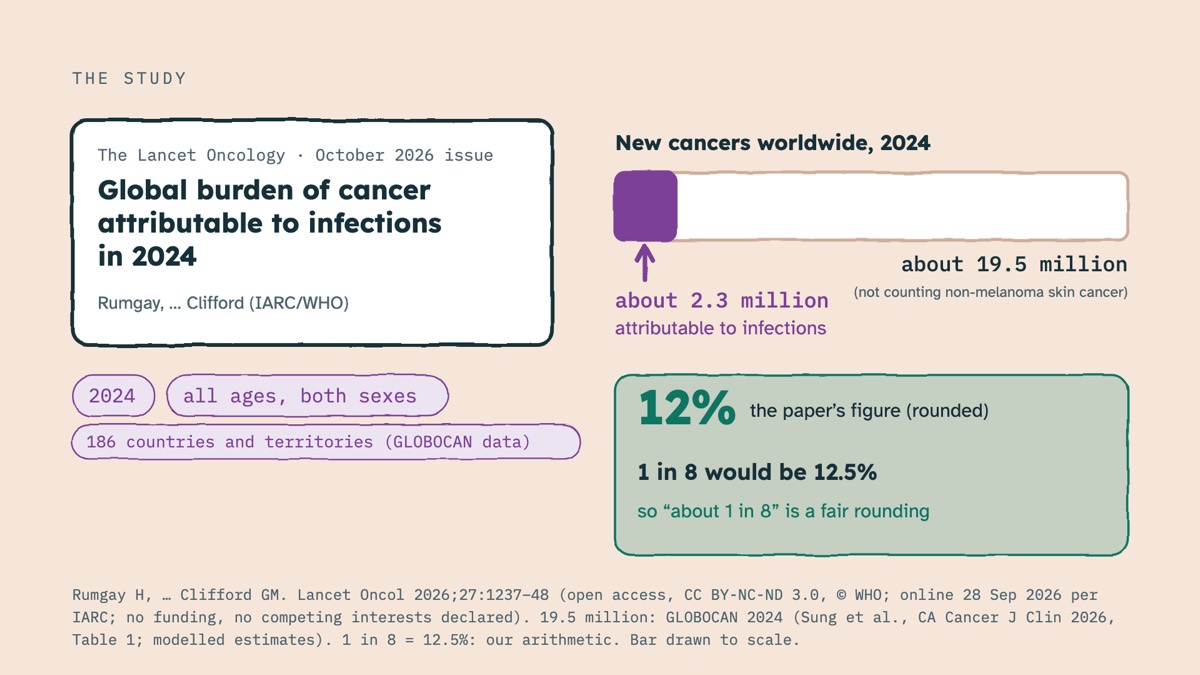
Notice the wording. IARC's headline said "linked to"; its first sentence said "caused by". The paper says "attributable to": the estimated share of cancers that wouldn't have happened without the infection. And something the reports we could read left out: there's no error range. The authors found no reliable way to calculate one, and wanted to avoid, in their words, "the impression of precision".
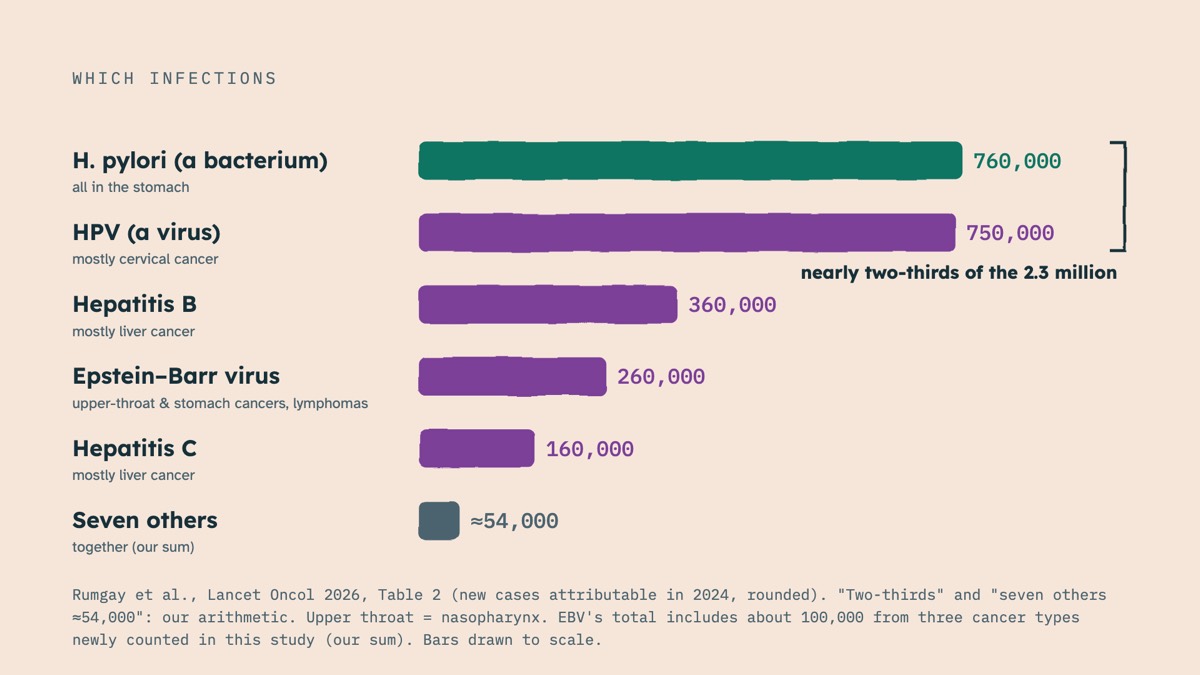
Two infections account for nearly two-thirds of the total: H. pylori, a stomach bacterium, with about 760,000 cancers, all of them in the stomach, and HPV, the human papillomavirus, with about 750,000, mostly cervical cancer. Then come hepatitis B, Epstein–Barr virus and hepatitis C.
And the burden is very uneven. In sub-Saharan Africa, about a quarter of all cancers were attributed to infections, though cancer records there are sparse; in Eastern Asia, 15 percent; in North America, about 5. So 12 percent is a world average, not a figure for any one country.
How they worked it out
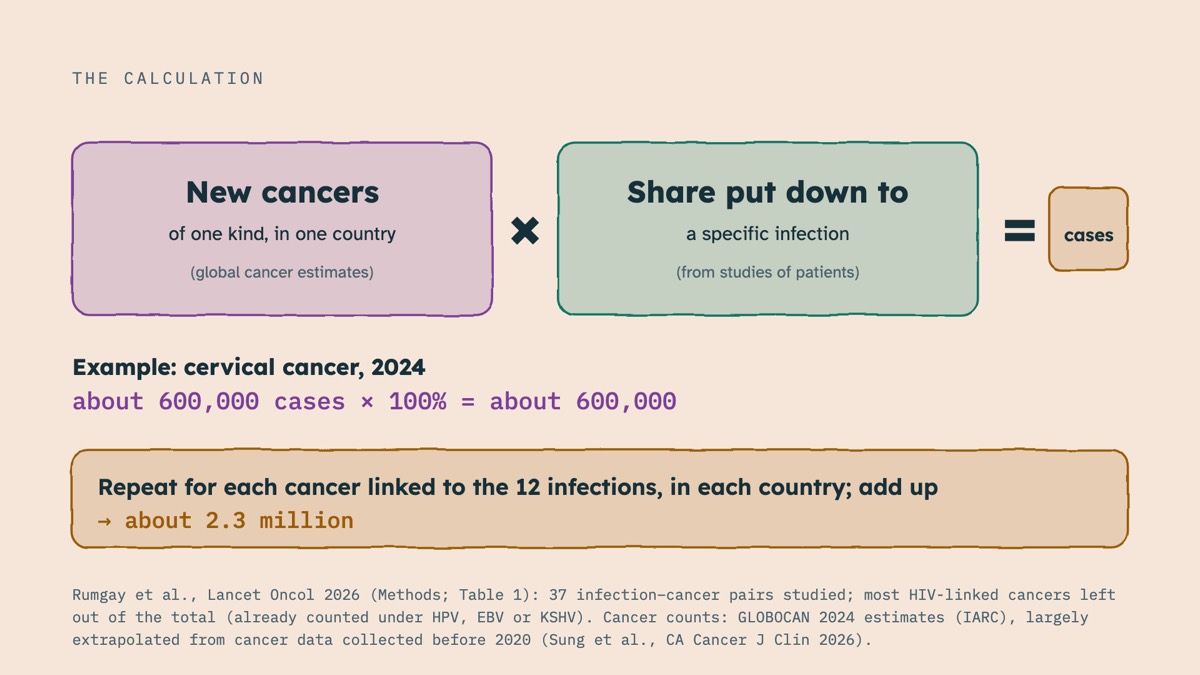
No one tested every cancer patient on Earth. Instead, the researchers combined two sets of numbers. First, how many new cancers of each kind each country had in 2024, from the agency's own global estimates. Second, for each kind, the share put down to a specific infection. Multiply, then add it all up across the 12 infections, and you get about 2.3 million.
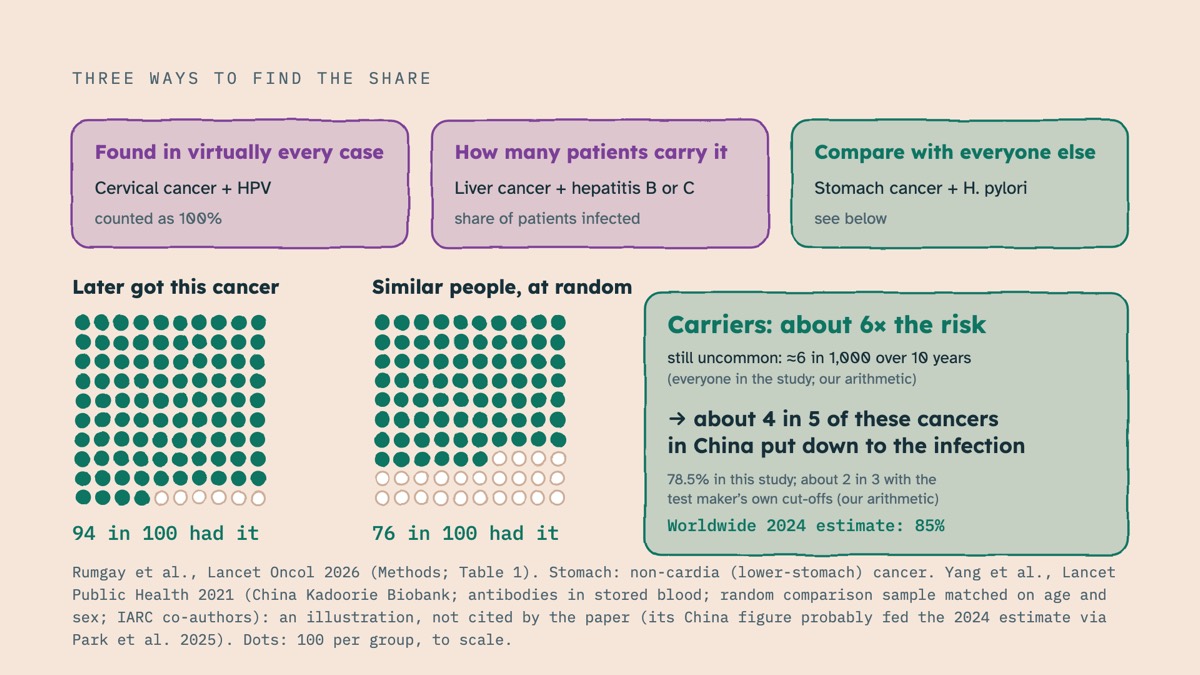
How do they get that share? It depends on how tight the link is. For cervical cancer, HPV is found in virtually every case, so all of it is counted. For liver cancer, they look at how many patients carry hepatitis B or C. And for the most common stomach cancer, they compare. In one large study in China, stored blood showed H. pylori in 94 of 100 people who later got it, versus 76 of 100 similar people picked at random. Carriers had about six times the risk, though the cancer stayed uncommon: about 6 in 1,000 people in the study over ten years. So about four in five of those cancers in China were put down to the infection; the exact share depends on the test used.
The method has limits. It assumes the infection really is a cause. It gives a share for a whole population, not anyone's personal chance. And "attributable" doesn't mean the infection acted alone: smoking, alcohol and other factors can work alongside it, which is why shares for different causes can add up to more than 100 percent.
Cause or just a link?
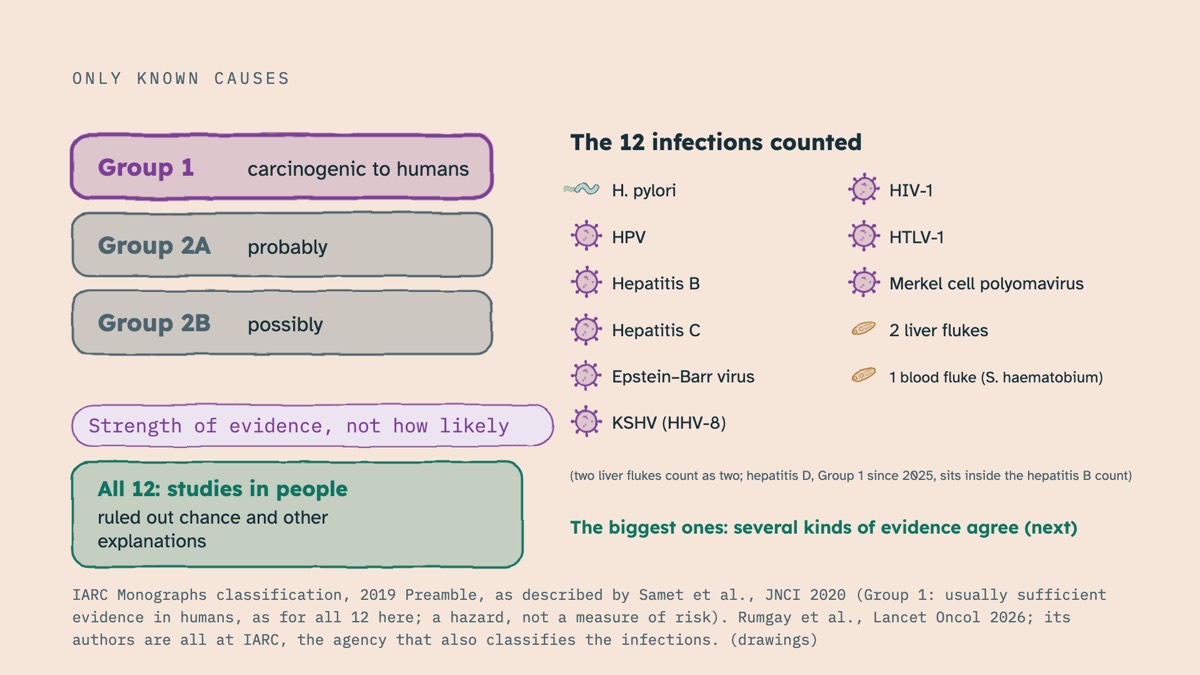
The study counted only infections that IARC puts in its top group, "carcinogenic to humans": 12 of them. That label is about how strong the evidence is that something can cause cancer, not how likely it is to. For all 12, studies in people ruled out chance and other explanations with reasonable confidence. For the biggest ones, several kinds of evidence agree.
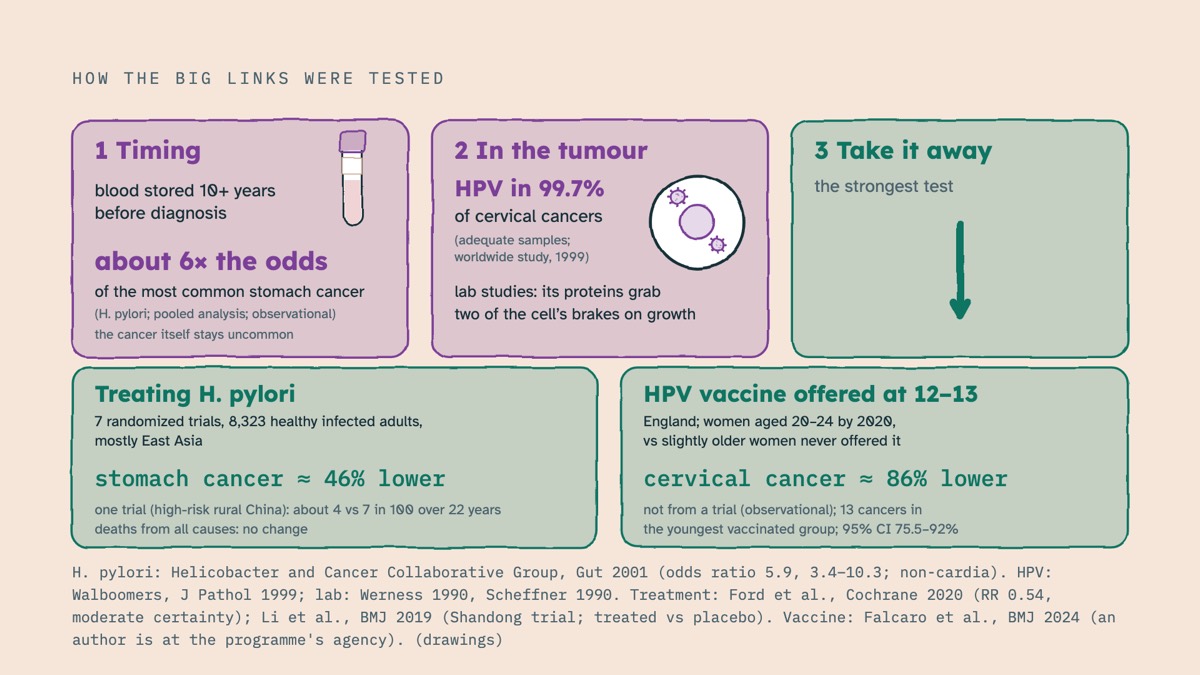
First, timing. In studies that stored blood years before anyone was diagnosed, people with H. pylori had about six times the odds of the most common kind of stomach cancer, when the blood was taken ten or more years earlier. Second, the infection is in the tumour: HPV turns up in nearly all cervical cancers, and in lab studies its proteins grab two of the cell's brakes on growth. Third, the strongest test: take the infection away. In randomized trials of healthy infected adults, mostly in East Asia, treating H. pylori cut later stomach cancer by almost half. And in England, young women offered the HPV vaccine at 12 or 13 had about 86 percent less cervical cancer than slightly older women never offered it. That one isn't from a trial, but it fits.
Infections that haven't reached IARC's top group aren't counted. Some gut bacteria, for example, turn up more often with bowel cancer, but they may show up only after a tumour starts rather than cause it. And a few links the study did count, about 5 percent of the total, rest on the authors' own reading of newer evidence. Even without them, it would still be more than one in ten.
What it means day to day
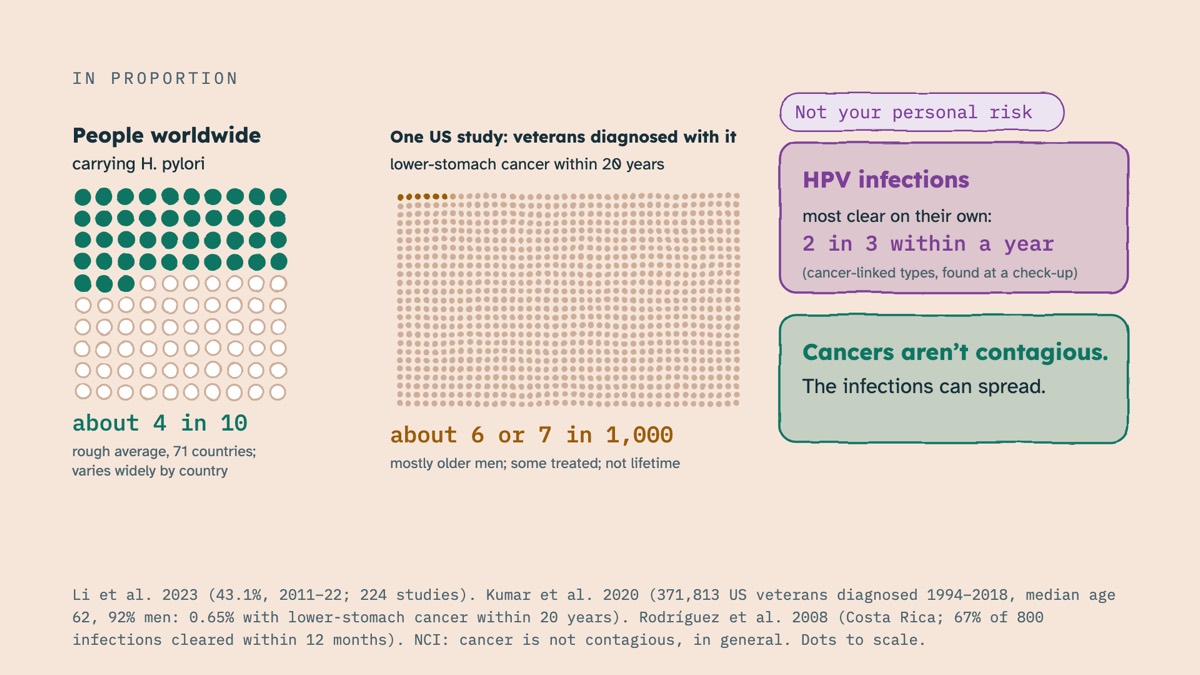
Numbers like these can feel unsettling, so first: this isn't your personal risk. These infections are common, and most people who carry them don't get cancer. About four in ten people worldwide carry H. pylori; in one large study of U.S. veterans diagnosed with it, fewer than 1 in 100 were diagnosed with stomach cancer within 20 years. Most HPV infections clear on their own, two-thirds within a year in one study. And the cancers themselves aren't contagious; it's the infections that can spread.
Second, there are real tools, and they work at different steps. Vaccines against HPV and hepatitis B, the infections behind about half of these cancers, prevent infection; they don't clear one someone already has, and the payoff builds over decades. Screening, like cervical screening, can find changes before they become cancer. And tests can find hepatitis B and C, HIV and H. pylori, which can be treated or controlled; studies show that lowers cancer risk, though it doesn't erase it. In the U.S., CDC's published guidance, from 2020 and 2023, calls for testing all adults for hepatitis B and C at least once.
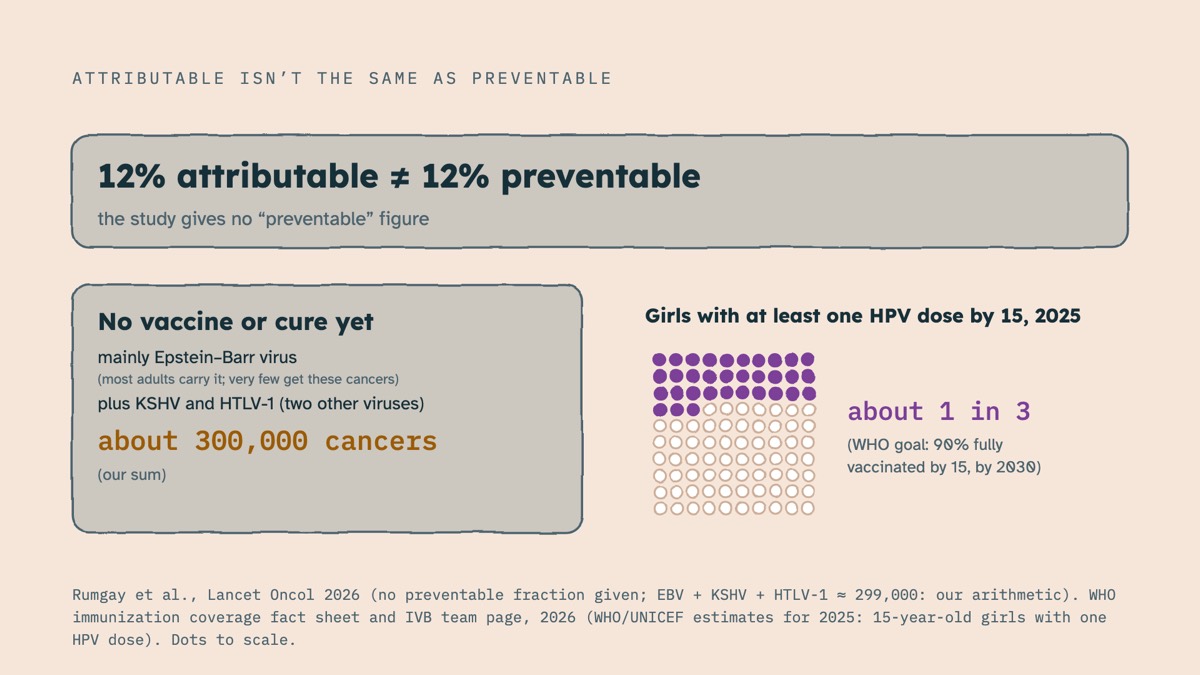
Third, keep it in proportion. The study doesn't say 12 percent of cancers could be prevented. About 300,000 of these cancers come from infections with no vaccine or cure yet, and in 2025, only about a third of girls worldwide had had even one HPV dose by age 15.
So the headline holds up, with fine print. About one in eight new cancers worldwide is estimated to be due to a dozen infections known to cause cancer, mostly in Asia. It's a population estimate, not your risk. For what applies to you, a clinician can say which vaccines, screenings or tests fit your age and history.
Sources
6 sources cited in the video, in the order they come up.


