Family History, Negative Gene Test: When to Screen?
Inside this episode
The video’s narration, chapter by chapter, with stills from the video and every source at the end.
The short version
One grandmother is a real but small signal: about 1.2 to 1.5 times the risk of someone with no family history. Not double. For most people with that history, guidelines say mammograms from 40, every year or two. An MRI usually needs a calculated lifetime risk of about 20 percent, which one grandmother rarely reaches. What guidelines point to next is a formal risk assessment, with a model that actually counts grandmothers.
What one grandmother adds
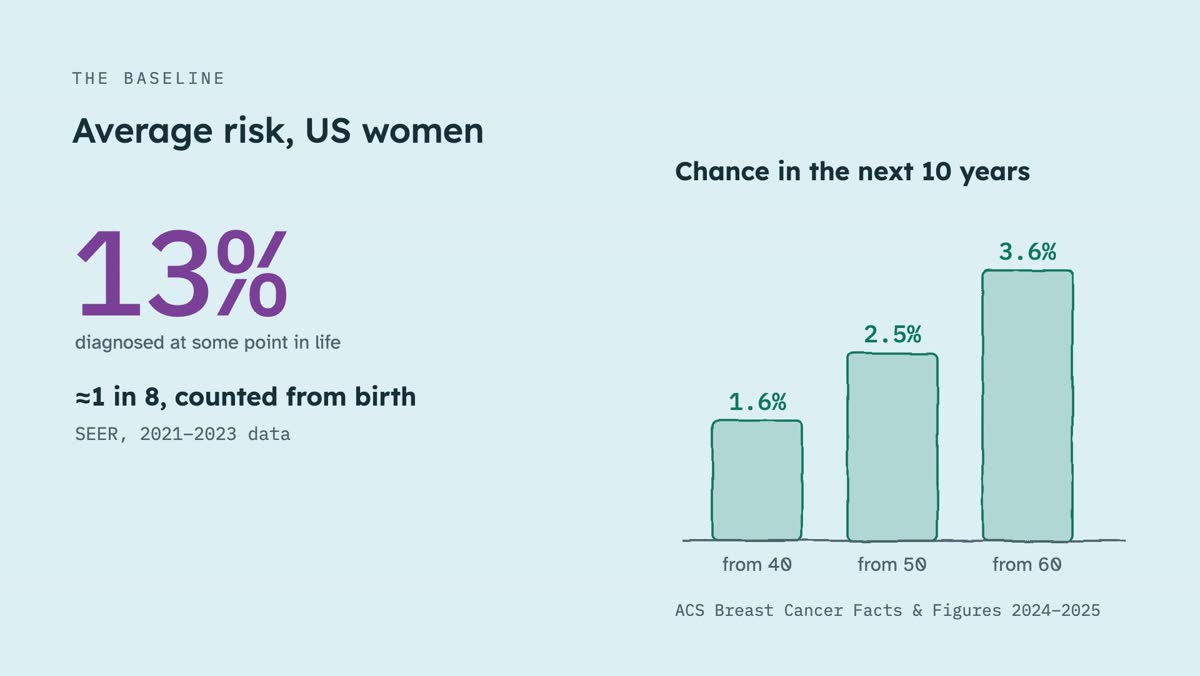
Start with the baseline. About 13 percent of U.S. women are diagnosed with breast cancer in their lifetime, roughly 1 in 8, counted from birth. Any ten-year stretch is much smaller: about 1.6 percent from age 40, 2.5 from 50, and 3.6 from 60.
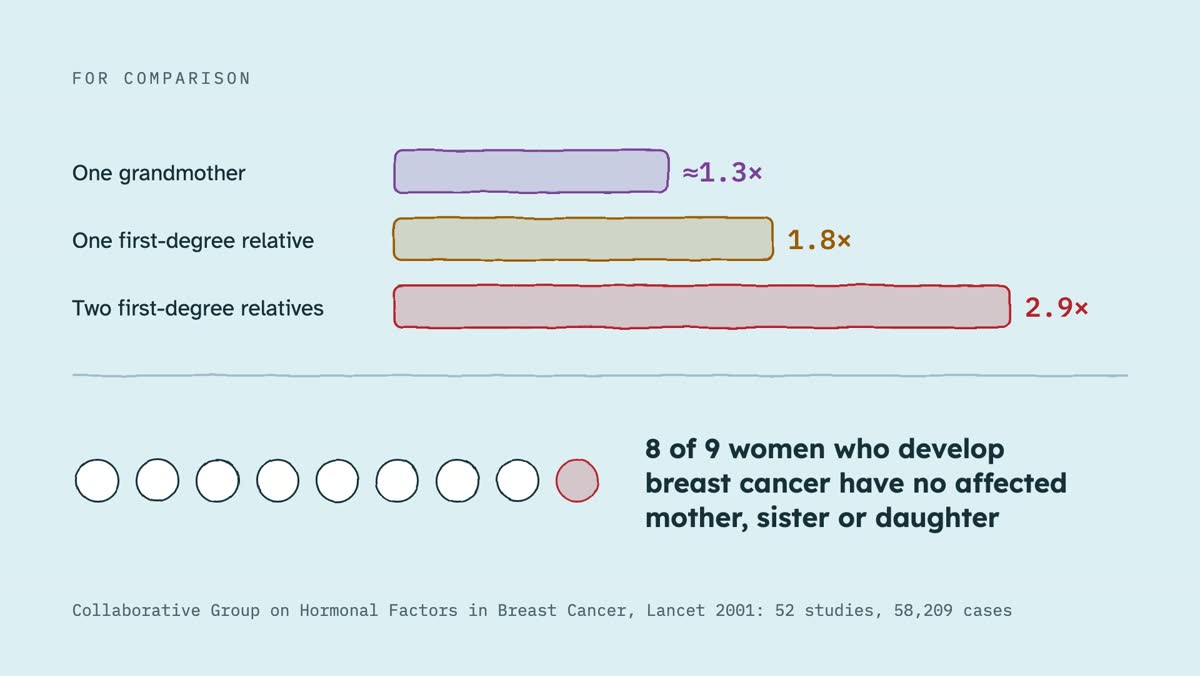
Family history works like a multiplier on that. A 1997 analysis pooling 74 studies put one affected second-degree relative, like a grandmother or an aunt, at 1.5 times the risk. But studies that follow women forward find less, so treat that as the high end. In a U.S. cohort of about 75,000 women, one affected grandmother meant about 1.3 times the risk.
For comparison, one affected mother, sister or daughter means about 1.8 times the risk, and two, about 2.9. And the flip side: eight of every nine women who develop breast cancer have no affected mother, sister or daughter.
Her age at diagnosis matters. In that U.S. cohort, a grandmother diagnosed before 50 meant about 1.5 times the risk. Diagnosed only at 50 or older, about 1.25, and that wasn't statistically clear. Which side she's on seems to matter less: in a preprint of a large genealogy study, a mother's mother and a father's mother looked about the same.
So what makes one grandmother a bigger deal? U.K. guidance lists red flags, including cancer in both breasts, breast cancer in a man, ovarian cancer, Jewish ancestry, or a relative diagnosed at 40 or younger. Without any of those, one grandmother diagnosed after 40 counts, in most cases, as near-average risk, handled in primary care.
The negative test
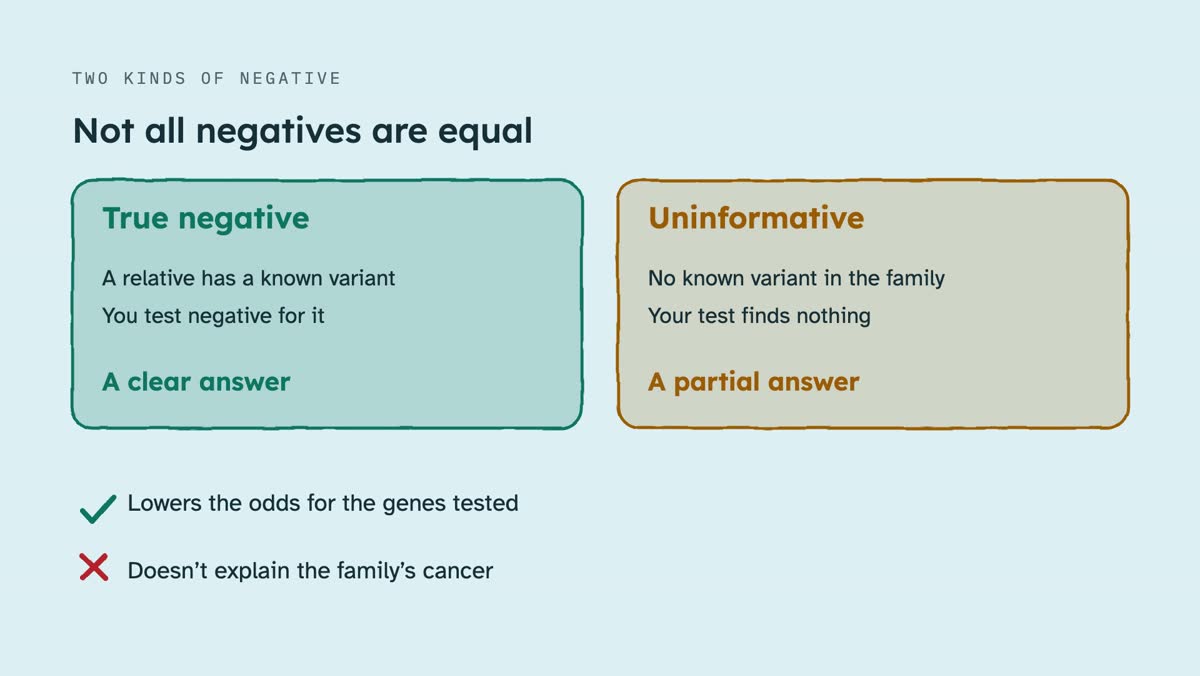
There are two kinds of negative. If a relative has a known harmful variant, and you test negative for it, that's a true negative. If no one in the family has a known variant, and your test finds nothing, it's uninformative. It makes a harmful change in the tested genes less likely, but it doesn't explain the family's cancer.
It shows in the numbers. In a 2026 Ontario study, true negatives had about a 13 percent chance of breast cancer by age 80, close to the general population's 12. After an uninformative negative, it was about 26 percent. Those were high-risk families, so that number doesn't apply here. But a negative test doesn't erase a family history.
Which kind did our listener get? If no relative was ever found to carry a variant, it's the uninformative kind. That's not bad news. It just means the family history still belongs in the risk estimate.
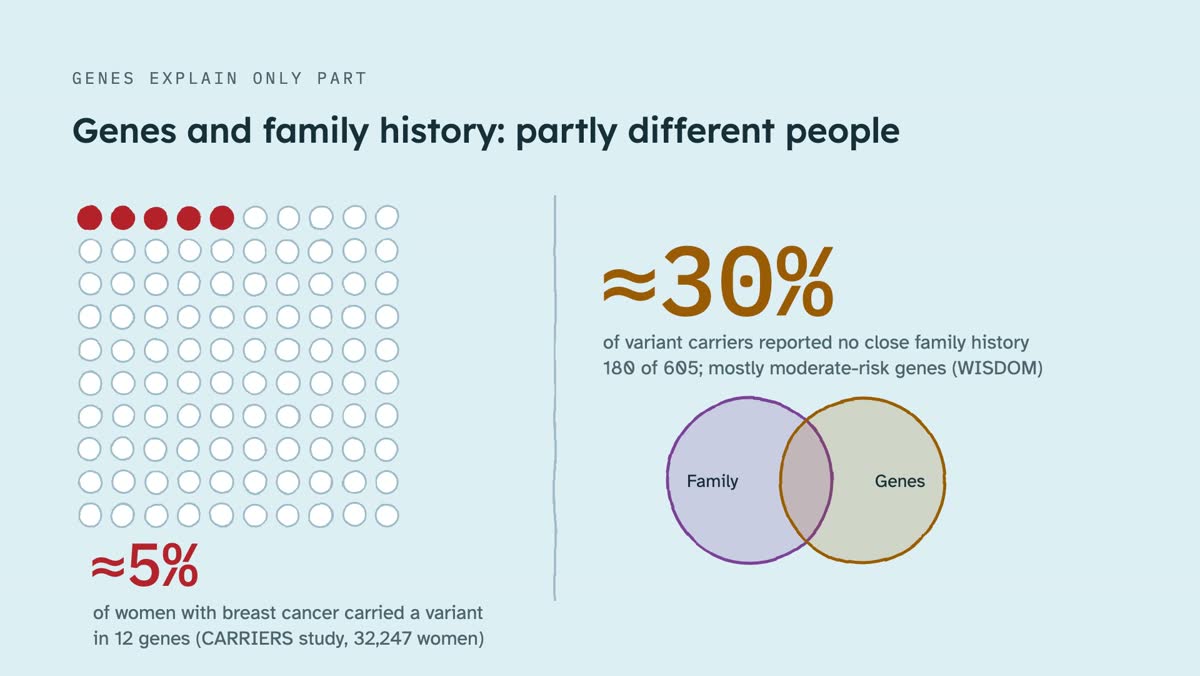
Why doesn't a clean result settle it? Known genes explain only part of family risk. In a large U.S. study, only about 5 percent of women with breast cancer carried a harmful variant in 12 key genes. And it cuts both ways. In the WISDOM trial, about 30 percent of variant carriers reported no close family history.
It also matters which test it was. The FDA-cleared 23andMe report checks 44 BRCA variants, and its labeling says a negative doesn't rule out others. By the company's own estimate, that covers only about 30 to 40 percent of BRCA variants in people of European, African American or Hispanic ancestry. And it skips other genes, like PALB2, CHEK2 and ATM.
Here's a twist. Clinicians use short questionnaires, listed by the U.S. Preventive Services Task Force, to decide who gets genetic counseling. We scored one grandmother on them. Diagnosed at 50 or older, in one breast, every tool we scored is negative. Diagnosed earlier, or in both breasts, one or two flip. So for many families like this, a negative test is just what you'd expect.
When to start mammograms
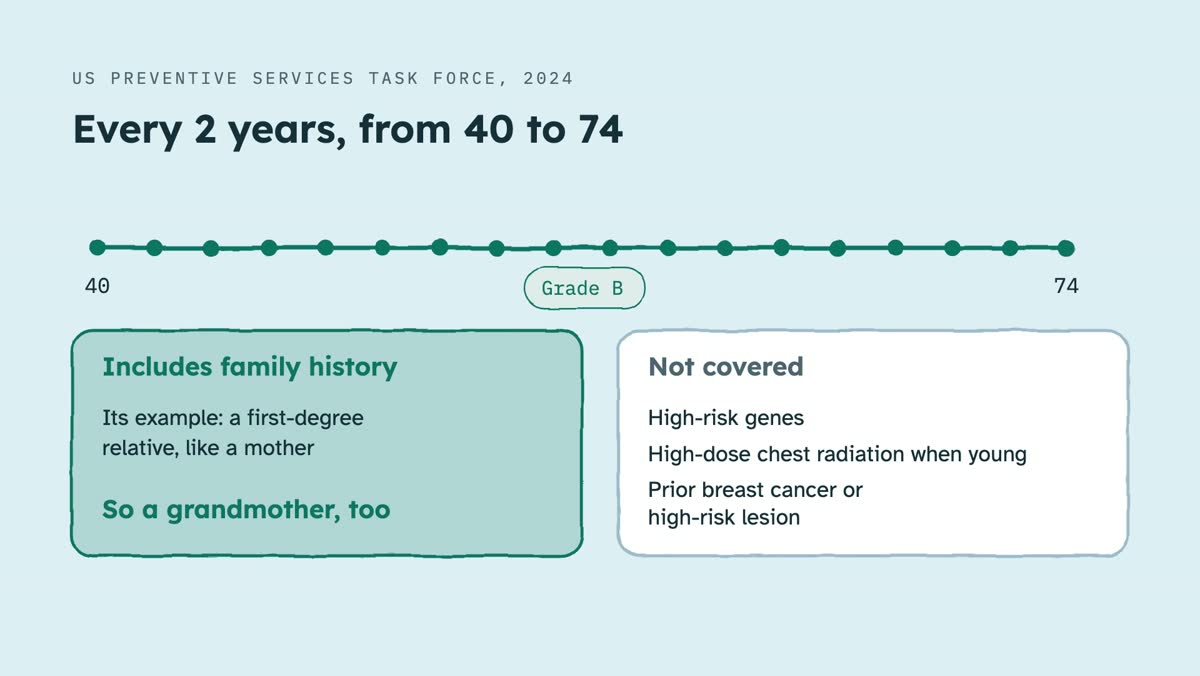
In 2024, the Task Force recommended a mammogram every two years from 40 to 74, and it explicitly includes people with a family history. Its example is a first-degree relative, like a mother. The exceptions are high-risk genes, high-dose chest radiation when young, or a prior breast cancer or high-risk lesion. If a mother doesn't take you out of that group, a grandmother doesn't either.
Most other U.S. groups also start around 40, and split on how often. Radiologists say every year. The obstetricians' college says every one or two years. The American Cancer Society makes 40 to 44 optional, and recommends yearly from 45. And in 2026, the American College of Physicians said to discuss it in your 40s, then every two years if you choose.
Why the split? In your 40s, the benefit is small and the trial evidence is soft. Pooled trials found about 3 fewer breast cancer deaths per 10,000 women over ten years, a result that wasn't statistically significant. The Task Force's 2024 report had misprinted it, and JAMA corrected that in 2026. A British trial that started at 40 saw 25 percent fewer breast cancer deaths in the first ten years, but over 23 years, the difference was no longer statistically clear.
So the Task Force leaned on computer models. Screening every two years from 40 instead of 50 would prevent about 1.3 more breast cancer deaths per 1,000 women over a lifetime, at the cost of about 500 more false-positive recalls, 65 more benign biopsies, and 2 more cancers that would never have caused harm. For Black women, who are about 40 percent more likely than White women to die of breast cancer, the gain was 1.8.
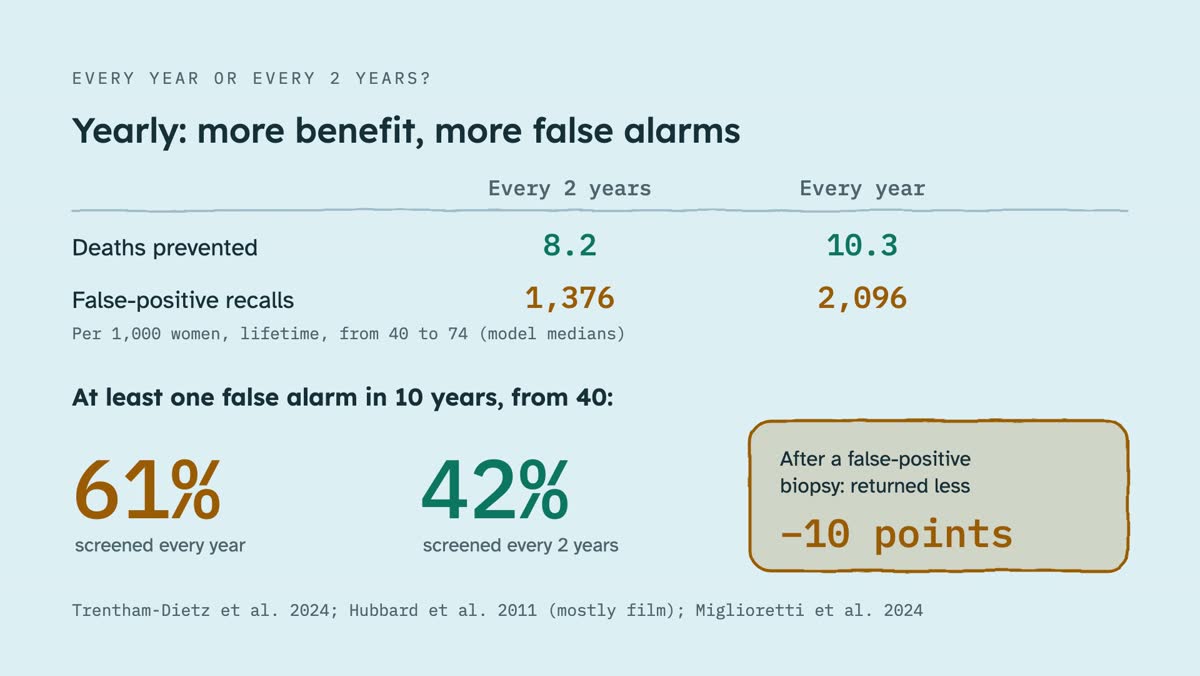
Yearly screening adds both. In the same models, it prevented about 10 deaths per 1,000 instead of 8, with about 2,100 false-positive recalls instead of 1,400. Over ten years from 40, about 61 percent of women screened yearly had at least one false alarm, versus 42 percent every two years. And after a false alarm that led to a biopsy, women were 10 points less likely to come back than after a normal result.
Does one grandmother justify yearly screening? A 2012 modeling study, weighing false alarms against life-years gained, put the threshold for yearly screening in your 40s at about 4.3 times average risk, and for every two years, about 1.9. One grandmother, at 1.2 to 1.5, is below both. But since 2024, the Task Force starts everyone at 40 anyway, so the real choice is yearly or every two years, a values call to make with a clinician.
What if the listener is under 40? No guideline we reviewed recommends routine mammograms before 40 at this level of risk. Radiologists recommend a formal risk assessment for every woman by 25. Even for high-risk women, the 2023 summary from the NCCN, a cancer centers network, starts ten years before the youngest relative's diagnosis, but not before 30, or at 40, whichever comes first. So a grandmother diagnosed at 55 points to 40.
From 50, every guideline we reviewed supports screening, every one to three years, and the trials are stronger: about 8 fewer breast cancer deaths per 10,000 women over ten years in their 50s, and 21 in their 60s. Here, the grandmother mostly feeds the risk estimate. After 75, guidelines differ.
Who gets an MRI?
For family history, U.S. guidelines that cover MRI tie it to a calculated risk, or to known high-risk groups, like gene carriers. The American Cancer Society's rule: a yearly MRI at a lifetime risk of about 20 to 25 percent or more, on models built mainly on family history. Between 15 and 20, not enough evidence. Below 15, it recommends against.
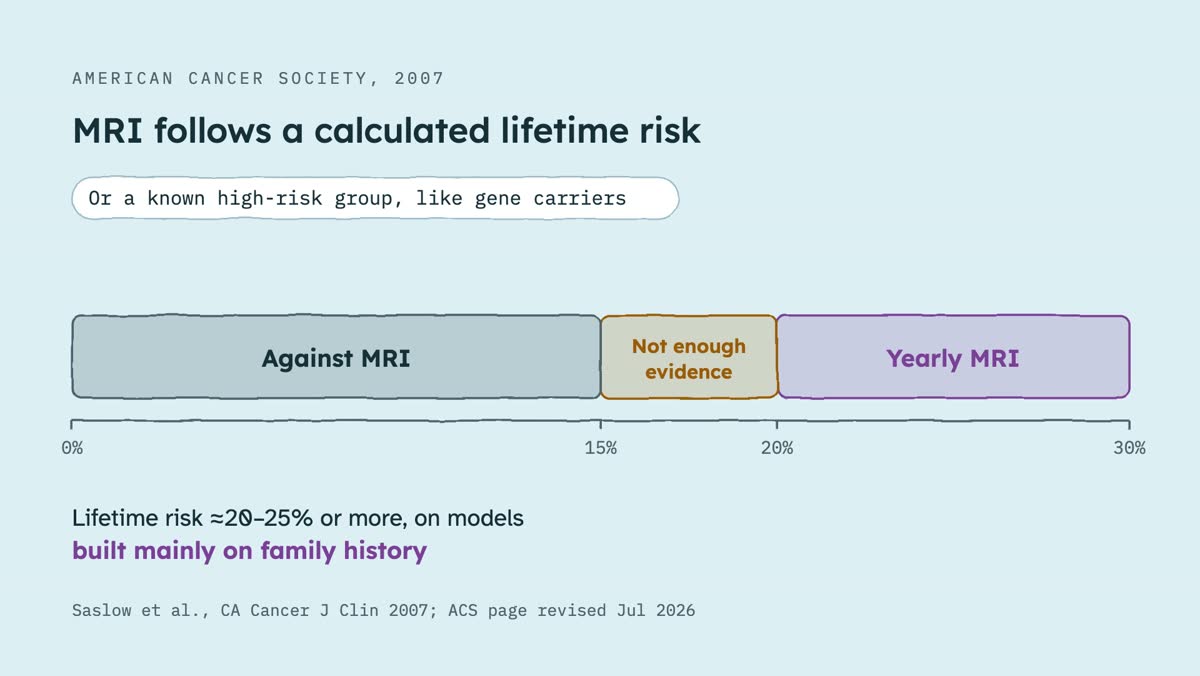
Radiologists use similar lines. Above 20 percent: MRI, usually from 25 to 30. Between 15 and 20, intermediate risk: yearly mammograms by 40, and MRI only "may be appropriate." And U.K. guidance doesn't offer MRI at moderate risk at all.
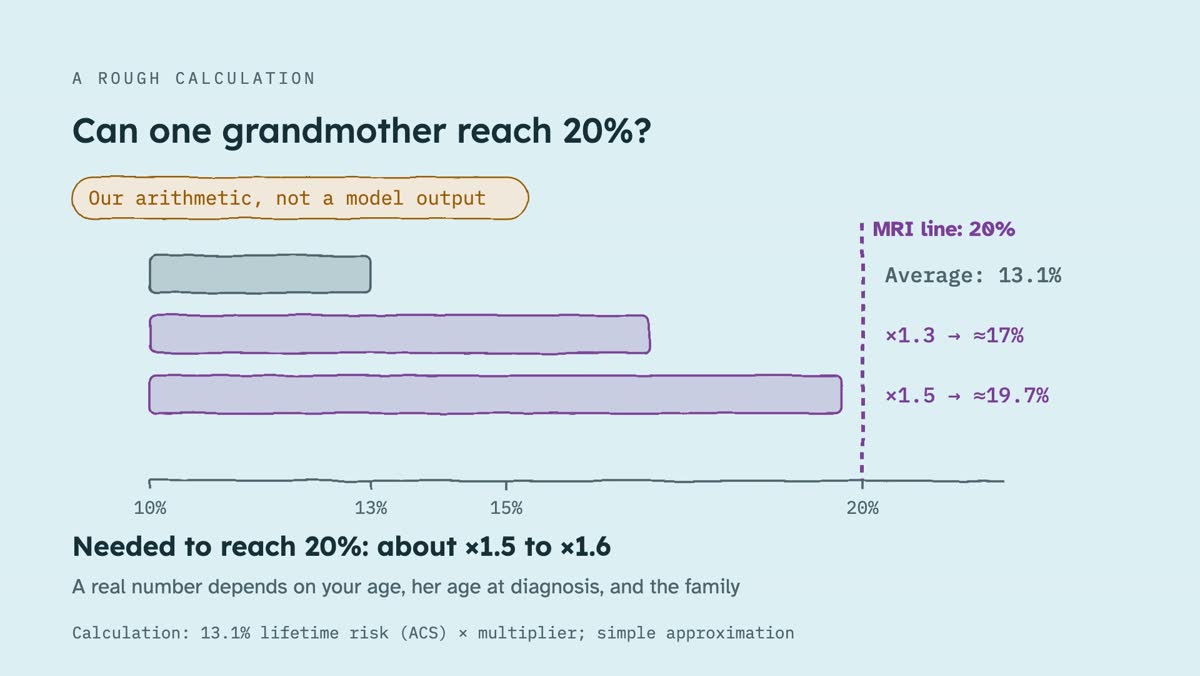
Can one grandmother reach 20 percent? We found no published number from today's main models for that exact family, so here's our own rough arithmetic. From an average lifetime risk of about 13 percent, you'd need about 1.5 to 1.6 times the risk to reach 20. Every estimate for one second-degree relative falls below that. A real number depends on your age, her age at diagnosis, and the rest of the family.
And MRI finds less as risk drops. At one U.S. center, in women already getting MRI because of family history, it found about 8 cancers per 1,000 exams, and only 14 percent of its biopsies found cancer. In gene carriers or after chest radiation, it was 26 per 1,000, and 41 percent.
MRI also means more false alarms, especially the first time. In a Dutch trial in women with extremely dense breasts, the first round had about 80 false positives per 1,000 screens, and the second about 26. It uses a contrast dye, gadolinium, which the label says can stay in the body for months to years. And no trial yet shows that adding MRI reduces breast cancer deaths.
Dense breasts
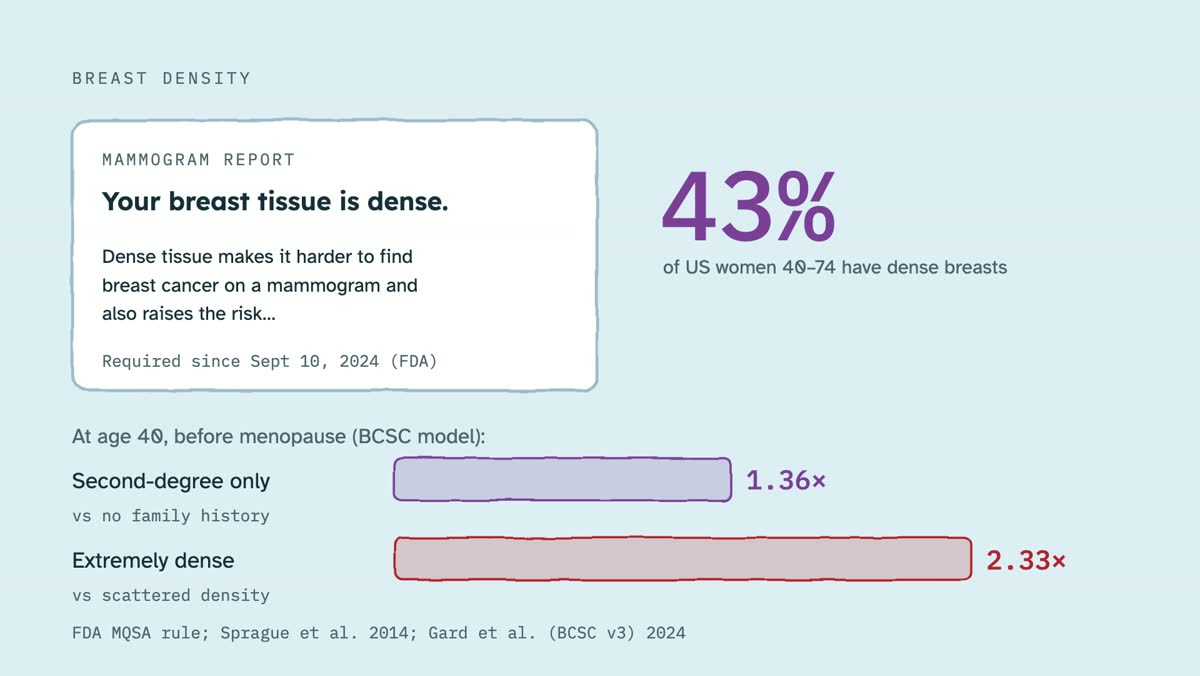
Since September 2024, U.S. mammogram reports must say whether breast tissue is dense. Dense tissue makes cancer harder to find, and raises risk. It's common, about 43 percent of women 40 to 74, and it can matter more than a grandmother. Extremely dense breasts at 40, before menopause, carried about 2.3 times the risk of scattered density, and less later.
The best evidence for extra imaging comes from density, not family history. In the DENSE trial, offering MRI to women with extremely dense breasts halved the cancers found between screenings, from 5.0 to 2.5 per 1,000. In a separate study, abbreviated MRI found 11.8 invasive cancers per 1,000, versus 4.8 for 3D mammography. But no study has shown fewer breast cancer deaths yet.
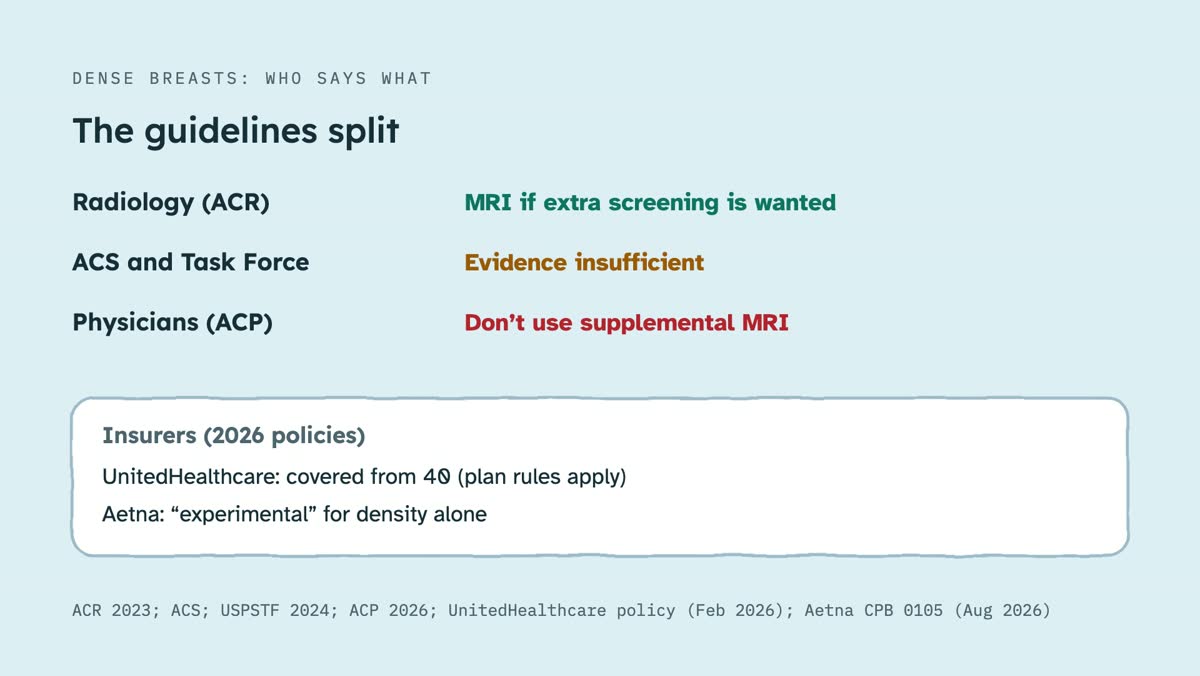
So the guidelines split. Radiologists recommend MRI for dense breasts if you want extra screening. The Cancer Society and the Task Force call the evidence insufficient, and the physicians' college says not to use it. Insurers split, too. In 2026, one major insurer's policy covers it from 40, depending on the plan, and another calls it experimental.
For someone in their 40s, that makes the first mammogram double as a risk test. Its density category feeds straight into the risk models that use it.
Which model counts?
The widely used National Cancer Institute calculator, based on the Gail model, asks only about mother, sisters and daughters. A grandmother-only history goes in as no family history at all. The obstetricians' college notes it's of limited use for second-degree relatives.
Other models see more. The BCSC model asks a yes-or-no question about an aunt or grandmother. Tyrer-Cuzick, also called IBIS, and CanRisk use the whole family tree, on both sides, with ages at diagnosis, and they can add breast density. Those two can actually weigh this grandmother.
Even good models drift. A 2026 Cochrane review found that, in women with a family history, Tyrer-Cuzick tended to over-predict: about 14 percent fewer cancers happened than it forecast. BOADICEA, the model behind CanRisk, was close, though the studies pooled older versions. So a Tyrer-Cuzick result just over 20 percent deserves a second look.
So the same family can come out as no family history on one tool, a yes-or-no flag on another, and a weighted family tree on a third. The most useful question to ask is: which model are you using, and which relatives does it count?
Before you go
If you're in a similar spot, here's what to bring to a risk assessment. Your grandmother's age at diagnosis, not at death, and whether it was one breast or both. Every relative on both sides with any cancer, with the type and age. Your ancestry, especially Ashkenazi Jewish. The full genetic test report. Any breast biopsy results. And your latest mammogram report, with its density.
And questions to ask. One: which model, and does it count my grandmother and my father's side? Two: is that a ten-year or a lifetime number? Three: how did it handle my negative test? Four: does it include my breast density? Five: would a different model put me over 20 percent?
This usually starts with primary care or a gynecologist, then a high-risk clinic or a genetic counselor if needed. In a randomized trial, counseling by phone held up against in-person visits on knowledge and satisfaction. And under federal guidance, private plans that aren't grandfathered must cover genetic counseling without cost sharing when a screening questionnaire flags higher risk, or a clinician judges it appropriate. With a grandmother-only history, that isn't guaranteed, so it's worth asking.
A risk estimate can open other doors. The Task Force recommends offering risk-reducing medicines, like tamoxifen, to women at increased risk and low risk of side effects, with no single cutoff. A grandmother alone is unlikely to qualify. And one thing anyone can change: each 10 grams of alcohol a day, less than one drink, is linked to about 5 to 9 percent higher risk.
So here's how guidelines line up for a history like this, with no red flags. Under 40: a formal risk assessment, with mammograms usually from 40. From 40 to 74: mammograms every year or two, a choice to make with your clinician. And MRI only if a family-history model reaches about 20 percent, or in a separate, still-debated conversation about dense breasts.
Sources
53 sources cited in the video, in the order they come up.
What one grandmother adds
- SEER Cancer Stat Facts, female breast cancer
- American Cancer Society, Breast Cancer Facts & Figures 2024-2025
- Pharoah et al. 1997 (meta-analysis)
- Welsh et al. 2009 (US health-plan cohort)
- Collaborative Group on Hormonal Factors in Breast Cancer, Lancet 2001
- Albright et al. 2019 (Utah genealogy study)
- Albright et al. preprint (maternal vs paternal tables)
- NICE CG164, familial breast cancer
The negative test
- Dossa et al. 2026 (Ontario cohort)
- Hu et al., CARRIERS, NEJM 2021
- Fergus et al. 2026 (WISDOM carriers without family history)
- FDA De Novo DEN170046 (23andMe BRCA, 2018)
- FDA 510(k) K223597 (23andMe BRCA, 44 variants, 2023)
- USPSTF 2019, BRCA-related cancer risk assessment
When to start mammograms
- USPSTF 2024, breast cancer screening
- ACR/SBI 2021 (average risk)
- ACOG Clinical Practice Update 2024
- American Cancer Society 2015 guideline
- American Cancer Society recommendations page (revised Jul 2026)
- American College of Physicians 2026
- Nelson et al. 2016 (screening trials meta-analysis)
- JAMA correction to the USPSTF statement, 2026
- Duffy et al. 2020 (UK Age trial)
- Trentham-Dietz et al. 2024 (CISNET models)
- Hubbard et al. 2011 (false positives over 10 years)
- Miglioretti et al. 2024 (returning after a false positive)
- van Ravesteyn et al. 2012 (risk thresholds for screening at 40)
- ACR 2023 (higher-than-average risk)
- NCCN Guidelines Insights 2023
Who gets an MRI?
- Saslow et al. 2007 (ACS MRI guideline)
- ACR Appropriateness Criteria, female breast cancer screening (2025)
- Sippo et al. 2019 (MRI by risk group)
- Bakker et al. 2019 (DENSE trial)
- Veenhuizen et al. 2021 (DENSE second round)
- Gadolinium contrast label (gadoterate, DailyMed)
DENSE breasts
- FDA mammography rule (density notice)
- Sprague et al. 2014 (how common dense breasts are)
- Gard et al. 2024 (BCSC model v3)
- Comstock et al. 2020 (abbreviated MRI vs 3D mammography)
- UnitedHealthcare breast imaging policy (Feb 2026)
- Aetna Clinical Policy Bulletin 0105
Which model counts?
- NCI Breast Cancer Risk Assessment Tool (Gail)
- ACOG Practice Bulletin 179
- BCSC risk calculator v3
- IBIS (Tyrer-Cuzick) risk evaluator
- CanRisk
- McGarrigle et al., Cochrane 2026
Before you go
- Schwartz et al. 2014 (phone vs in-person genetic counseling)
- US Department of Labor, ACA FAQs Part XII
- US Department of Labor, ACA FAQs Part XXIX (screening-tool result and no-cost counseling)
- USPSTF 2019, medications to reduce breast cancer risk
- Nelson et al. 2019 (evidence review for that recommendation)
- WCRF/AICR 2017 breast cancer report (alcohol)


