
Do You Really Need 10,000 Steps a Day?
Inside this episode
The video’s narration, chapter by chapter, with stills from the video and every source at the end.
Before anything else. An earlier all-clear doesn't cover new symptoms. Chest pain that's new, or changes in pattern, intensity or how long it lasts, means calling 911. And during exercise, chest discomfort, unusual breathlessness, fainting, or a racing or irregular heartbeat mean stop right away and get checked.
The short version
Ten thousand steps most likely began as a 1960s walking slogan and pedometer, not a health finding. At about 9,000 steps plus his workouts, he's already where most of the research curves flatten. Guidelines count minutes and strength days, not steps, and he plausibly meets both. The bigger open question for his heart is cholesterol, and that's a conversation about risk, not more steps.
Where 10,000 came from
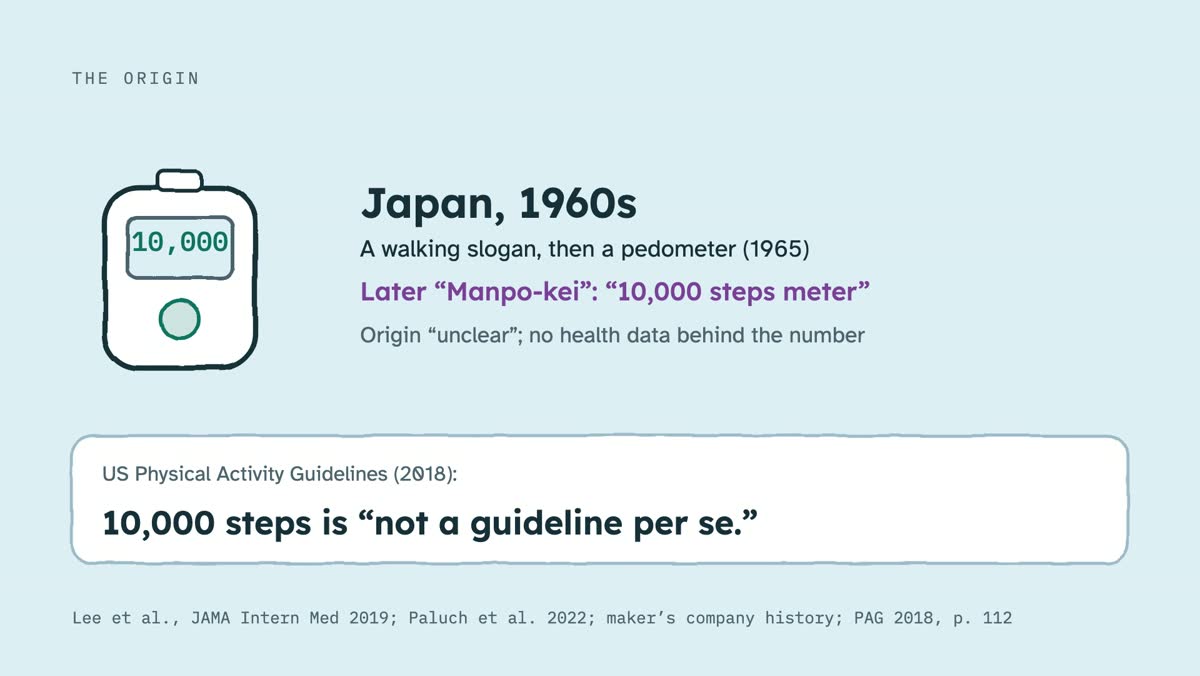
The most likely origin is Japan in the 1960s: a 10,000-steps-a-day walking slogan, and a pedometer built for it, first sold in 1965. It was later called Manpo-kei, which means "10,000 steps meter." Researchers still call the origin unclear, and no one has found health data behind the number. And the U.S. activity guidelines say that 10,000 steps is "not a guideline per se."
So what do the data show? A major analysis that re-crunched the raw data on about 47,000 adults found the risk of dying fell steeply at first, then leveled off: at about 6,000 to 8,000 steps a day for people 60 and older, and about 8,000 to 10,000 for people under 60. The top step group had about half the death rate of the bottom.
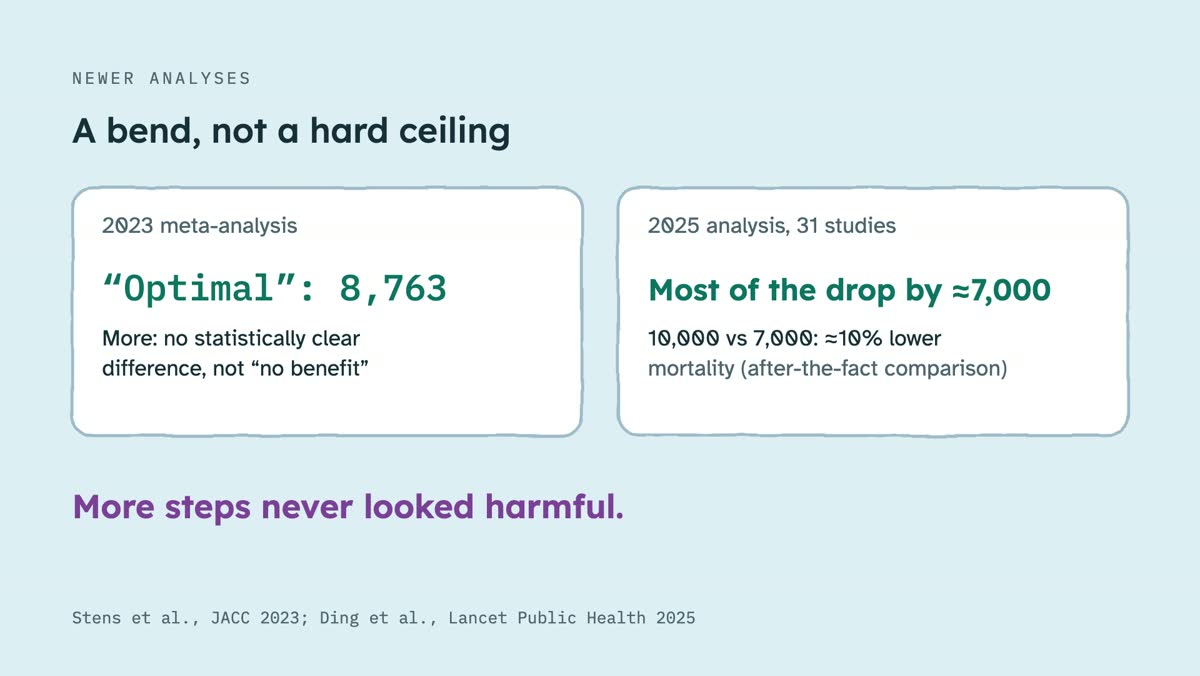
Newer analyses agree on the bend, but not on a hard ceiling. A 2023 meta-analysis called 8,763 steps "optimal," meaning more didn't make a statistically clear difference, not that benefit stopped. And a 2025 analysis of 31 studies found most of the drop by about 7,000 steps. In an after-the-fact comparison, 10,000 was linked to about 10 percent lower mortality than 7,000. More steps never looked harmful.
What about people around 40? The data are thin. In a U.S. study of adults aged 38 to 50, people taking 7,000 or more steps had much lower death rates than those under 7,000, with no further drop above 10,000. But that study counted only 72 deaths. And we found no step study of men his age with high cholesterol or sleep apnea.
Two caveats. Every one of these studies is observational: people who are already sick walk less, which can make steps look better than they are. And trackers are imprecise. In everyday use, only about 4 in 10 device tests landed within 10 percent of the true count. Even at that accuracy, by our math, a reading of 9,000 could mean anywhere from about 8,200 to 10,000 real steps. A wrist tracker can't really tell 9,000 from 10,000.
Steps and the heart
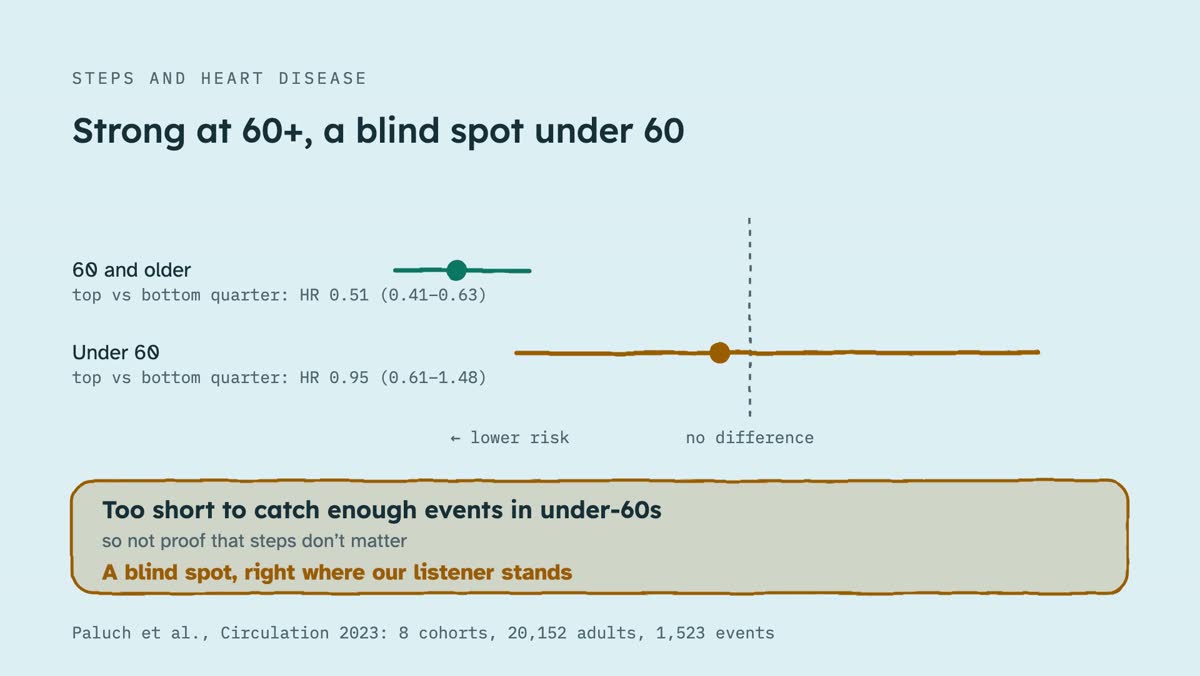
For heart attacks, strokes and heart failure, a major analysis that re-crunched raw data from eight cohorts found a strong link in people 60 and older: the top step group had about half the risk. But in people under 60, there was no clear link at all. The authors suggest the study was too short to catch enough heart events in younger people, so it's not proof that steps don't matter. It's a blind spot, right where our listener stands.
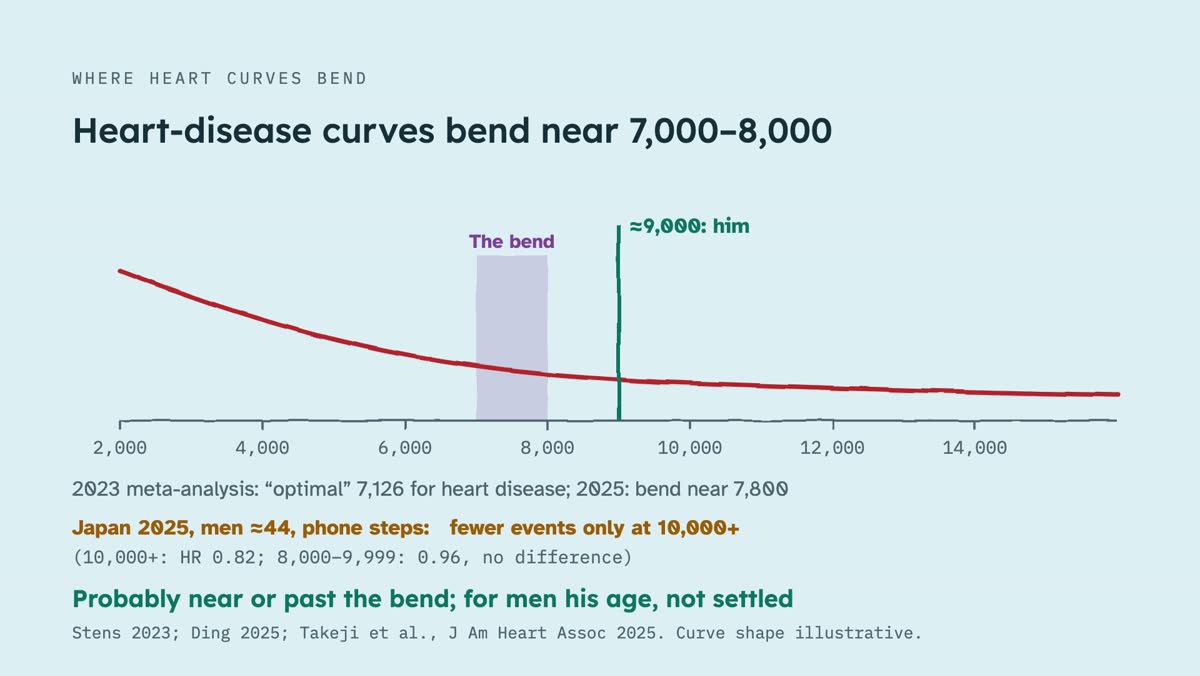
Other analyses put the bend for heart disease around 7,000 to 8,000 steps, with estimates still drifting slightly lower beyond that. One caution: a 2025 Japanese study of men around 44, using phone step counts, found fewer cardiovascular events only at 10,000 or more, not at 8,000 to 9,999. So at 9,000, he's probably near or past the bend, but for men his age, it isn't settled.
What does walking do to risk factors? In walking trials, mostly in inactive people, systolic blood pressure fell about 3.6 points. LDL cholesterol barely moved, about 2 points, and that wasn't statistically significant.
Running, lifting, climbing
Official guidelines don't set any step target. They ask for 150 to 300 minutes a week of moderate activity, or half that if it's vigorous, plus muscle-strengthening that works all the major muscle groups on two or more days. One vigorous minute counts as two moderate ones.
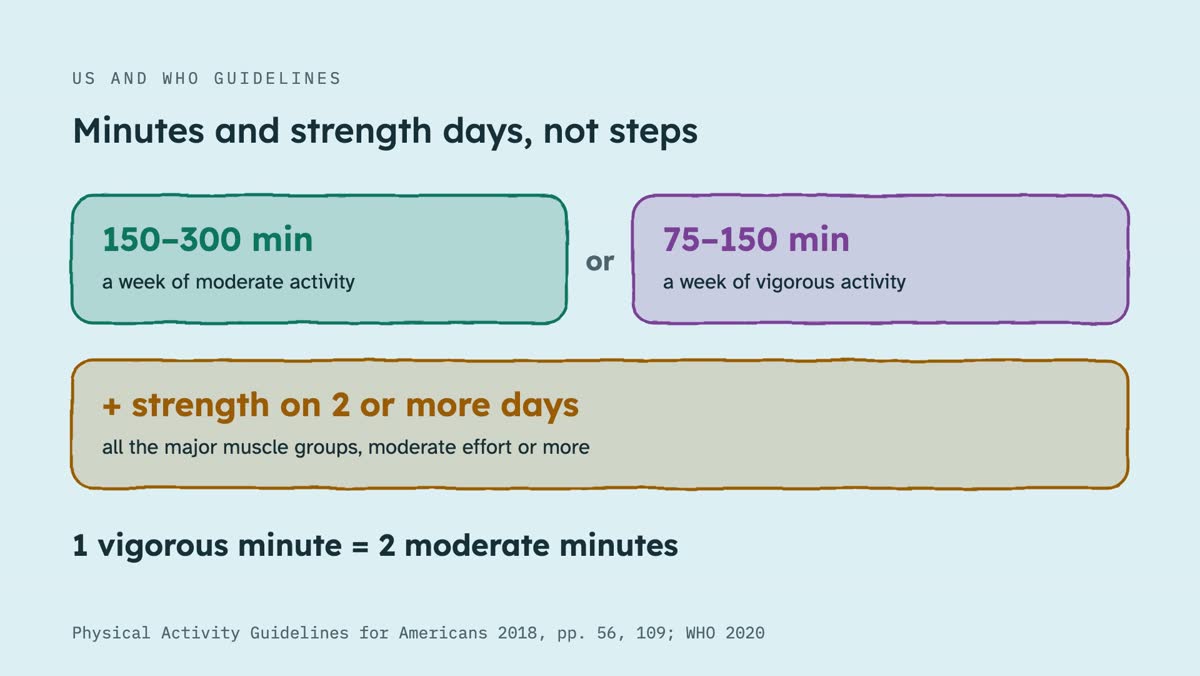
A step counter sees some of this, but not all. Running counts: a recreational runner takes about 170 steps a minute, so a half-hour run is roughly 5,000 steps. But it's vigorous, so each minute earns double credit. Strength training and climbing barely register as steps, yet active climbing rates as moderate to vigorous effort, and both build strength.
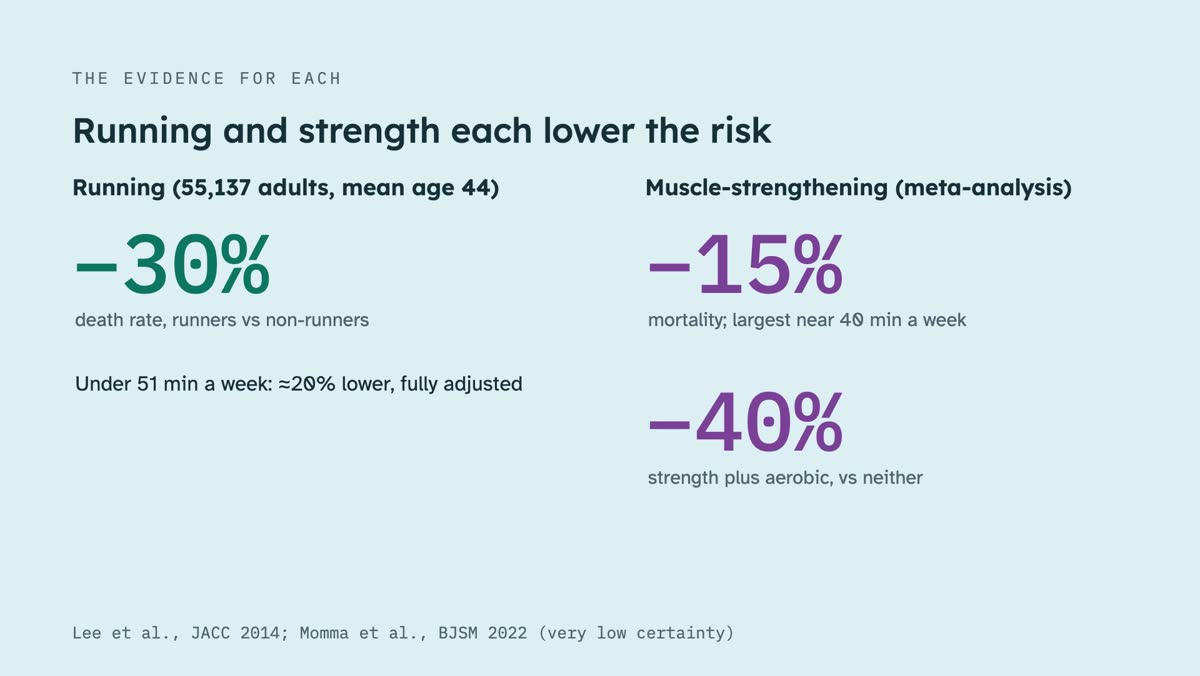
Each type has its own evidence. In a study of 55,000 adults, runners had about 30 percent lower death rates than non-runners, and even under 51 minutes a week was linked to lower risk, about 20 percent after full adjustment. Muscle-strengthening is linked to about 15 percent lower mortality, largest around 40 minutes a week, and doing both was linked to about 40 percent lower mortality than doing neither.
Underneath all of this is fitness. Each step up in cardio fitness, one MET, is linked to about 11 to 17 percent lower mortality. Meanwhile, sheer volume shows diminishing returns. Compared with no leisure activity, three to five times the guideline minimum was linked to about 39 percent lower mortality, and ten times or more, about 31 percent. No harm, but no extra gain.
So is his routine enough? Here's an illustration, not a measurement. Assume three runs of 20 to 30 minutes. That's 120 to 180 moderate-equivalent minutes. Add active climbing, and he's at roughly 140 to 270, before counting any brisk walking. Personal training is one strength day, and a hard climbing session plausibly counts as a second. By the guidelines, he's plausibly there. A log of workout minutes says more than a step total.
Exercise and cholesterol
Here's the catch. Across 148 exercise trials, LDL cholesterol fell about 7 points on average, HDL rose about 2, and triglycerides fell about 8. But results varied so much that a new study could easily find no LDL change, and strength training alone didn't lower LDL. For apo B, the particle count on his panel, there's no reliable number at all.
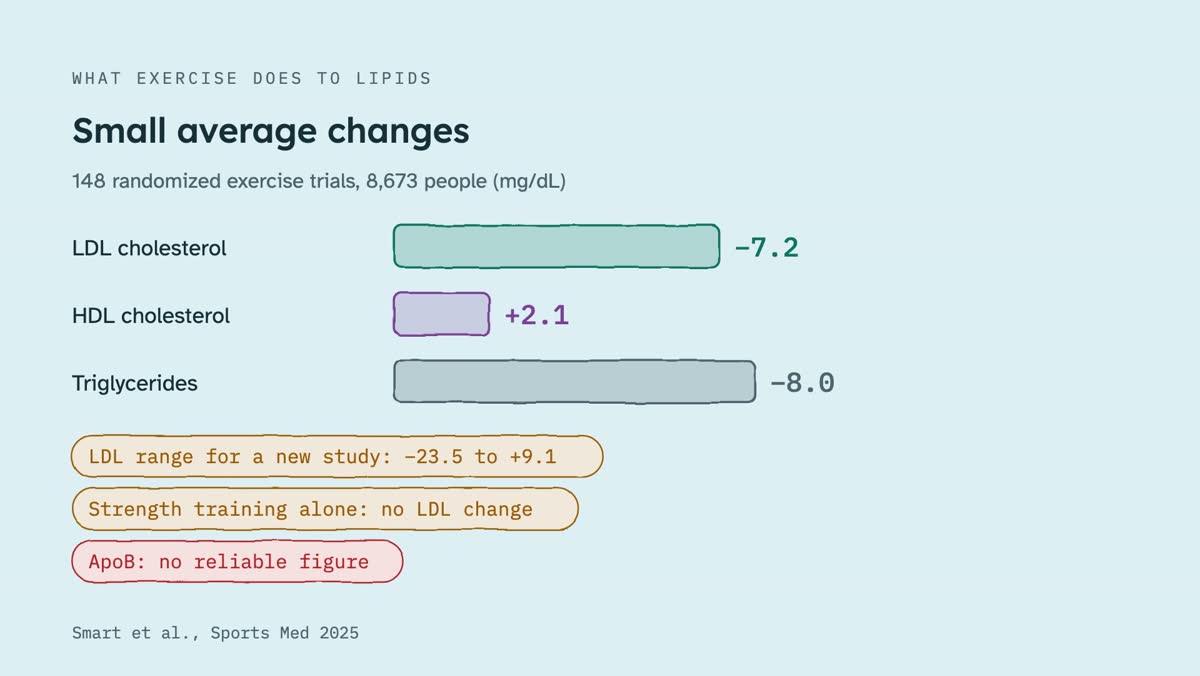
On that panel, triglycerides are low and HDL is in the low 50s, the profile exercise tends to produce. What's left is an LDL around 120, which exercise moves least reliably, and apo B in the low 90s. Our read: more exercise is unlikely to move them much.
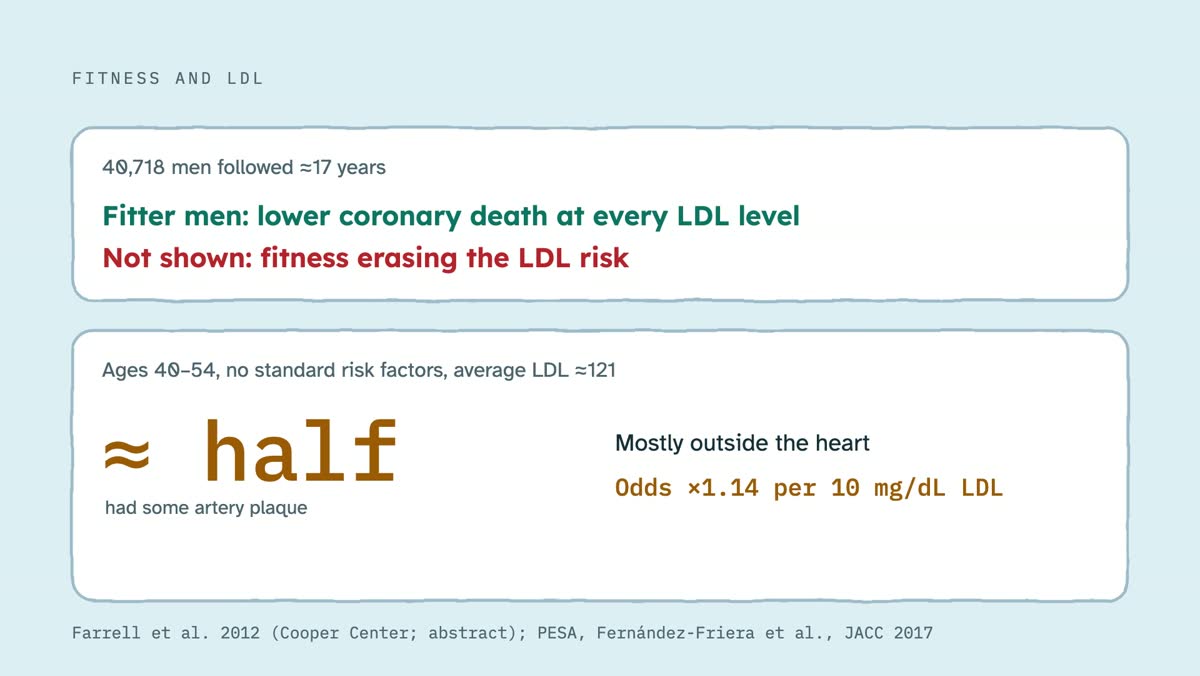
And fitness hasn't been shown to cancel LDL. In about 40,000 men, fitter men had lower coronary death rates at every LDL level, but the study didn't show fitness erasing the LDL risk. In a Spanish study of people around 45 with no standard risk factors, and an average LDL close to his, about half already had some artery plaque, mostly outside the heart, and the odds rose with LDL.
So what decides treatment? The 2026 U.S. cholesterol guideline uses 10- and 30-year risk estimates called PREVENT. For adults 30 to 59 with low 10-year risk, LDL under 160, and 30-year risk under 10 percent, it recommends lifestyle counseling. If 30-year risk is 10 percent or higher, a moderate-dose statin is reasonable. PREVENT needs his blood pressure and other details he didn't send, so we can't say which group he's in.
Two more markers. The guideline counts apo B of 120 or more as a risk enhancer, so his low 90s is above his lab's cutoff but well below the guideline's. And it recommends that every adult have LP-little-a measured at least once. It isn't on his panel.
How he's doing
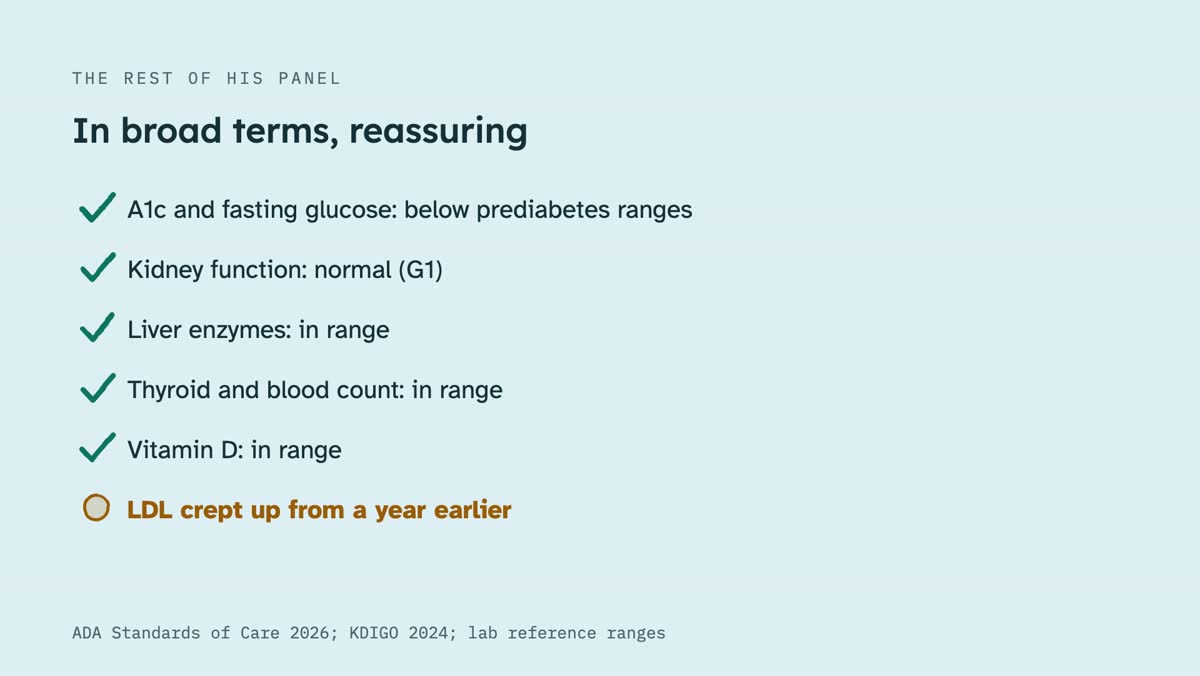
In broad terms, the rest of his panel is reassuring. His A-one-C and fasting glucose are well below the prediabetes ranges. Kidney function, liver enzymes, thyroid, blood count and vitamin D were all in range. His LDL did creep up from a year earlier.
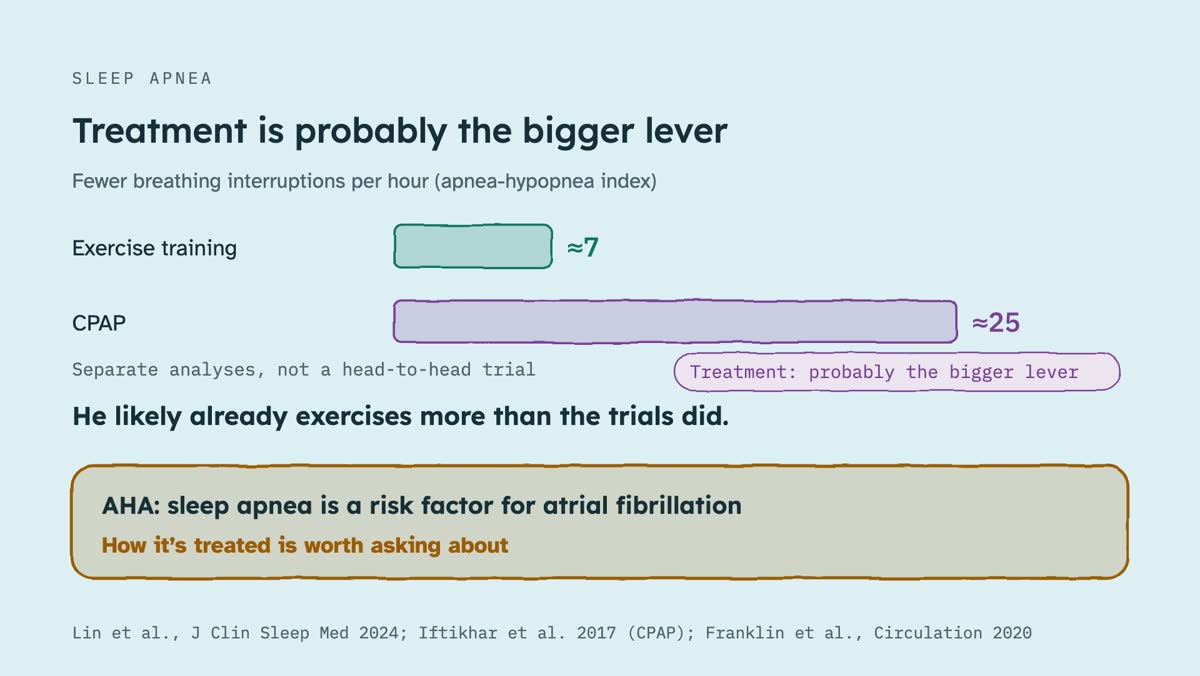
Sleep apnea matters more than it might seem. In trials, mostly in untrained people, exercise cut breathing interruptions by about 7 an hour. In a separate analysis, CPAP cut them by about 25, the most of any treatment. He likely already exercises more than those trials did, so treatment is probably the bigger lever. And the heart association lists sleep apnea as a risk factor for atrial fibrillation, so how it's treated is worth asking about.
One flag isn't about cholesterol. His iron saturation was slightly above the lab range on both tests, while ferritin, the main iron-stores marker, was normal. Hemochromatosis guidelines use saturation as a screening test, and European guidance recommends genetic testing when it stays unexplained and high. But saturation bounces around from test to test. So it's a question for his clinician, such as whether a repeat morning test makes sense, not a diagnosis.
Working around injuries
Quadriceps strains are common in soccer, about one in five muscle injuries in elite players, mostly in the kicking leg, and usually in the rectus femoris, the muscle at the front of the thigh that also crosses the hip. The biggest risk factor is a recent strain. In Australian football, one in the past eight weeks raised the odds of another about 25-fold. Nearly all of this data comes from elite players in their 20s.
Even at elite clubs, a quadriceps strain cost a median of about two weeks, and longer when it was a re-injury or involved the tendon. The researchers call those best-case numbers.
What helps most? In amateur men's soccer, a structured rehab program with return-to-play criteria cut re-injuries by about two thirds. The popular FIFA 11+ warm-up cut injuries overall by about 39 percent, though not in its one trial of veteran players, and it hasn't been shown to prevent quad strains. And across sports, strength-training programs prevent injuries. Stretching doesn't.
Can he stay fit meanwhile? Yes. Endurance holds for months on as few as two sessions a week if the intensity stays up, and strength holds with one. And two strains in two months is the kind of history a sports medicine clinician or physical therapist is well placed to assess, especially before sprinting and kicking again.
Before you go
First, how risky is exercise itself? Vigorous exertion briefly raises the risk of sudden death, but in one large study, that worked out to one death per one and a half million workouts. In long races, cardiac arrest happens in about 0.6 per 100,000 finishers. The clearest possible cost of very high training is atrial fibrillation, at volumes far above his.
If you're in a similar spot, here are questions worth bringing to a clinician. One: what are my 10- and 30-year PREVENT risk numbers? Two: has my LP-little-a been measured? Three: how should my apo B be read alongside those? Four: is my sleep apnea well treated? Five: should my iron saturation be repeated? And six: for the thigh strains, what should my return-to-play criteria be?
So, do you need 10,000 steps? Not as a magic number. For someone already near 9,000 with real workouts, the step count is the least informative number in the file. The levers that matter now are cholesterol risk, sleep apnea treatment, and staying healthy enough to keep going for decades.
Sources
45 sources cited in the video, in the order they come up.
Safety
- 2021 AHA/ACC chest pain guideline (Gulati et al.)
- AHA 2020 statement on exercise-related cardiac events (Franklin et al.)
Where 10,000 came from
- Lee et al. 2019, steps and mortality in older women
- Yamasa company history of the Manpo-kei (manufacturer's account, Japanese)
- Physical Activity Guidelines for Americans, 2nd edition (p. 112)
- Paluch et al. 2022 (Steps for Health)
- Stens et al. 2023
- Ding et al. 2025
- CARDIA, Paluch et al. 2021
- Fuller et al. 2020, wearable accuracy
Steps and the heart
- Paluch et al. 2023, steps and CVD
- Takeji et al. 2025, KenCoM steps and CV events
- Murtagh et al. 2015, walking and risk factors
Running, lifting, climbing
- WHO 2020 physical activity guidelines (Bull et al.)
- Heiderscheit et al. 2011, running step rate
- 2024 Adult Compendium of Physical Activities
- Lee et al. 2014, running and mortality
- Momma et al. 2022, muscle-strengthening
- Lang et al. 2024, fitness umbrella review
- Arem et al. 2015, activity dose and mortality
Exercise and cholesterol
- Smart et al. 2025, exercise and lipids
- Farrell et al. 2012, fitness, LDL and coronary deaths
- PESA, Fernández-Friera et al. 2017
- 2026 ACC/AHA dyslipidemia guideline
How he's doing
- ADA Standards of Care 2026, Section 2
- Lin et al. 2024, exercise in sleep apnea
- Iftikhar et al. 2017, sleep apnea treatments
- ACG 2019 hemochromatosis guideline
- EASL 2022 haemochromatosis guideline
- Adams et al. 2007, repeat iron testing
Working around injuries
- Ekstrand et al. 2011, muscle injuries in pro football
- Hägglund et al. 2013, muscle injury risk factors
- Pietsch et al. 2026, quadriceps strains
- Orchard et al. 2020, subsequent strains
- Ekstrand et al. 2020, time-loss
- Hägglund et al. 2007, rehab RCT
- Thorborg et al. 2017, FIFA 11+
- Hammes et al. 2015, FIFA 11+ in veterans
- Silvers-Granelli et al. 2015
- Lauersen et al. 2014, preventing sports injuries
- Spiering et al. 2021, maintaining fitness
- Pecci et al. 2026, return-to-play criteria


