
Do Statins Lower Your Body's GLP-1?
Inside this episode
The video’s narration, chapter by chapter, with stills from the video and every source at the end.
The short version
Welcome to Health Loom. A claim like this can be unsettling if you take a statin, a cholesterol-lowering medicine, so here's the short version. A GLP-1 drop shows up in some lab-dish and animal experiments; in people, the results are mixed. In trials, statins nudged blood sugar up a little: at standard doses, about one extra diabetes diagnosis per 1,000 people a year, mostly in people already near the line. No study in people has shown that GLP-1 is the reason. And for people a statin is recommended for, researchers find the heart benefit is much bigger.
What the GLP-1 studies show
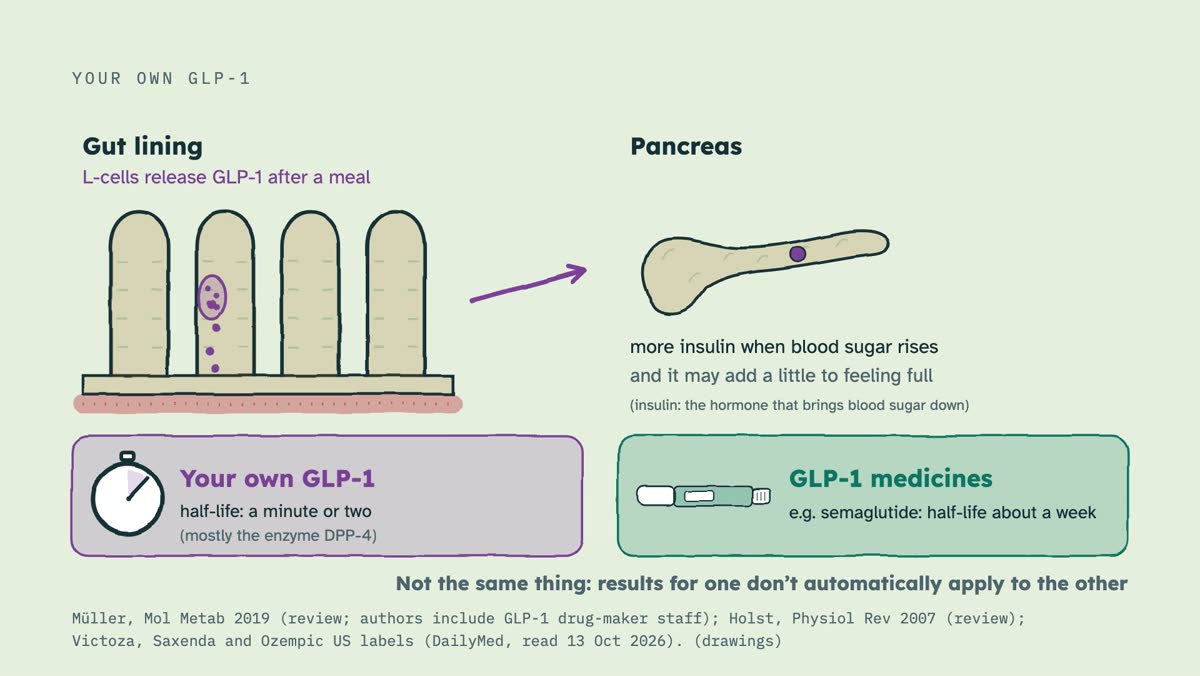
Quick background. When you eat, cells in your gut lining release GLP-1. It helps the pancreas release insulin when blood sugar rises, and may add a little to feeling full. Half of your own GLP-1 is broken down within a minute or two, mostly by an enzyme. GLP-1 medicines are built to resist that enzyme; semaglutide's half-life is about a week. So findings about one don't automatically carry over to the other.
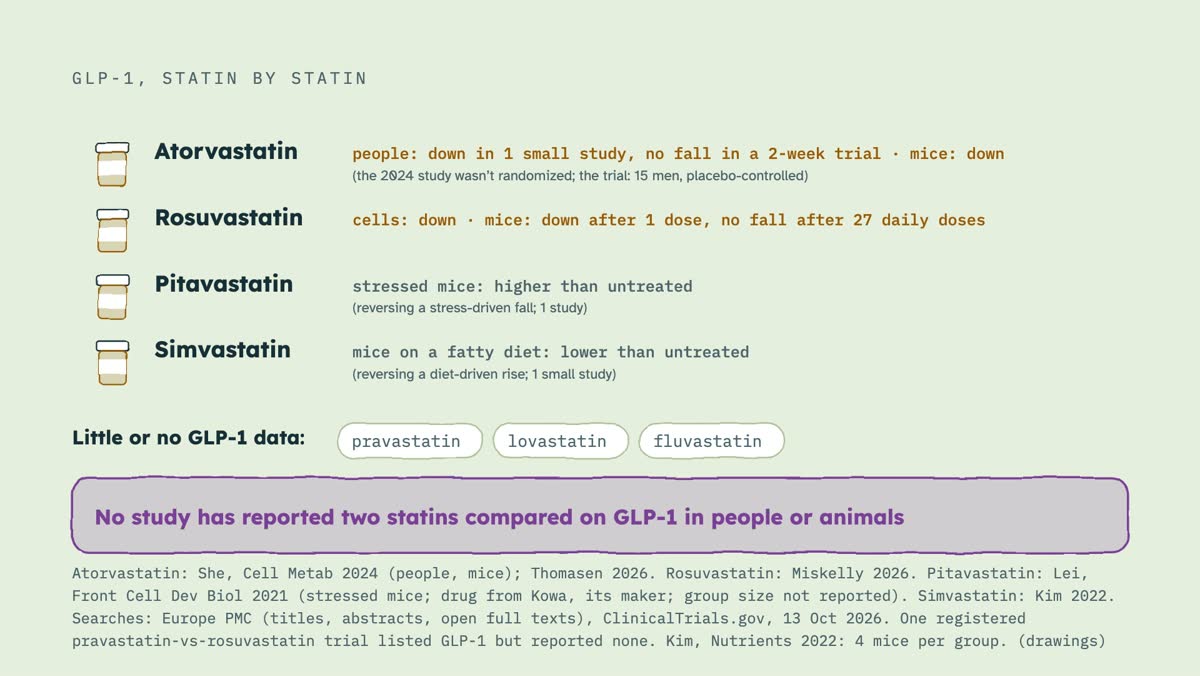
Now the statin studies. In mouse gut cells in a dish, rosuvastatin cut GLP-1 release. In mice, a single dose lowered GLP-1 after a sugar dose by about a third, but after 27 days of daily injections, it didn't fall. In another lab's 2024 study, mice on a fatty diet given atorvastatin for 12 weeks had lower GLP-1.
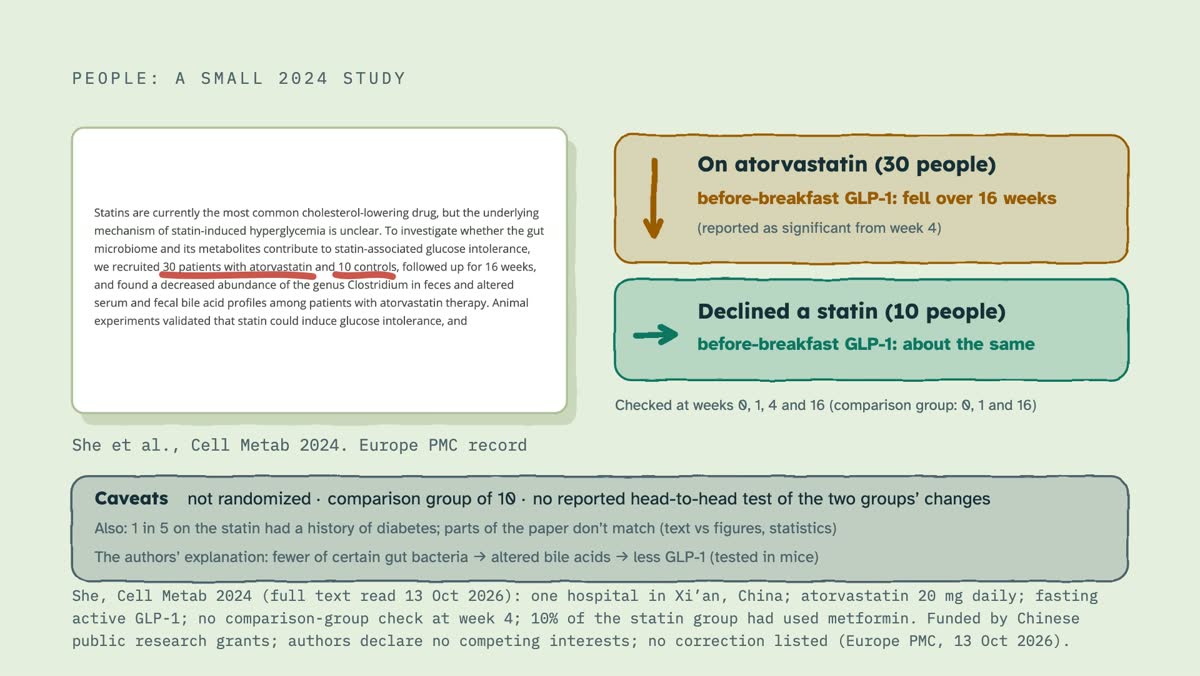
In people, the results are mixed. That 2024 study, whose title says statins lower blood GLP-1, also followed 30 people starting atorvastatin at one hospital in China, and 10 who had declined a statin. In the statin group, before-breakfast GLP-1 fell over 16 weeks; in the comparison group, it stayed about the same. But the groups weren't randomized, the comparison group was small, and the paper didn't report a direct test of one group's change against the other's. The authors trace the drop to changes in gut bacteria, a chain they tested in mice.
Two other human studies didn't find a drop. The rosuvastatin team also looked at a Swedish study of about 3,700 older adults: statin users without diabetes showed no clear difference in GLP-1, fasting or after a sugar drink, once age, sex and body size were accounted for. To be fair, the team still calls their short-term lab findings a plausible explanation for statins' mild blood-sugar rise, and recommends monitoring blood sugar after prescribing rosuvastatin, though they think the long-term risk mostly runs through other pathways.
And in the only placebo-controlled trial we found, 15 healthy young men took atorvastatin and a placebo for two weeks each. Before breakfast and after a meal, GLP-1 showed no meaningful change, and neither did blood sugar. But the trial was tiny and lasted only two weeks, the 2024 study wasn't randomized, and the big study was a one-time snapshot, so this isn't settled.
Is it all statins?
For GLP-1, nobody knows. Only a few statins have been studied, mostly in cells or mice, with mixed results. For atorvastatin, the two human studies we read disagree. No study has reported two statins compared on GLP-1 in people or animals, and several statins have little or no GLP-1 data.
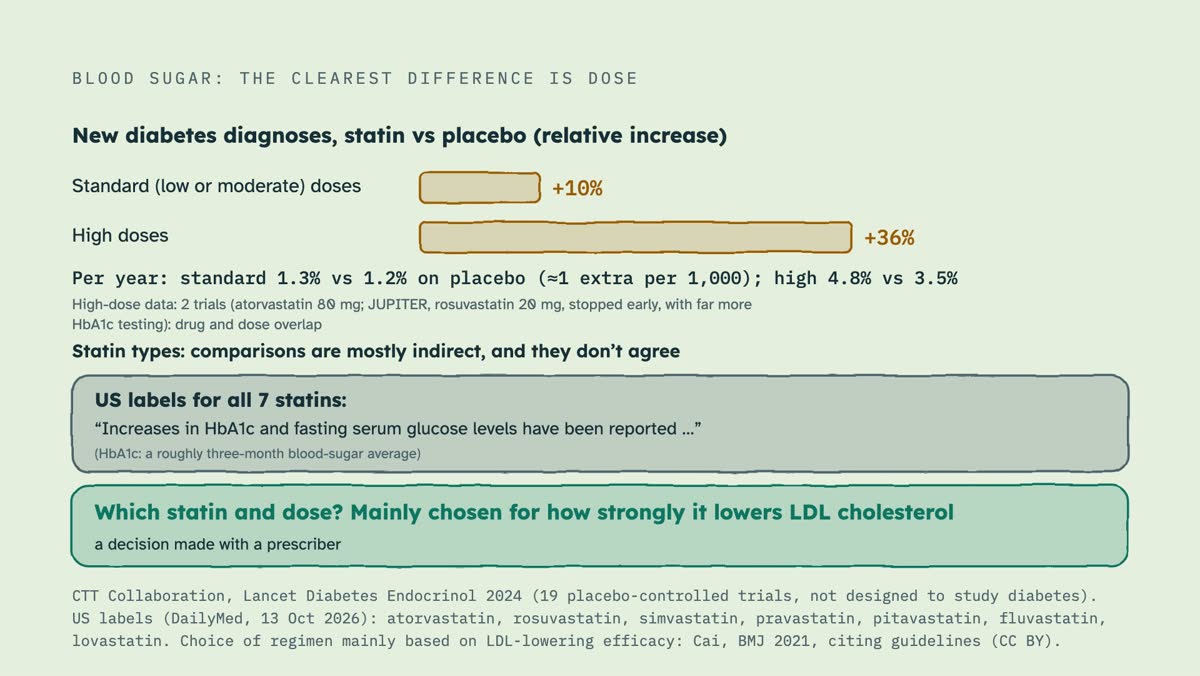
For blood sugar, the clearest difference is dose: higher doses nudge it up a little more. In blinded trials, standard doses raised the rate of new diabetes diagnoses about 10 percent over placebo, about one extra per 1,000 people a year; high doses, about 36 percent. Comparisons of statin types on diabetes are mostly indirect and don't agree, and every US statin label carries a blood-sugar warning. Which statin and dose someone takes is mainly chosen for how strongly it lowers LDL cholesterol, and that's a decision to make with a prescriber.
Blood sugar: how big, and why?
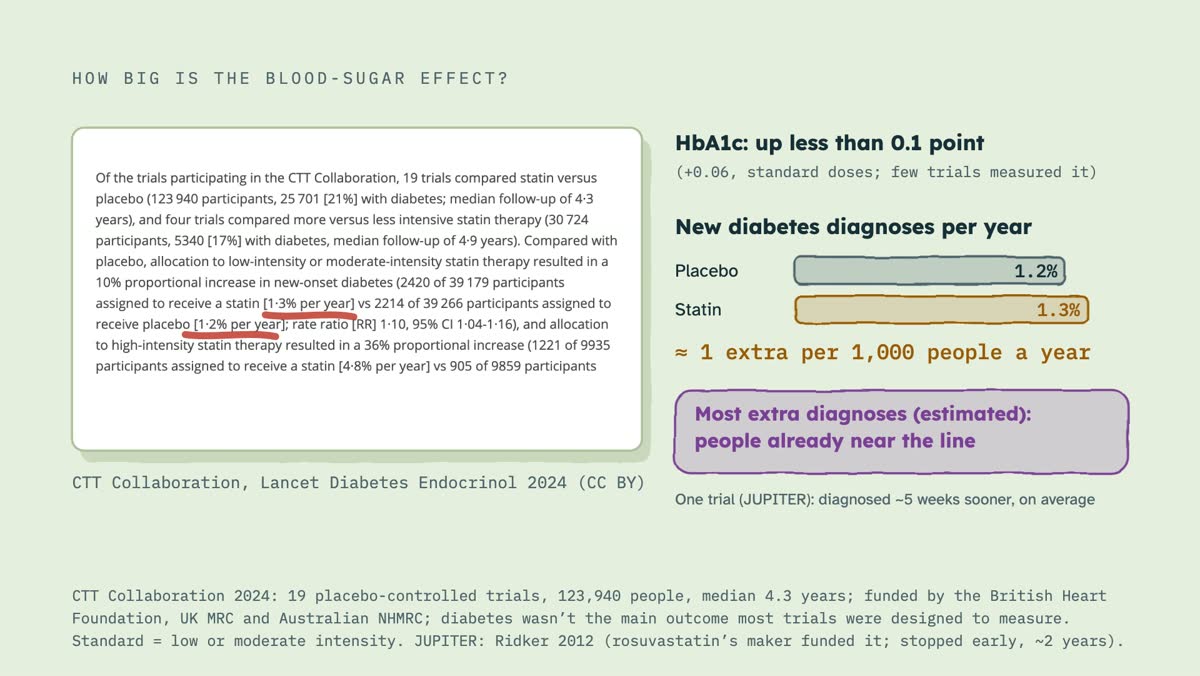
In the trials that measured it, standard-dose statins raised average HbA1c, a roughly three-month blood-sugar average, by less than a tenth of a point. New diabetes diagnoses ran at 1.3 percent a year on standard-dose statins versus 1.2 percent on placebo: about one extra per 1,000 people a year. Most of the extra diagnoses were estimated to fall in people already near the line for diabetes; in one trial, those diagnosed on the statin were diagnosed about five weeks sooner on average.
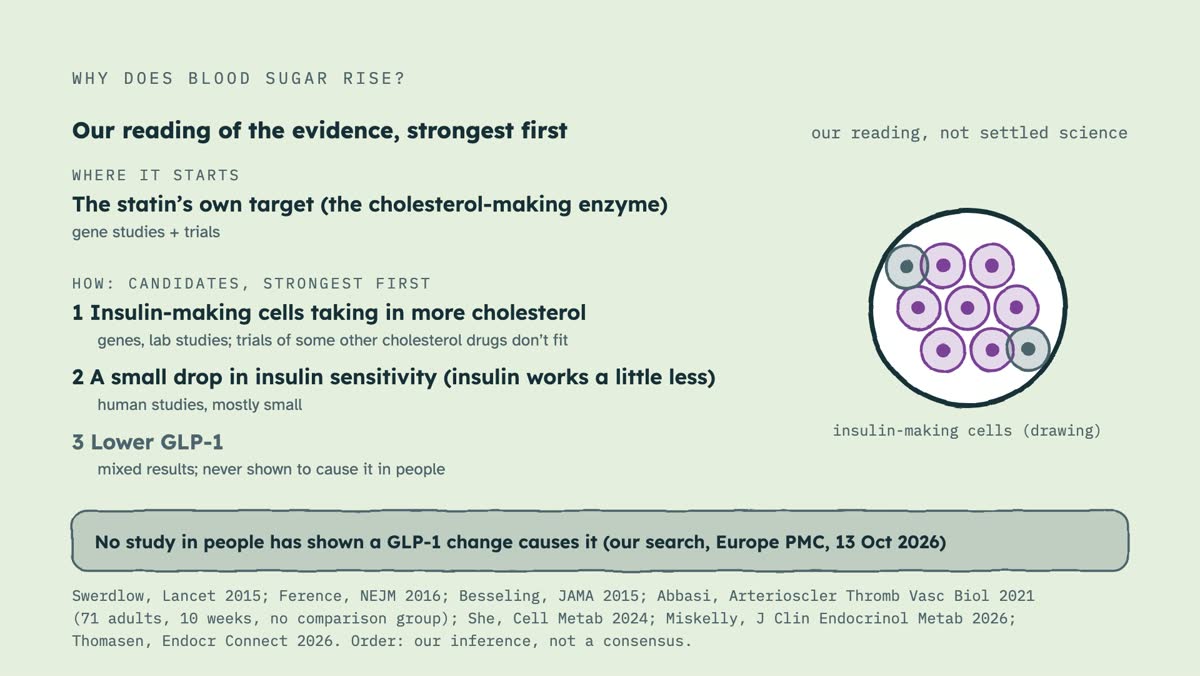
So why does it happen? Gene studies that mimic statins point, at least in part, to the statin's own target, the enzyme cells use to make cholesterol. The leading ideas: insulin-making cells taking in more cholesterol, and a small drop in insulin sensitivity, meaning the body responds a little less to insulin. GLP-1 sits near the bottom of the list: no study in people has shown a GLP-1 change causes it. That ranking is our reading of the evidence, not settled science.
Weight and appetite
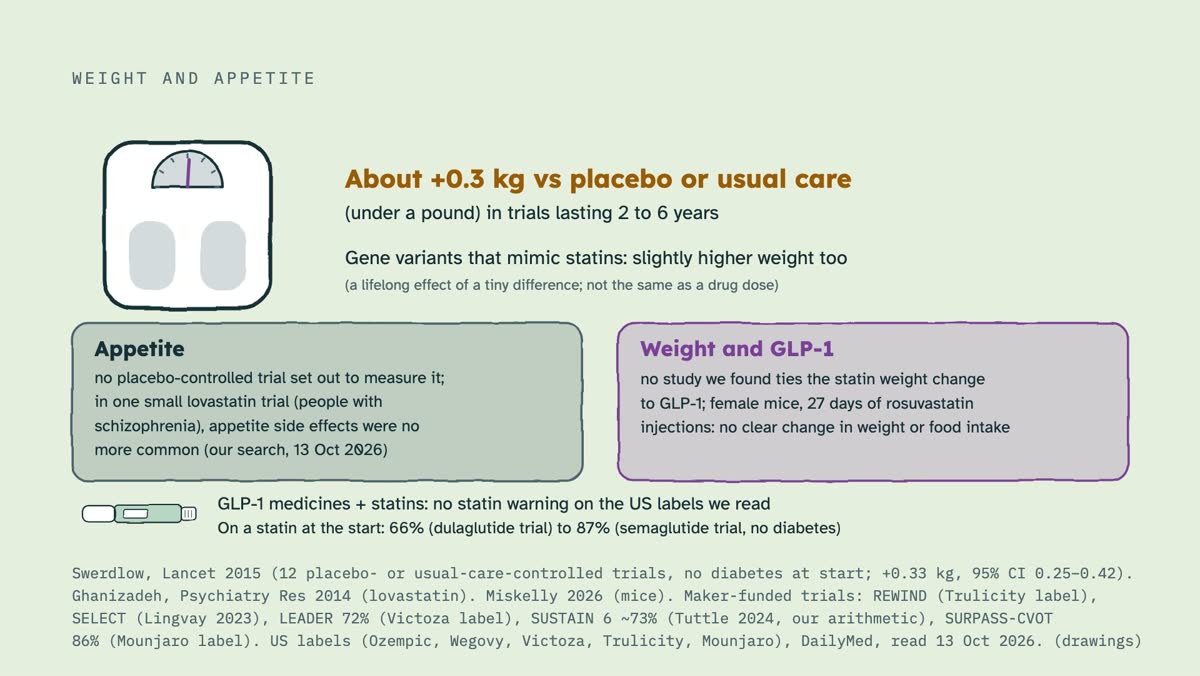
In trials against placebo or usual care, lasting two to six years, people on statins ended up, on average, about a third of a kilogram heavier: under a pound. Gene variants that mimic statins also come with slightly higher weight. No trial we found set out to measure appetite on statins, and no study ties the weight change to GLP-1. And for people taking a statin and a GLP-1 medicine, none of the US labels we read warns against the combination, and most people in the GLP-1 medicines' big heart trials were already on a statin.
Should most people worry?
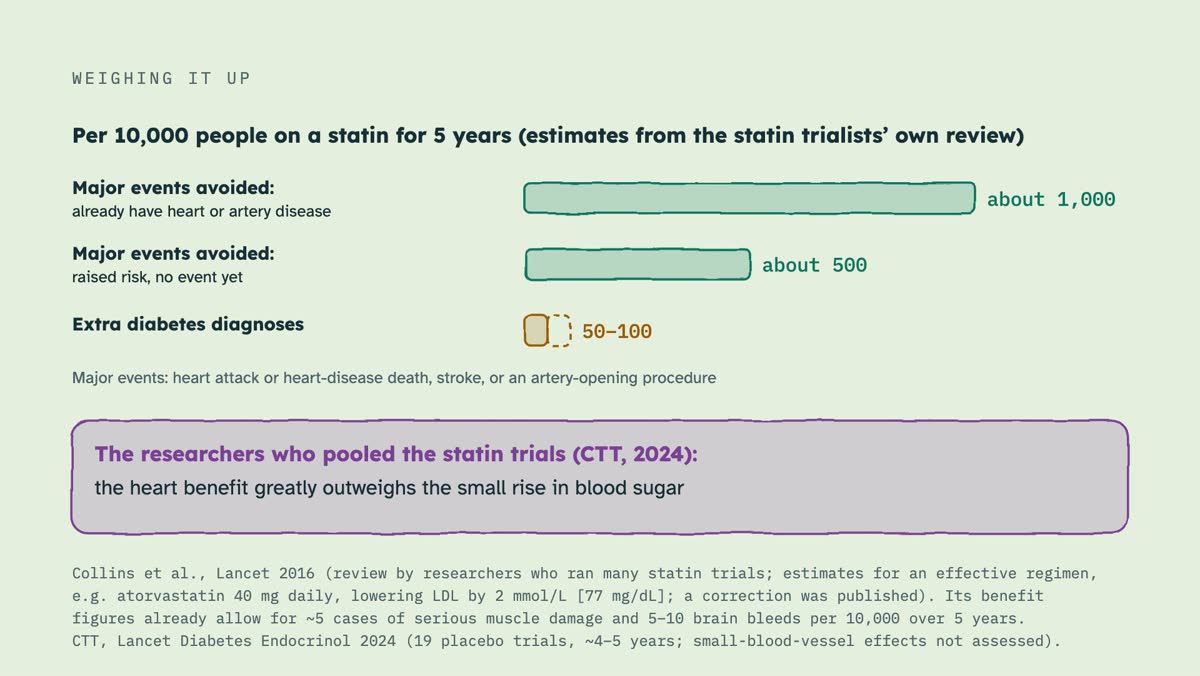
Here's the trade-off. A major review of the trial evidence estimates that treating 10,000 people with an effective statin regimen for five years would spare about 1,000 a heart attack, stroke or artery-opening procedure if they already have heart or artery disease, or about 500 if they're at raised risk without it, against 50 to 100 extra diabetes diagnoses. And the researchers who pooled the statin trials conclude the heart benefit greatly outweighs the small rise in blood sugar.
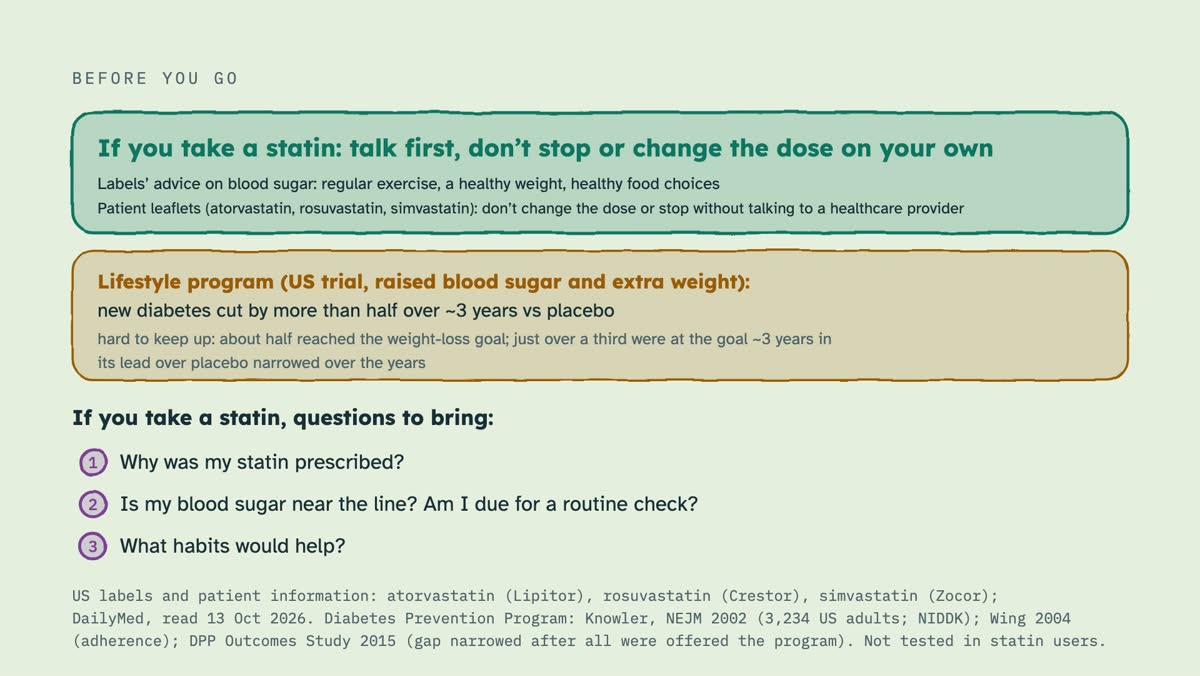
If you take a statin, the labels advise healthy habits, and leaflets for several statins say not to stop or change the dose without talking to your healthcare provider. In a large US trial of adults with raised blood sugar and extra weight, an intensive lifestyle program cut new diabetes by more than half over about three years, compared with placebo, though only about half reached its weight-loss goal, and its lead over placebo narrowed over the years. If you take one, questions worth bringing: Why was my statin prescribed? Is my blood sugar near the line, and am I due for a routine check? And what habits would help?
Sources
35 sources cited in the video, in the order they come up.
- Miskelly 2026, rosuvastatin and GLP-1 (mouse gut cells, mice, Malmö cohort)
- Thomasen 2026, atorvastatin vs placebo in 15 healthy men
- She 2024, atorvastatin, gut bacteria and GLP-1 (30 vs 10 people, mice; full text read)
- Lei 2021, pitavastatin in stressed mice
- Kim 2022, simvastatin in mice on a fatty diet
- Pravastatin vs rosuvastatin trial (GLP-1 listed, not reported)
- Müller 2019, GLP-1 review
- Holst 2007, physiology of GLP-1 (review)
- Ozempic label
- Wegovy label
- Victoza label
- Saxenda label
- Trulicity label
- Mounjaro label
- Lingvay 2023, SELECT baseline characteristics
- Tuttle 2024, SUSTAIN 6 by kidney risk
- CTT Collaboration 2024, statins and new-onset diabetes
- Ridker 2012, JUPITER benefits and diabetes risk
- Cai 2021, statin adverse events in primary prevention
- Swerdlow 2015, HMGCR genes, weight and diabetes
- Ference 2016, PCSK9 and HMGCR genes and diabetes
- Besseling 2015, familial hypercholesterolemia and diabetes
- Abbasi 2021, statins, insulin resistance and secretion
- Ghanizadeh 2014, lovastatin trial (appetite side effects)
- Collins 2016, efficacy and safety of statin therapy (review)
- Lipitor (atorvastatin) label
- Crestor (rosuvastatin) label
- Zocor (simvastatin) label
- Livalo (pitavastatin) label
- Pravastatin label
- Lescol XL (fluvastatin) label
- Lovastatin label
- Knowler 2002, Diabetes Prevention Program
- Wing 2004, meeting lifestyle goals in the DPP
- DPP Outcomes Study 2015, 15-year follow-up


