
Do 10,000 Steps Really Help You Lose Weight?
Inside this episode
The video’s narration, chapter by chapter, with stills from the video and every source at the end.
The short version
Here's what to expect. On the scale, walking adds something real but modest: in year-long trials, about one to two kilos more than the same diet alone. His diet is the bigger lever. But walking's surest payoffs barely show up on the scale: lower blood pressure, less belly fat, better blood sugar and fitness, and, if the walking continues, a better shot at keeping the weight off. And a step count that varies? The evidence so far points to the weekly total. We'll cover what 10,000 steps burns, what walking adds to a diet, whether consistency matters, what the scale can't see, sleep, and what to ask a clinician.
What 10,000 steps burns
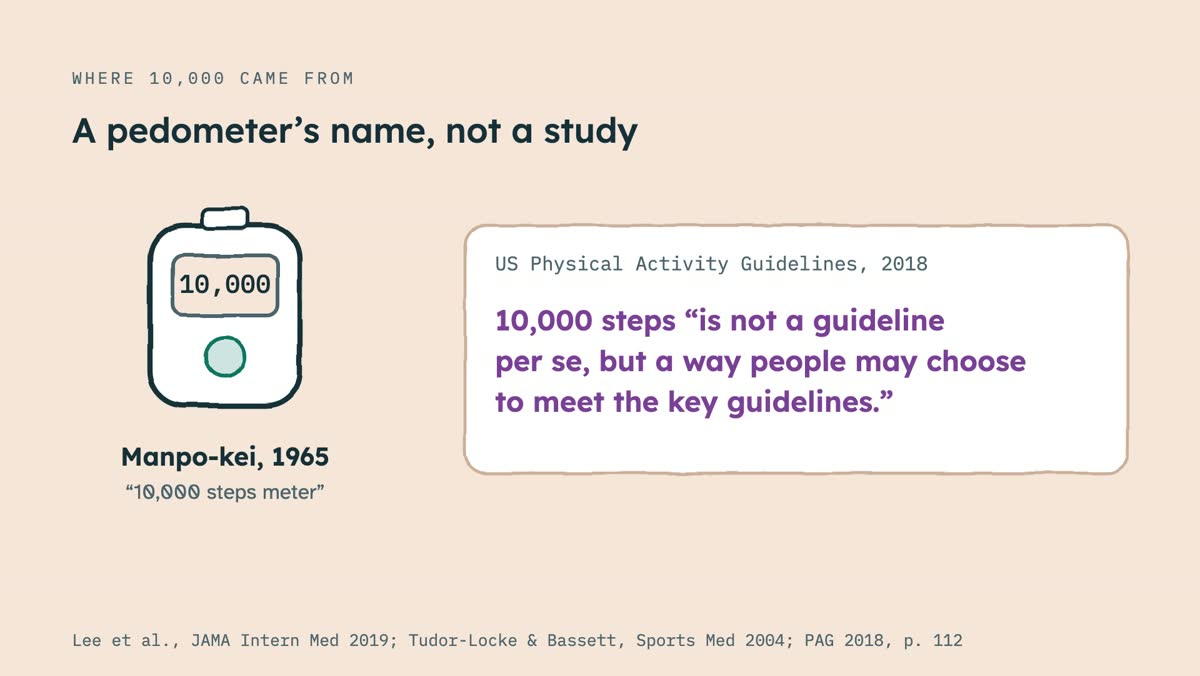
No study produced the number. Researchers say it likely comes from the name of a Japanese pedometer sold in 1965, called the Manpo-kei, or "10,000 steps meter." And the U.S. activity guidelines say 10,000 steps "is not a guideline per se, but a way people may choose to meet the key guidelines."
So what does it burn? Taking an illustrative man of 95 to 100 kilos, our calculation: 10,000 steps at an ordinary three miles an hour takes about an hour and a half and burns roughly 390 to 450 calories above what he'd burn sitting still. But only the extra steps count. Going from a typical 5,000 a day to 10,000 adds roughly 170 to 225 calories a day, a bit less if the extra steps are slower.
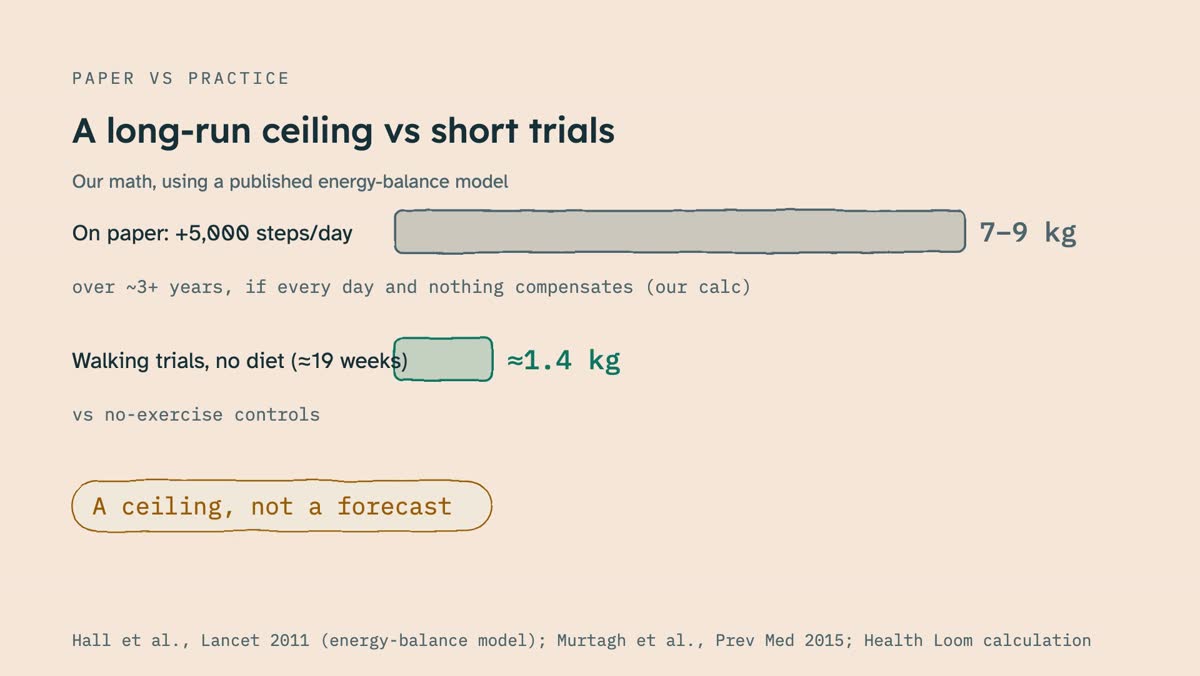
On paper, that adds up. By our math, using a published energy-balance model, 5,000 extra steps every single day could eventually take off about 7 to 9 kilos over three years or more. That's a ceiling, not a forecast. In randomized walking trials without a diet, which ran about four months on average, people lost about 1.4 kilos compared with controls.
Exercise without dieting can work at big, supervised doses. In one trial, young men who walked or jogged off a verified 400 or 600 calories a session, five days a week for ten months, lost about four and six kilos. That's far more exercise than most walking programs ask for.
Why the gap? Partly short trials and fewer extra steps. But people also compensate, mostly by eating a little more. In one trial that measured it, exercisers ate roughly 90 to 125 calories a day more than controls. In a study of over 1,700 adults, about 28 percent of activity energy seemed to be offset by the body spending less elsewhere, and about 46 percent at higher BMIs. And people vary enormously: in one small trial, weight change ranged from losing nearly 15 kilos to gaining almost 2.
On top of a diet
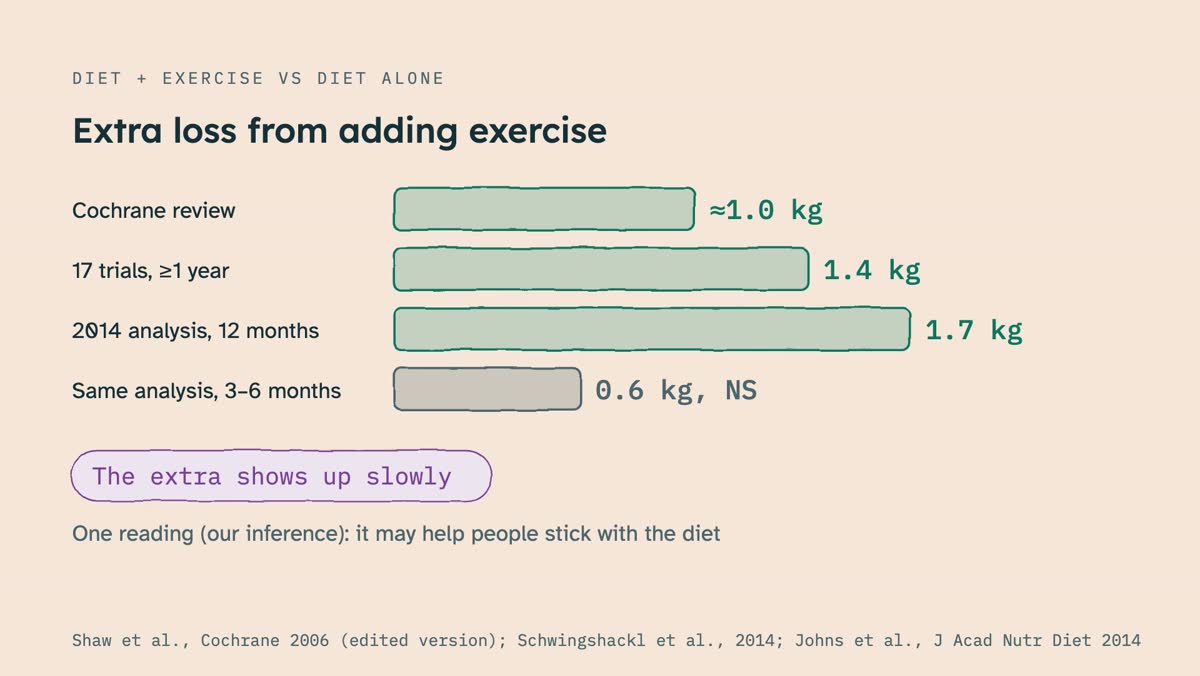
Every major pooled analysis lands in the same range. Adding exercise to a reduced-calorie diet took off about one to two kilos more over a year than the diet alone. The Cochrane review says about one kilo. A 2014 analysis found 1.7 kilos at 12 months, but no significant difference at three to six months. So the extra shows up slowly. One reading: exercise may help people stick with a diet more than it burns off a big extra deficit.
The clearest single trial followed 439 women after menopause for a year. Diet alone took off 7.2 kilos, and diet plus exercise 8.9, a gap that didn't reach the trial's statistical threshold. What did differ was shape: waist size fell seven centimeters with the combination, against four and a half with diet alone.
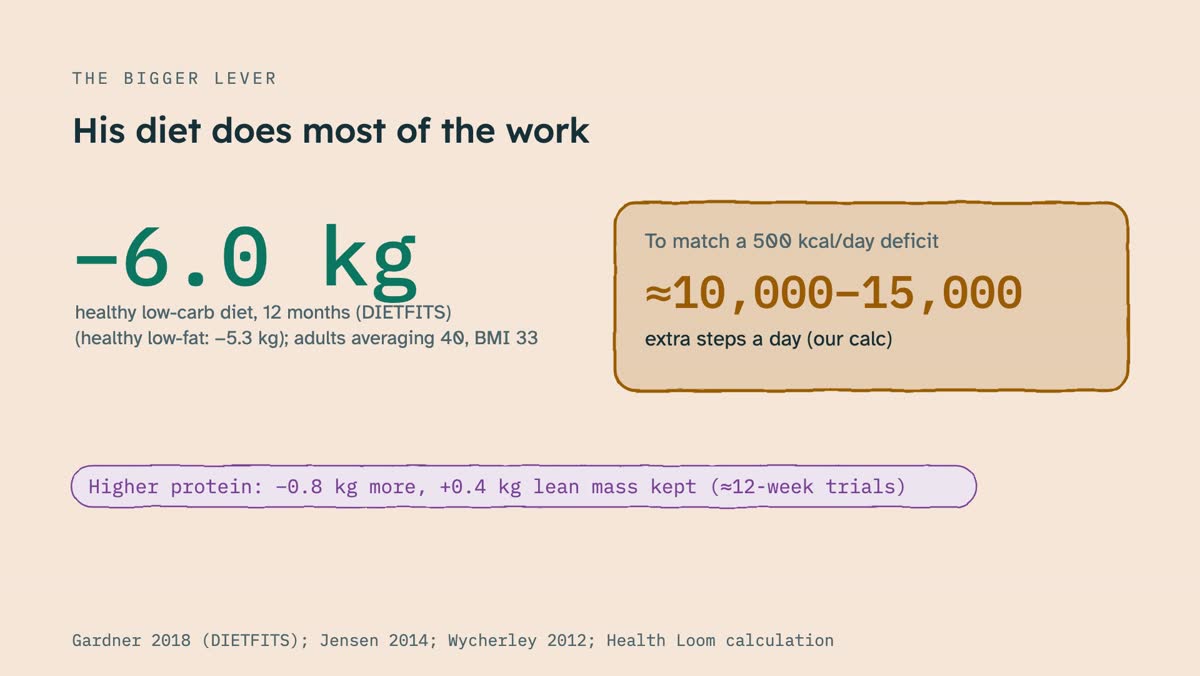
His diet is the bigger lever. In DIETFITS, a year-long trial in adults averaging 40 years old with a BMI of 33, a healthy low-carb diet took off about six kilos. By our math, matching a typical 500-calorie daily diet deficit by walking alone would take roughly 10,000 to 15,000 extra steps a day. And higher-protein diets help a little: in short trials, slightly more loss and a bit more lean mass kept.
What about muscle? Adding exercise to a diet kept about 0.9 kilos more lean mass across 34 trials, most clearly with strength or mixed training. Endurance training like walking gave about half a kilo, which wasn't statistically significant. Our reading: strength work and protein protect muscle best, and walking mostly adds a little fat loss and fitness.
Does consistency matter?
The U.S. guidelines count activity in bouts of any length. They prefer spreading it across the week, and say activity on at least three days a week produces health benefits. His three to four active days already fit that pattern.
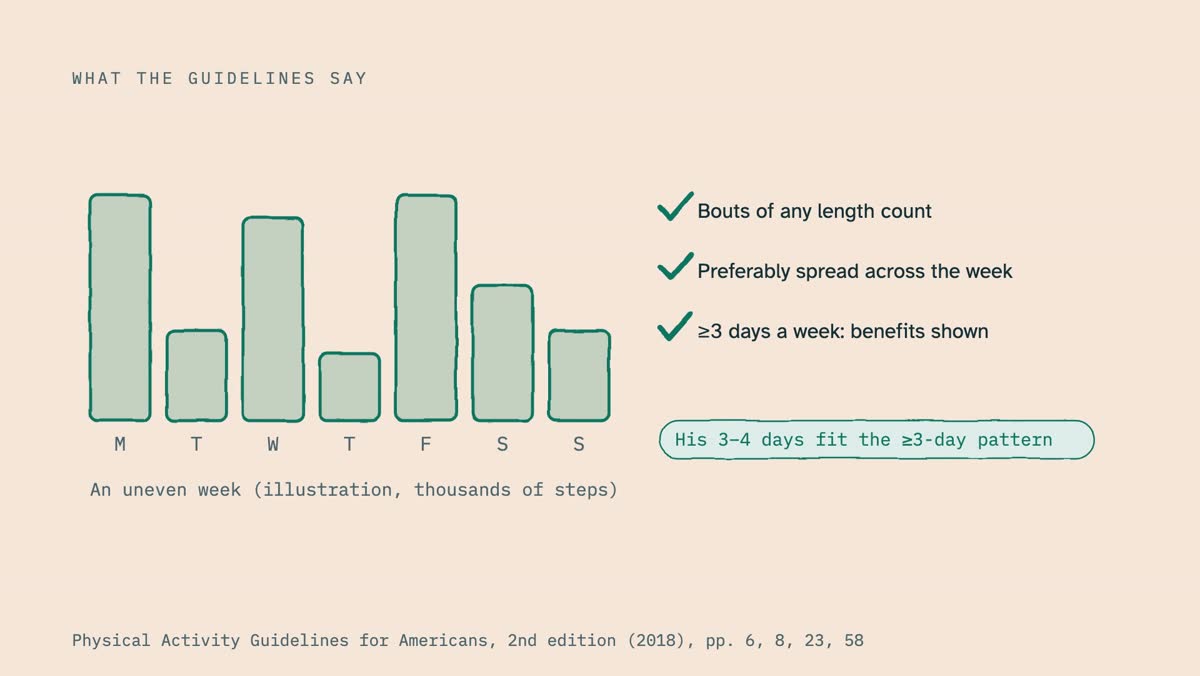
Big studies compare "weekend warriors," who pack their activity into a day or two, with people who spread it out. In about 350,000 U.S. adults, at the same weekly total, death rates were similar. In the UK Biobank, both patterns were linked to a lower risk of developing obesity than being inactive, with no significant difference between them. These studies are observational, but they point to the weekly total.
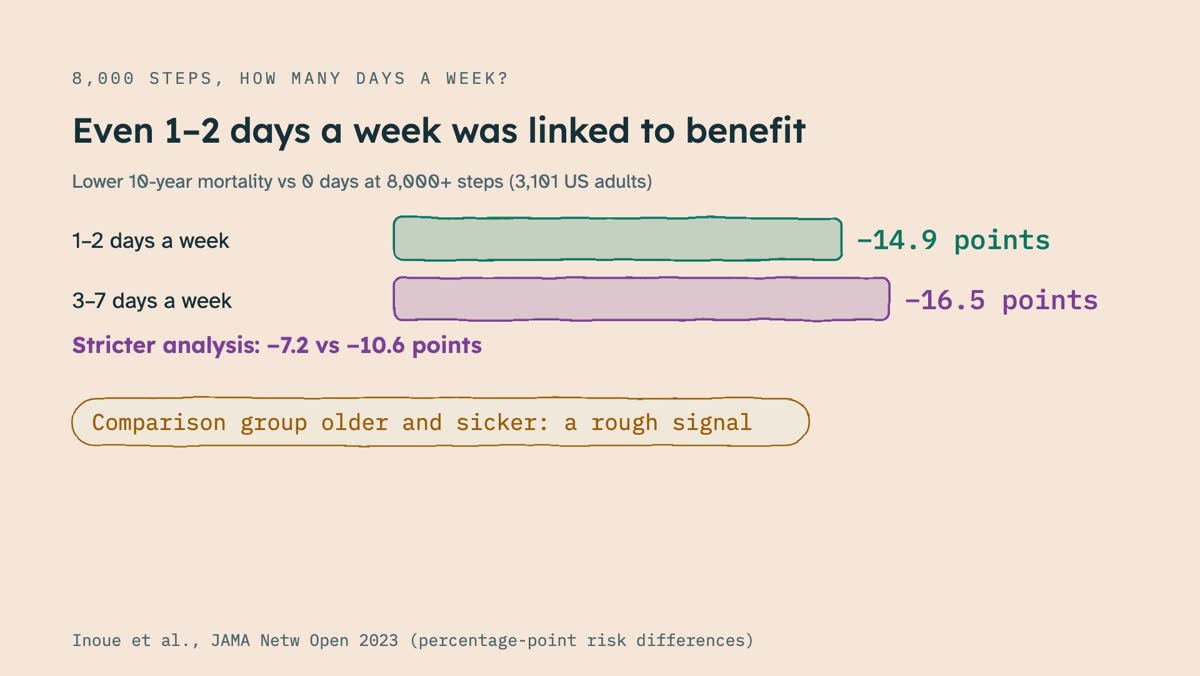
Step studies point the same way. Reaching 8,000 steps on just one or two days a week was linked to lower 10-year mortality than never reaching it. But the comparison group was older and sicker, and a stricter analysis favored three or more days, so treat that as a rough signal.
Two studies measured day-to-day variability itself, and they disagree. Among tracker users, the steadiest walkers lost about a third of a kilo more over six months than the most variable, but the average count mattered more: about a quarter of a kilo for every extra 1,000 steps a day. Another study linked more variable stepping to a lower risk of diabetes.
Two practical notes. About 100 steps a minute roughly marks moderate intensity for most adults. And trackers are imperfect: in daily life, only 42 percent of tests landed within 10 percent of research devices. So, as we read it, weekly averages on the same device are the better guide. And a tracker isn't magic: in one two-year trial, young adults who added a wearable to a weight-loss program lost less, 3.5 kilos against 5.9 without it.
What the scale can't see
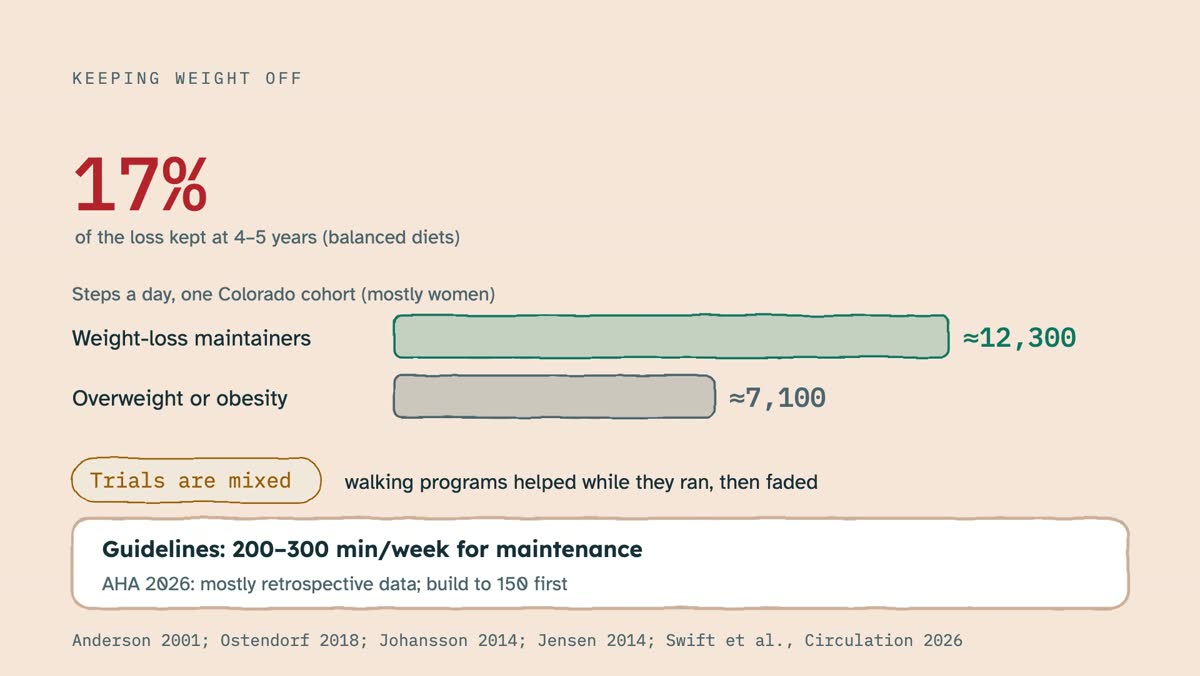
First, keeping weight off. Regain is the norm: after balanced diets, people kept only about 17 percent of their loss four to five years later. People who keep it off are far more active. In one Colorado group, maintainers averaged about 12,000 steps a day, against about 7,000 in people with overweight or obesity. But trials that assign exercise for maintenance are mixed, likely because many people stop: walking programs helped while they ran, and faded once people were on their own. Guidelines suggest 200 to 300 minutes a week for maintenance, though a 2026 heart association statement says that rests mainly on retrospective studies, and to build to 150 first.
Is regain about a broken metabolism? Mostly not. After weight loss, most of the extra drop in daily calorie burn comes from muscles working more efficiently in everyday movement, not from resting metabolism. And in women who dieted strictly, the resting drop was small and temporary. In pooled trials, higher-protein diets improved maintenance by about one and a half kilos, which bears on a higher-protein diet like his.
Blood pressure: walking programs lowered systolic pressure by about four points on average. That's relevant with high blood pressure in his family. In one study, people whose parent had hypertension had 70 percent higher risk if they were least fit, but only 16 percent if most fit, compared with fit people without that family history.
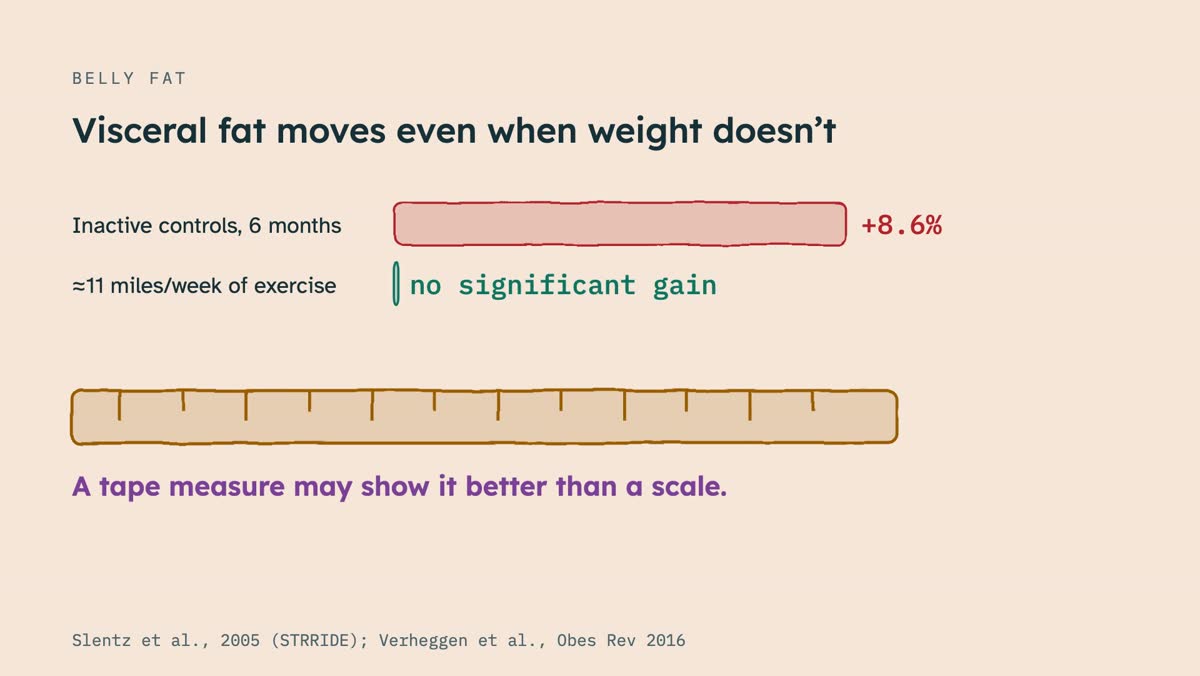
Belly fat: exercise trims the deep visceral fat around the organs, even with little weight change. In one trial, inactive controls' visceral fat rose 8.6 percent in six months, while about 11 miles a week of exercise, including walking, prevented that gain. As we read it, a tape measure may show walking's effect better than a scale.
Blood sugar: in the Diabetes Prevention Program, people with prediabetes who missed their weight goal but met the activity goal had about 44 percent lower diabetes incidence than those who missed both, an association within the trial. And for people of Asian ancestry, the American Diabetes Association uses a lower BMI threshold, 23 instead of 25, when considering diabetes testing in people with a risk factor.
Fitness: walking programs reliably raise it. And in pooled cohort studies, people with obesity who were fit had death rates not significantly different from fit people at a normal weight, while unfit people with obesity had about double the risk.
The one thing walking doesn't reliably deliver is lower LDL cholesterol. Exercise lowers it about seven points on average, but walking studies disagree, and adding exercise to a diet didn't lower LDL any further. Meanwhile, lower-carb diets raise LDL a few points on average compared with low-fat or higher-carb diets: about six points in DIETFITS, near zero for moderate carb cuts, and more for very-low-carb ketogenic diets. With high cholesterol, that makes a recheck worth asking about.
Sleep and migraine
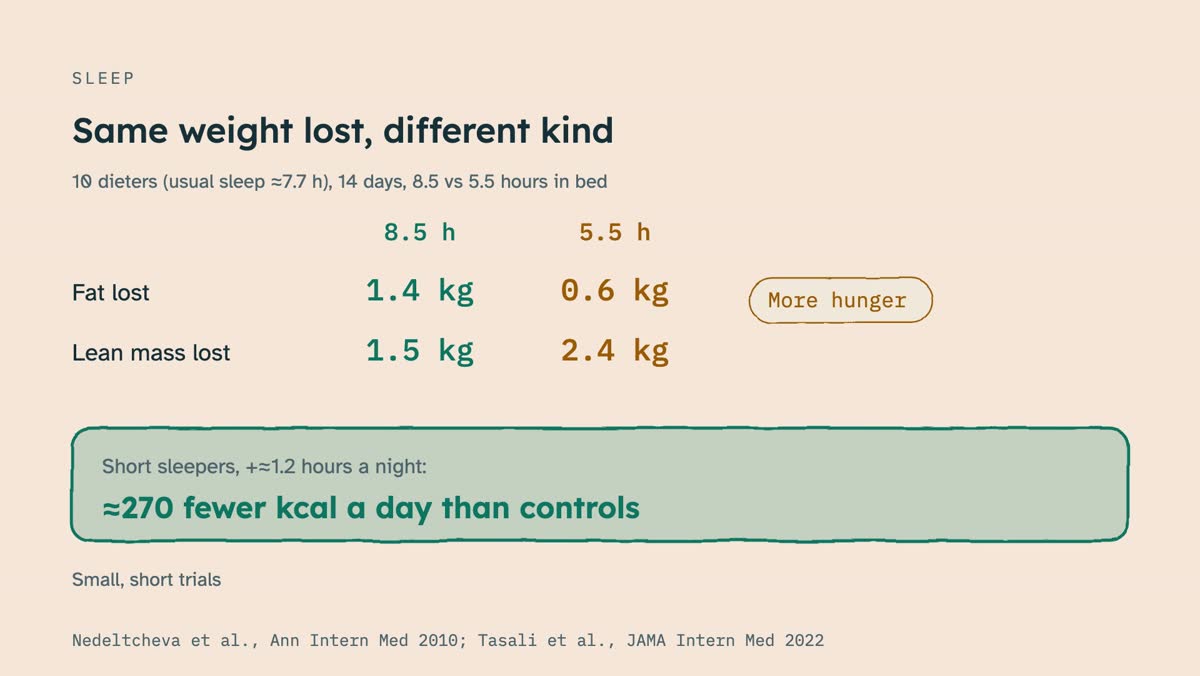
He sleeps five to six hours. In a small two-week trial, dieters who usually slept about seven and a half hours had time in bed cut to five and a half. Their weight loss didn't change, but they lost 55 percent less fat and 60 percent more lean mass, and felt hungrier. And when short sleepers added about an hour a night, they ate about 270 fewer calories a day than controls. These are small, short trials, but sleep may shape what a diet takes off.
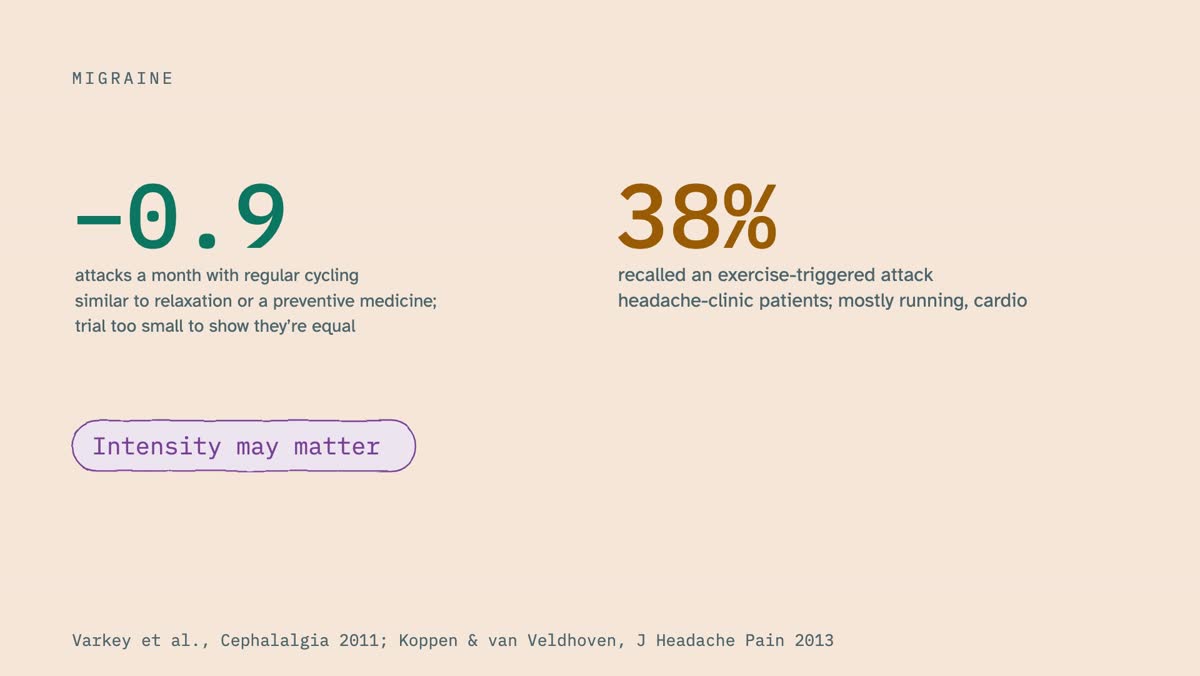
And with migraine: in a small trial, attacks fell by about one a month with regular indoor cycling, similar to relaxation training or a standard preventive medicine, though the trial was too small to show they're equal. But in a headache clinic, 38 percent of patients recalled at least one attack set off by exercise, mostly running or cardio workouts. So intensity may matter.
Before you go
So, do 10,000 steps help with weight? A little, on the scale: in trials, regular brisk exercise added about one to two kilos over a year on top of a diet, with the diet doing most of the work. A varying count looks fine, since the evidence points to the weekly total. And walking's biggest payoffs are the ones the scale can't see, plus a better chance of keeping the weight off, as long as the walking continues after the diet ends.
If you're in a similar spot, here are six questions to bring to a clinician. One: given my BMI and Asian ancestry, should my blood sugar be checked? Two: should we recheck my cholesterol now that I've cut carbs? Three: with high blood pressure in my family, what's my trend? Four: should I add strength training to protect muscle? Five: is my sleep worth working on? And six: how do I fit activity around migraine?
Sources
48 sources cited in the video, in the order they come up.
What 10,000 steps burns
- Lee et al. 2019, origin of 10,000 steps
- Tudor-Locke & Bassett 2004
- Physical Activity Guidelines for Americans, 2nd ed. (p. 112)
- CADENCE-Adults 41–60 (Tudor-Locke 2020)
- 2024 Adult Compendium of Physical Activities
- Hall et al. 2011, energy-balance model
- Murtagh et al. 2015, walking trials
- Donnelly et al. 2013, Midwest Exercise Trial 2
- Martin et al. 2019, E-MECHANIC
- Careau et al. 2021, energy compensation
- King et al. 2008, individual variability
On top of a diet
- Shaw et al., Cochrane review of exercise for overweight or obesity
- Schwingshackl et al. 2014
- Johns et al. 2014
- Foster-Schubert et al. 2012, four-arm trial
- Gardner et al. 2018, DIETFITS
- Jensen et al. 2014, AHA/ACC/TOS obesity guideline
- Wycherley et al. 2012, higher-protein diets
- Deller et al. 2026, exercise and lean mass during calorie restriction
- Oppert et al. 2021, EASO exercise statements
Does consistency matter?
- dos Santos et al. 2022, weekend warriors
- Kany et al. 2024, weekend warriors and incident disease
- Inoue et al. 2023, step patterns and mortality
- El Fatouhi et al. 2021, step variability and weight
- Pulsford et al. 2025, stepping patterns and type 2 diabetes
- CADENCE-Adults 21–40 (Tudor-Locke 2019)
- Fuller et al. 2020, wearable accuracy
- Jakicic et al. 2016, IDEA trial
What the scale can't see
- Anderson et al. 2001, long-term maintenance
- Ostendorf et al. 2018, activity in weight-loss maintainers
- Johansson et al. 2014, maintenance strategies
- Swift et al. 2026, AHA scientific statement
- Rosenbaum & Leibel 2010, adaptive thermogenesis
- Martins et al. 2020, metabolic adaptation
- Lee et al. 2021, Cochrane, walking for hypertension
- Shook et al. 2012, fitness and parental hypertension
- Slentz et al. 2005, STRRIDE visceral fat
- Verheggen et al. 2016, exercise vs diet and visceral fat
- Hamman et al. 2006, Diabetes Prevention Program
- ADA Standards of Care 2026, Section 2
- Weeldreyer et al. 2025, fitness, BMI and mortality
- Smart et al. 2025, exercise and lipids
- Feng et al. 2025, carbohydrate-restricted diets
- Nikitara et al. 2026, diet network meta-analysis


