
Deep Brain Stimulation: How It Works and Is It Worth It?
Inside this episode
The video’s narration, chapter by chapter, with stills from the video and every source at the end.
The short version
Deep brain stimulation, or DBS, uses a thin wire deep in the brain to calm faulty movement signals. Tremor isn't the main reason most people have it; mostly it's smoothing out the ups and downs of medication, giving more hours of good movement and fewer wild extra movements. A simple rule covers most of it: DBS improves what levodopa improves, with tremor the exception. So for freezing, a key question is whether yours gets better when your medication is working.
How it works
Movement plans start in the brain's outer layer, the cortex, and run through a loop of deep structures called the basal ganglia before coming back. Dopamine keeps that loop in balance. In Parkinson's, the cells that make dopamine die off, and in brain studies, dopamine markers in the key movement area were almost completely gone within about four years of diagnosis.
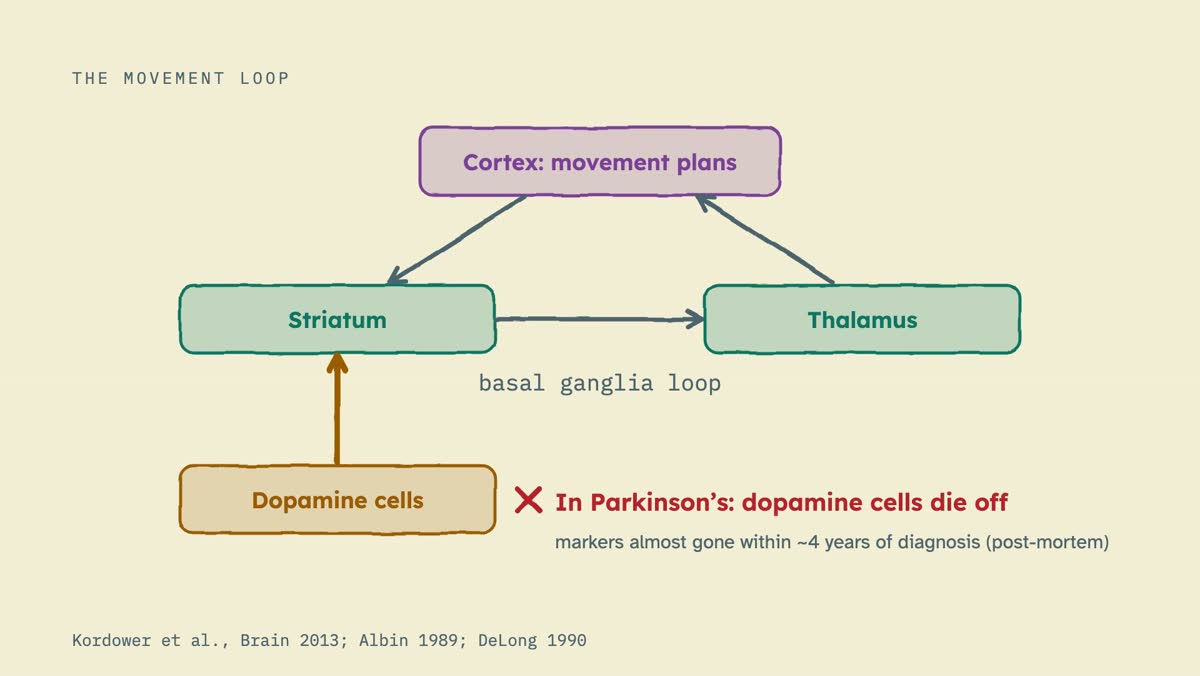
Two small structures in that loop act like brakes on movement: the subthalamic nucleus, or STN, and the inner part of the globus pallidus, the GPi. Without dopamine, the classic model says these brakes get stuck on, so movement becomes slow and stiff. It's a teaching model, not the whole story, but it explains why these are the two main targets.
Researchers also see an exaggerated rhythm in these areas, called beta, around 13 to 30 beats a second. When levodopa works, beta falls, and the size of that drop tracks improvement in slowness and stiffness, though not tremor.
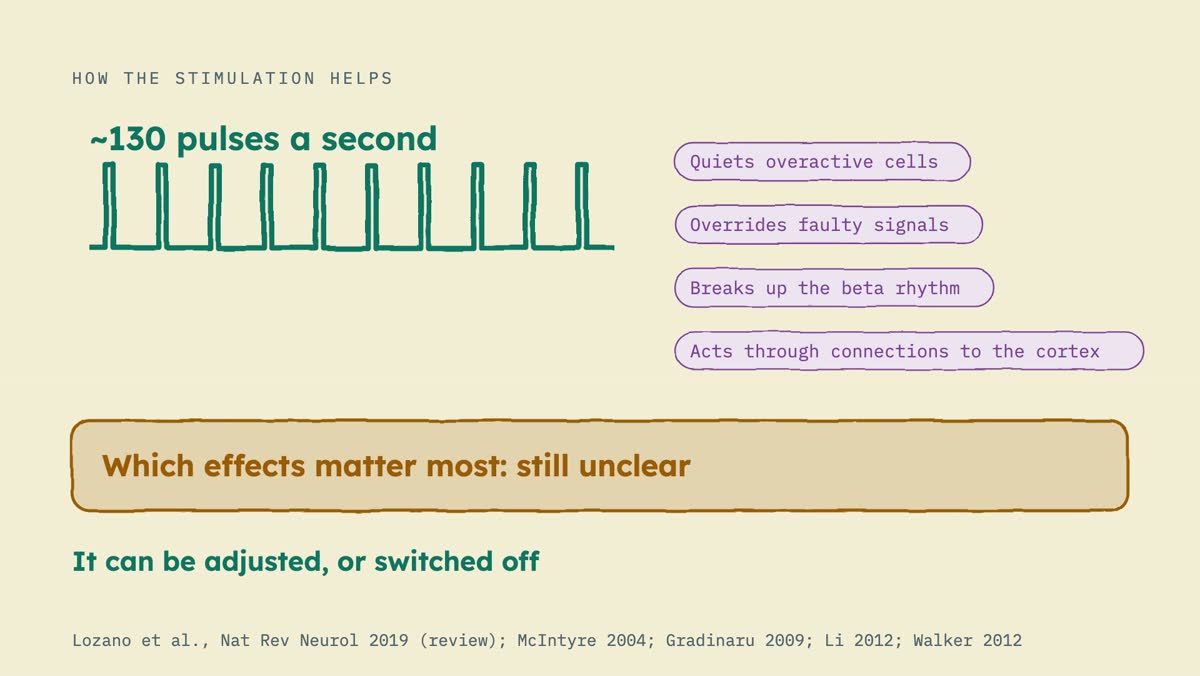
A DBS wire delivers tiny electrical pulses, usually around 130 a second. How that helps is still debated. It may quiet the overactive cells, override their faulty signals with a steady beat, break up the beta rhythm, or work through connections back to the cortex. Reviews say it's still unclear which of these effects really matter. What's clear is that it can be adjusted, or switched off.
The two main targets work about equally well for movement. In a trial of 299 patients comparing them, motor improvement was about the same. STN let people cut their Parkinson's medicine more, while depression scores got worse after STN and better after GPi. A third target, in the thalamus, reduces tremor but doesn't help slowness or stiffness, so it matters mainly for tremor.
The hardware keeps improving. Newer wires have segments that can steer current to one side, which widens the range of useful settings. Rechargeable batteries mean fewer replacement operations. And in February 2025, the FDA approved adaptive DBS on certain devices, which reads the brain's beta signal and adjusts stimulation automatically. It's promising, but the FDA said the data couldn't show it's clearly better than standard DBS, and it hasn't been shown to help freezing.
The surgery
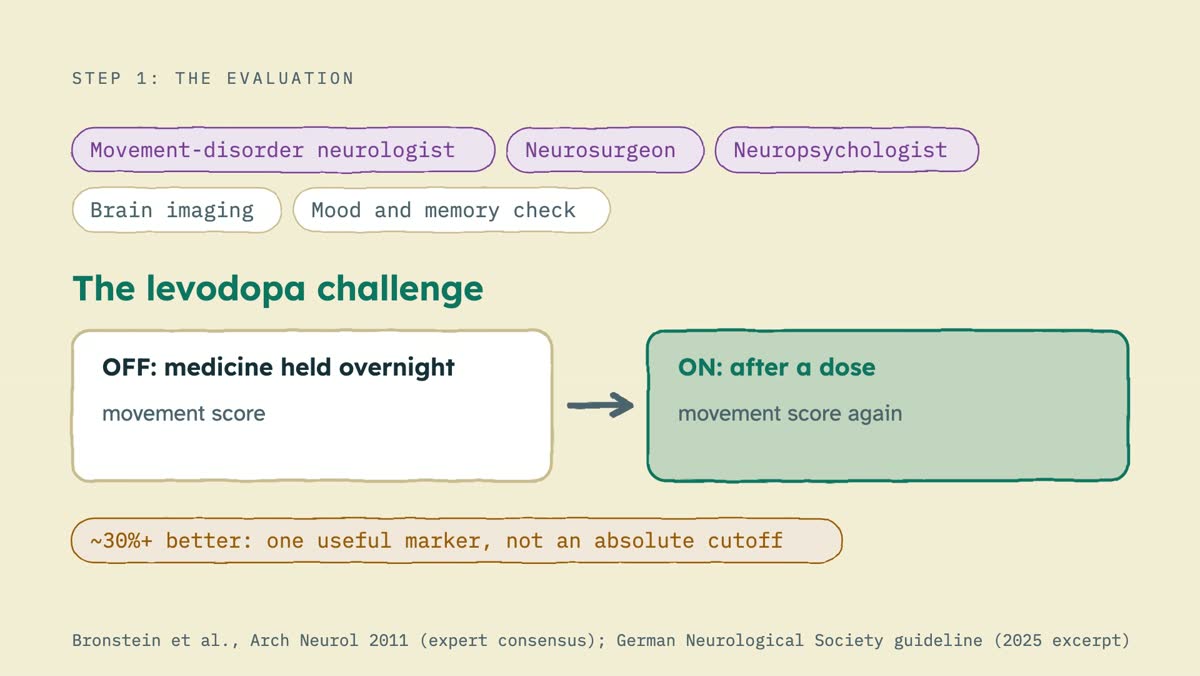
It starts with an evaluation by a team: a movement-disorder neurologist, a neurosurgeon and a neuropsychologist, plus brain imaging and a check of mood and memory. The centrepiece is the levodopa challenge. You skip your Parkinson's medicine overnight, get scored on movement tests, then take a dose and get scored again. A big improvement, often about 30 percent or more, is one useful marker, though experts say it's not an absolute cutoff.
For someone with freezing, a key part is watching walking and turning in both states. Freezing that eases when the medicine kicks in is often called off-freezing. Freezing that persists even when the medicine is working is called on-freezing. Experts advise judging the freezing's own response separately from the overall score, because the two types behave very differently with DBS.
Even so, prediction for one person is rough. In a study of 429 patients, the main pre-surgery measures explained less than half of the variation in benefit.
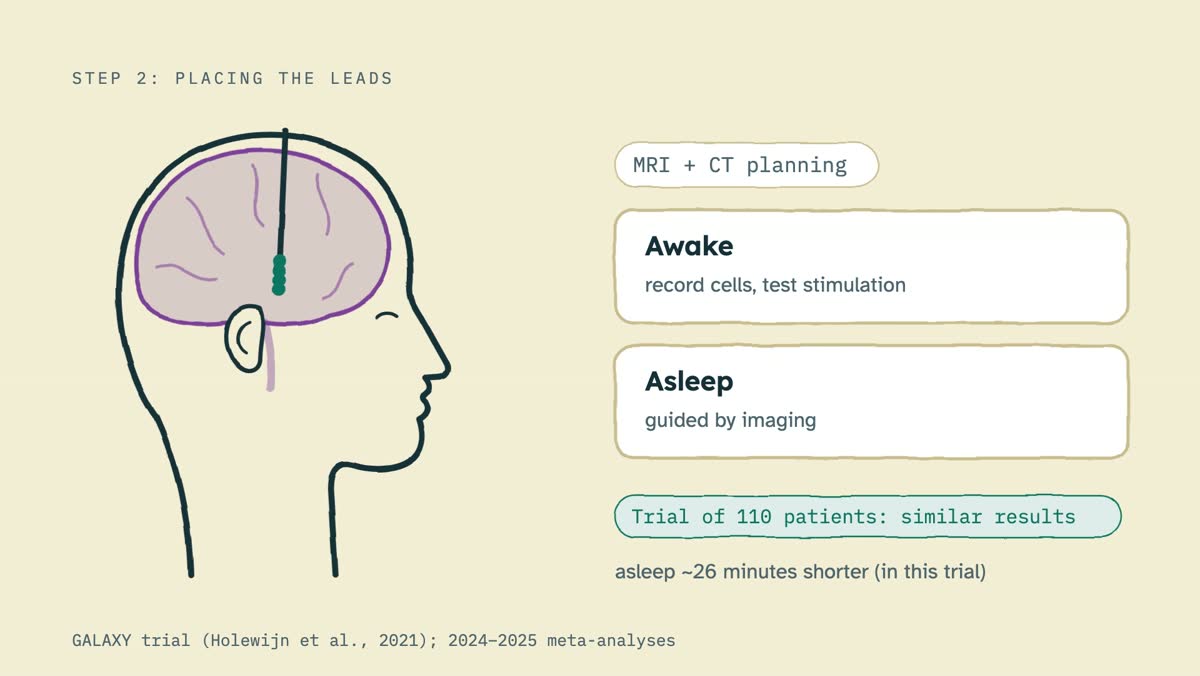
On surgery day, the team uses MRI, often combined with a CT scan, to plan a precise path to the target. Some centres operate with you awake, recording brain cells and testing stimulation as they go. Others operate with you asleep, guided by imaging. In a randomized trial of 110 patients, the movement results were about the same either way, and the asleep surgery was a little shorter.
The wires connect under the skin to a battery-powered pulse generator, usually below the collarbone, sometimes placed in a second, shorter operation. Most people go home after one to three nights. Many feel better right after surgery, before the device is even switched on. That's the microlesion effect from placing the wire, and it fades over the following weeks, sometimes longer, so it isn't a preview of the final result.
Programming usually starts a few weeks after surgery. A clinician tries each contact and tunes the strength, pulse width and frequency while your Parkinson's medicines are slowly reduced. Getting it right usually takes three to six months, and in national data, people averaged about seven programming visits in the first year.
What it helps
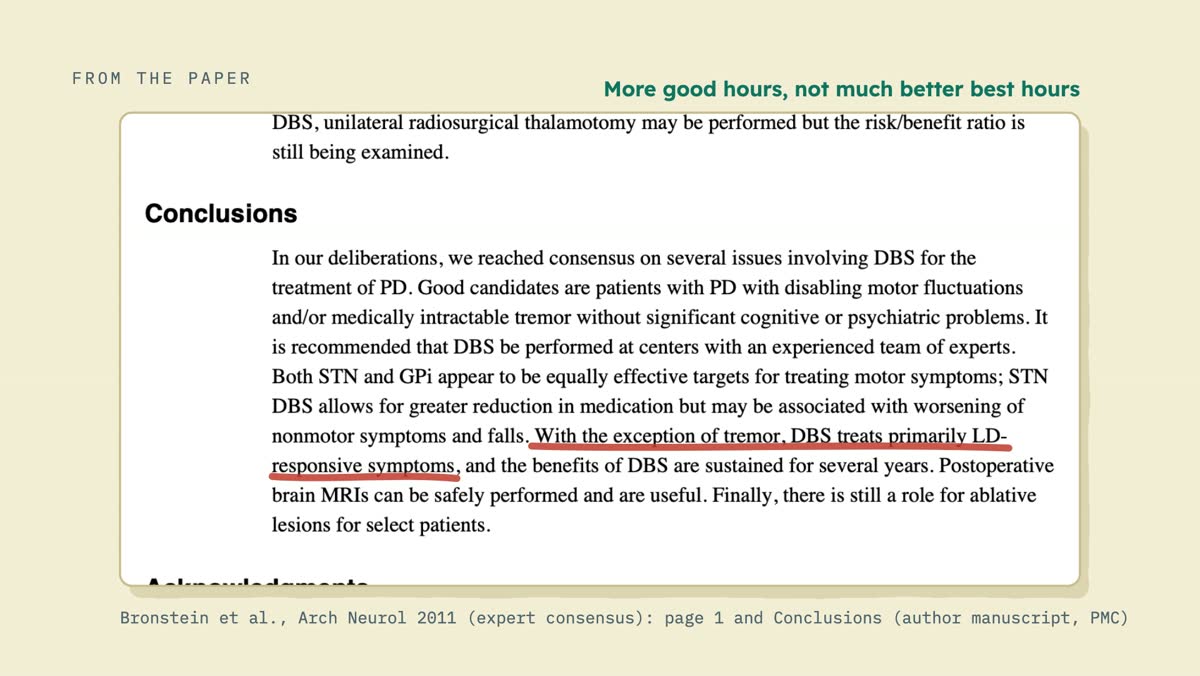
An international expert consensus put it simply: with the exception of tremor, DBS mainly treats the symptoms that respond to levodopa. Think of it as mostly stretching your good, on-medication hours across more of the day, rather than making your best hours much better.
A large US trial, run by the Veterans Affairs system with 255 patients, compared DBS plus medicine with medicine alone. Over six months, DBS added about four and a half hours a day of good movement without troublesome dyskinesia. A quarter of the patients were 70 or older. In that group, those who had DBS gained about 3.8 hours a day, while those on medicine alone lost about half an hour.
And tremor wasn't the main reason people had surgery in these trials. In a large UK trial, only about 4 in 10 listed tremor as a reason; most were there for off periods and dyskinesias, and the quality-of-life benefit didn't appear to depend on the reason.
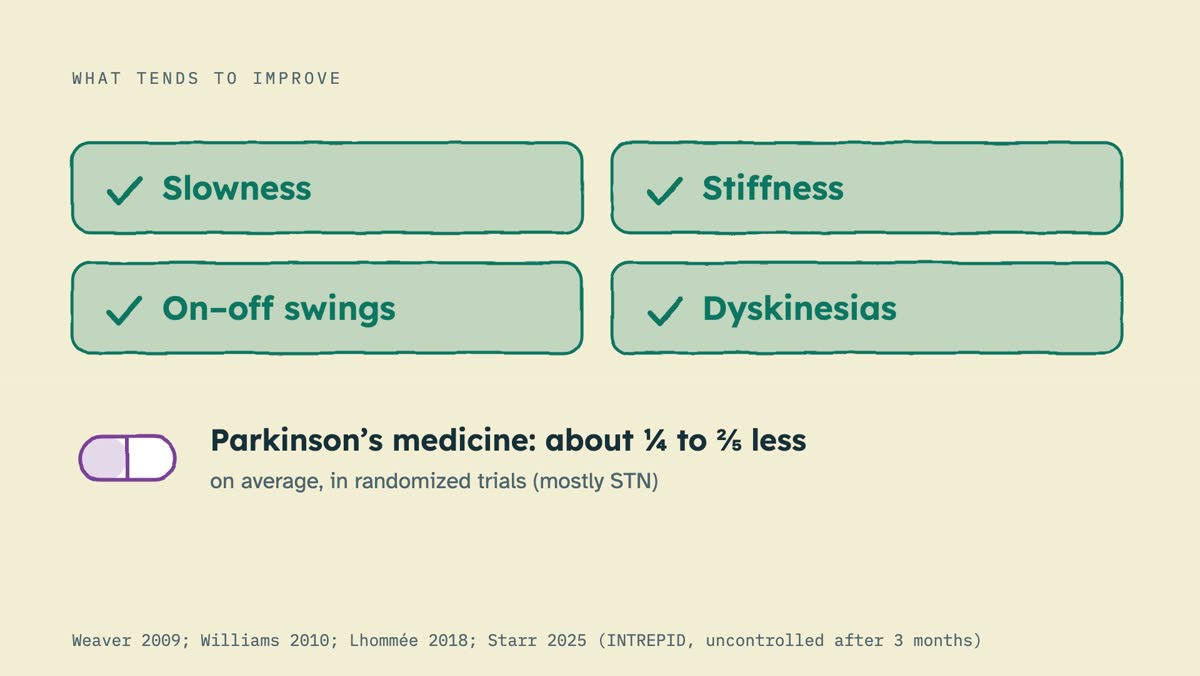
What tends to improve: slowness, stiffness, the swings between on and off, and the wild extra movements called dyskinesias. On average, people can also cut their Parkinson's medicine, by about a quarter to two fifths in randomized trials, mostly with the STN target.
What usually doesn't improve, or can get worse: speech, balance, some thinking skills such as word-finding, and walking problems that don't respond to levodopa. Swallowing effects are mixed.
Quality of life improves on average, but not for everyone: in several studies, only about half of patients reached a gain they'd actually notice, and on average the gains shrink over about five years.
How long does it last? In one trial's five-year follow-up, which had no comparison group, overall movement scores went from 51 percent better to 36 percent better. Tremor and dyskinesia control held up well, but walking scores went from 45 percent better at one year to just 11 percent better at five, which fits the disease progressing. DBS treats symptoms. There's no good evidence it slows Parkinson's itself.
Freezing
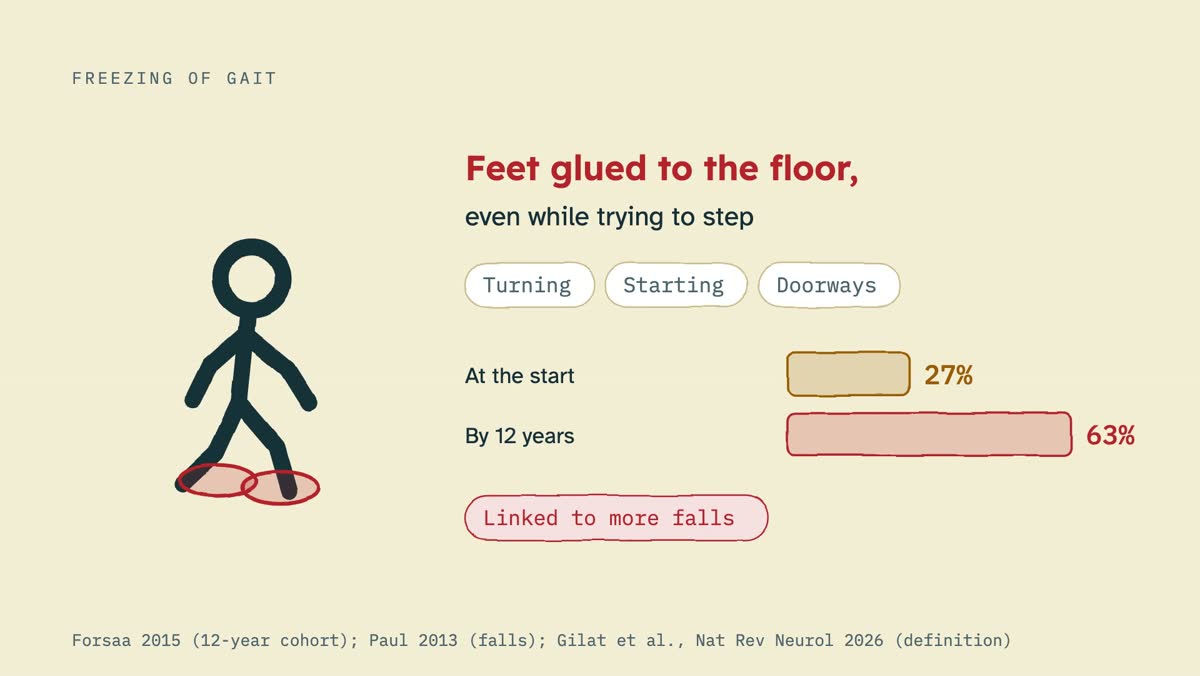
Freezing of gait is when your feet feel glued to the floor for a moment, even though you're trying to step, often when turning, starting or going through a doorway. It's common: in one long-term study, about a quarter of people had it at the start, and nearly two thirds by twelve years. And people who freeze are more likely to fall.
A key question is when your freezing happens. Off-freezing shows up as medication wears off and eases when it's working; in surveys it's the most common type, though careful testing finds more freezing that persists on medication. On-freezing persists even when the medicine is fully working. A rarer kind is actually triggered by the medicine. Telling them apart takes a structured test, off and then on medication, with fast turns, because freezing often doesn't show up in the clinic.
Here's what the evidence says. For off-freezing, STN stimulation helps on average when you're off medication, and studies still saw that benefit four to seven years later. In a large randomized trial that measured freezing, the share of patients reporting it fell from about half to about a third over two years, with no change on medicine alone. But those patients averaged just 52, and none were over 60.
For on-freezing, the picture is different. DBS mainly helps freezing when medicine has worn off; on top of medication, the added benefit is small. And freezing that's still there at your best on-time generally hasn't improved in group studies, though individuals vary. A 2026 analysis of 31 studies found the clearest benefit off medication.
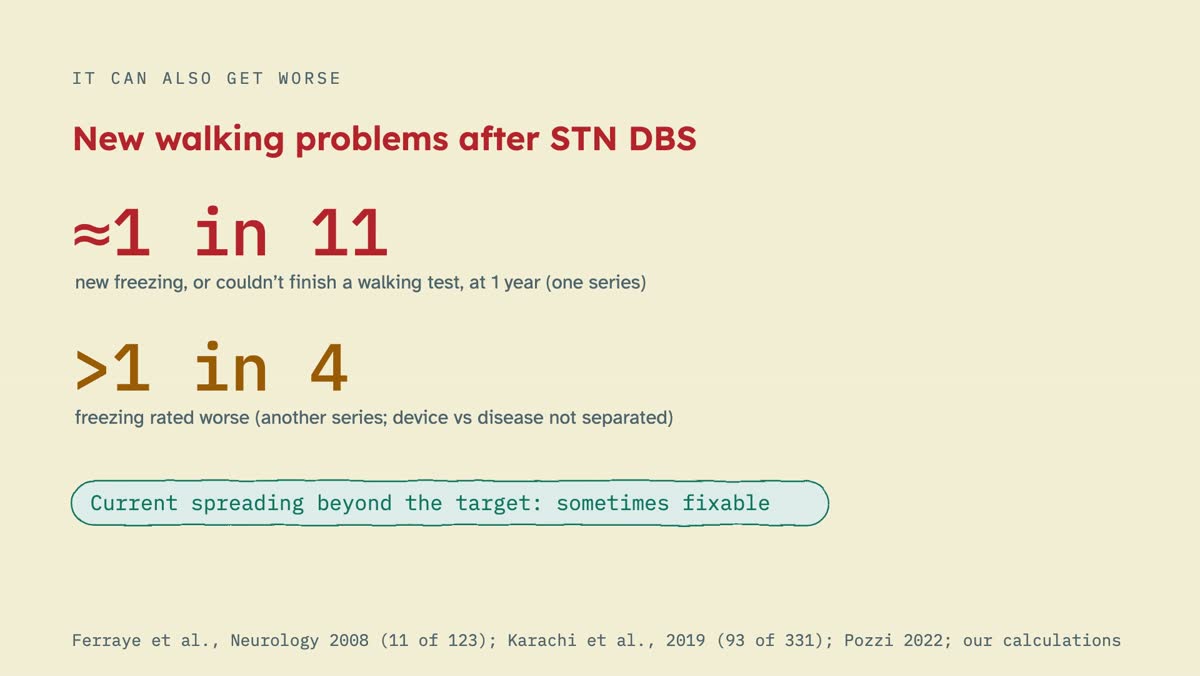
DBS can also bring new walking problems. In one large series, about 1 in 11 people had new freezing, or couldn't finish a walking test, a year after surgery. In another, freezing was rated worse in more than a quarter, though that study couldn't separate the device from the disease. Some of this may come from current spreading beyond the target, which reprogramming can sometimes fix.
Over the years, gait and balance benefits tend to fade, while benefits for stiffness and medication swings last. In one long-term group, the share of people falling often rose from 5 percent before surgery to about 37 percent at ten to fifteen years, by which time they'd had Parkinson's for over 20 years. There was no comparison group, and the authors linked it mainly to the disease progressing.
A 2026 expert consensus, mostly from the US, says freezing and balance problems shouldn't be the main reasons for surgery. But freezing that responds to levodopa doesn't rule it out. DBS may still help when off-time and medication swings are a big part of the picture, and off-freezing may improve as part of that.
If freezing persists after DBS, there are things to try, though none is proven. Lower stimulation frequencies, around 60 hertz, helped some people in small, short trials, but the benefit often wore off. Stimulating a nearby area as well has had mixed results, and other targets remain experimental. Outside surgery, cueing, like stepping to a beat or over a line, and targeted physiotherapy help a little, though the benefit often fades without practice.
Risks and side effects
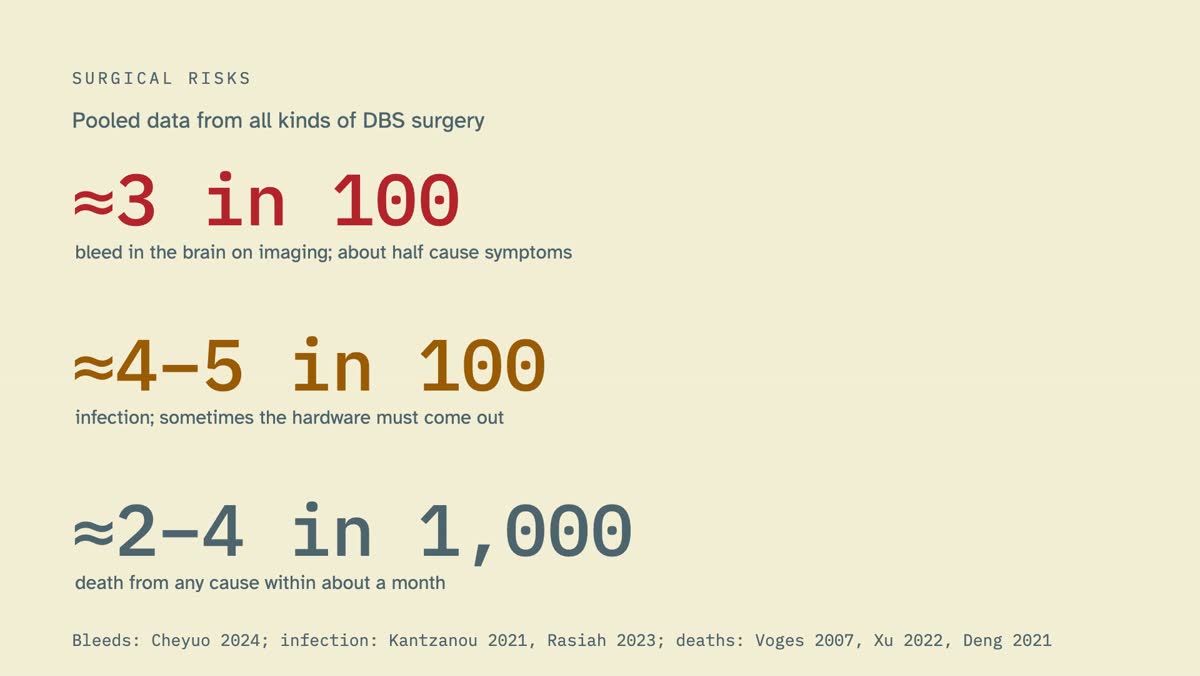
Brain surgery carries real risks. In pooled data from all kinds of DBS surgery, about 3 in 100 patients have a bleed in the brain on imaging, and about half of those cause symptoms. Infection affects about 4 to 5 in 100, and sometimes means removing hardware. Death from any cause in the month after surgery is rare, about 2 to 4 in 1,000.
In the veterans' trial, about 4 in 10 DBS patients had at least one serious adverse event in the first six months, against about 1 in 10 on medicine alone, and one person died from bleeding after surgery. Nearly all the other events had resolved by six months.
Over the years, more operations are common, mostly involving the battery unit, including battery changes: in national data from Australia, about half of patients had at least one more hardware operation over about five years.
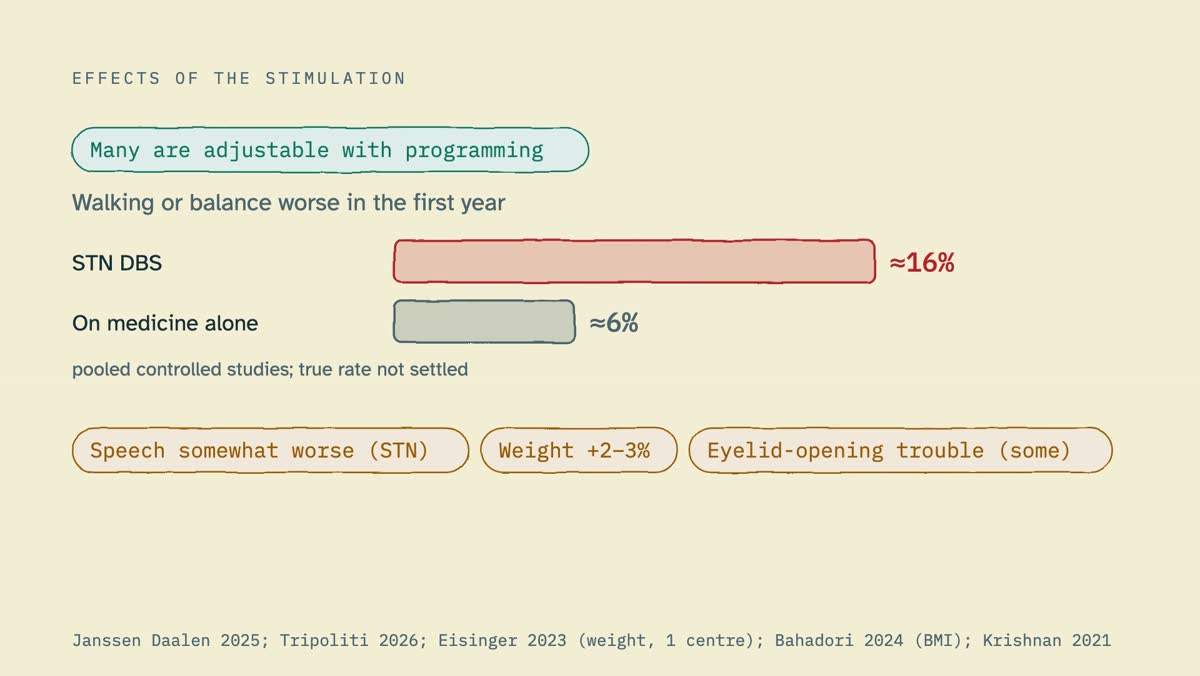
Then there are effects of the stimulation itself, many of them adjustable. Speech often gets somewhat worse after STN stimulation. In controlled studies, walking or balance got worse in the first year in about 16 percent, against about 6 percent on medicine, though the true rate isn't settled. People gain a little weight, about 2 to 3 percent on average. And a smaller number develop trouble opening their eyelids.
Mood and thinking matter too. Apathy is reported more often after STN stimulation, mostly in non-randomized studies, and mania occasionally appears and settles when settings change. Suicide after DBS is rare, under half a percent in a large survey, but higher than expected in the first year, and linked to depression after surgery, which is why mood screening and follow-up matter. Word-finding fluency often dips, usually without a big effect on daily life.
And age? Guidelines say fixed age limits are no longer appropriate; it's an individual assessment. But in several studies, older patients gained less in quality of life, and confusion right after surgery becomes more likely with age.
Life with the device
Day to day, you carry a small controller to check the battery or change settings within limits your team sets. Non-rechargeable batteries typically last about four to six years before a short replacement operation. Rechargeable ones last much longer, but need regular charging, which in older surveys added up to roughly one to three hours a week.
There are rules. Diathermy, a deep-heat therapy, is off-limits even with the device switched off. MRI scans are possible only under conditions specific to your exact device. At security checks, you tell staff about your device and ask to bypass the scanner. And if stimulation stops suddenly, symptoms can come back fast, and rarely severely, so battery checks matter. Follow-up continues too: about three programming visits a year after the first year, and remote programming is approved for some devices.
Is it worth it?
People who do best tend to have a strong response to levodopa, troublesome off-time or dyskinesias, good memory and mood, and expectations that match what DBS can do. Expert consensus calls the levodopa response the single best predictor, though it predicts the first year better than the long term.
Expectations matter more than you might think. In small studies, satisfaction tracked whether expectations were met more than how much movement scores improved. Apathy and depression before surgery predicted feeling worse afterwards, even with good motor results, and in interviews, unhappy patients often described expectations that hadn't been met.
Timing matters too. A trial in people aged 60 and under, with motor complications of recent onset, found DBS plus medicine beat medicine alone. Too late can mean dementia, or problems that no longer respond to levodopa, like on-freezing and falls.
And DBS isn't the only option for medication swings. Continuous infusion therapies deliver levodopa or apomorphine through a pump, under the skin or into the gut. Two newer under-the-skin infusions were approved in the US in late 2024 and early 2025. There are no published head-to-head trial results against DBS yet.
So where freezing is the main problem, the evidence points to a better chance of benefit if it's mainly off-freezing, and if off-time or medication swings are also a real problem. It's least likely to help if the freezing persists when the medicine is working.
If you're in a similar spot, here are questions worth bringing to your care team. One: is my freezing off-freezing, on-freezing, or both, and what did my levodopa challenge show for walking and turning? Two: which of my symptoms do you expect to improve, which won't, and which could get worse? Three: STN or GPi for me, and why? Four: given my age, what benefits and risks do you expect, including confusion after surgery? Five: what are this team's own rates of bleeding and infection? Six: who programs the device, how often, and how far will I travel? And seven: what about other options, like infusions, or physiotherapy for freezing?
So, is it worth it? DBS is an effective treatment for medication swings, and in follow-up studies that benefit lasted for years. But it treats what levodopa treats, it carries real surgical risk, and freezing that persists on medication is the part it's least likely to fix. The answer depends on what kind of freezing you have and what else is going on, which is exactly what a good care team can test with you.
Sources
93 sources cited in the video, in the order they come up.
How it works
- Kordower et al. 2013, dopamine loss after diagnosis
- Albin et al. 1989, basal ganglia model
- DeLong 1990, basal ganglia model
- Bergman et al. 1990, STN in parkinsonian monkeys
- Marsden & Obeso 1994, limits of the model
- Cui et al. 2013, direct and indirect pathways
- Kühn et al. 2006, levodopa and beta
- Kühn et al. 2008, stimulation and beta
- Kühn et al. 2009, beta, slowness and stiffness
- Neumann et al. 2016, beta and motor severity
- Lozano et al. 2019, DBS review
- McIntyre et al. 2004, mechanisms
- Gradinaru et al. 2009, afferent axons
- Li et al. 2012, cortex effects in rats
- Walker et al. 2012, cortex activation in patients
- Follett et al. 2010, STN vs GPi
- Benabid et al. 1991, thalamic stimulation for tremor
- Hariz et al. 2008, thalamic stimulation
- Dembek et al. 2017, directional leads
- Schnitzler et al. 2022, PROGRESS
- Bronte-Stewart et al. 2025, ADAPT-PD
- FDA approval order, adaptive DBS (P960009/S478, 20 Feb 2025)
The surgery
- Bronstein et al. 2011, expert consensus
- Reese et al. 2025, German guideline excerpt
- Artusi et al. 2020, selection criteria
- Wolke et al. 2023, levodopa challenge and prediction
- Holewijn et al. 2021, GALAXY trial
- Jech et al. 2012, microlesion effect
- Wu et al. 2025, microlesion effect
- Yuen et al. 2026, hospital stay
- Koeglsperger et al. 2019, programming
- Xu et al. 2022, Australian national data
What it helps
- Weaver et al. 2009, VA trial
- Williams et al. 2010, PD SURG
- Lhommée et al. 2018
- Starr et al. 2025, five-year outcomes
- Fasano et al. 2015, axial symptoms
- Tripoliti et al. 2026, speech
- Yu et al. 2020, swallowing
- Gronostay et al. 2024, quality of life
- Floden et al. 2014, quality of life
- Daniels et al. 2011, quality of life
- Martinez-Martin et al. 2020, EARLYSTIM quality of life
Freezing
- Gilat et al. 2026, definition
- Forsaa et al. 2015, 12-year cohort
- Paul et al. 2013, falls
- Amboni et al. 2015, self-reported freezing
- McKay et al. 2019, freezing after levodopa
- Espay et al. 2012, on-state freezing
- Schuepbach et al. 2013, EARLYSTIM
- Barbe et al. 2020, freezing in EARLYSTIM
- Schlenstedt et al. 2017
- Kim et al. 2019, long-term freezing
- Behboodi et al. 2026, meta-analysis
- Ferraye et al. 2008
- Karachi et al. 2019
- Pozzi et al. 2022, troubleshooting gait
- Zampogna et al. 2022, 15-year falls
- Ostrem et al. 2026, VA 10-year follow-up
- Safarpour et al. 2026, expert consensus
- Moreau et al. 2008, 60 Hz
- Xie et al. 2015, 60 Hz
- Xie et al. 2018, 60 Hz long term
- Weiss et al. 2013, SNr
- Thevathasan et al. 2018, PPN
- Gilat et al. 2021, exercise and training
Risks and side effects
- Cheyuo et al. 2024, bleeding
- Kantzanou et al. 2021, infection
- Rasiah et al. 2023, complications
- Voges et al. 2007, 30-day outcomes
- Deng et al. 2021, in-hospital outcomes
- Janssen Daalen et al. 2025, gait and balance
- Eisinger et al. 2023, weight
- Bahadori et al. 2024, BMI
- Krishnan et al. 2021, eyelid opening
- Voon et al. 2008, suicide
- Witt et al. 2008, mood and thinking
- Parsons et al. 2006, thinking
- Dafsari et al. 2018, age
- Yousef et al. 2025, delirium
Life with the device
- Reuter et al. 2015, stopped stimulation
- Rajan et al. 2016, stopped stimulation
- FDA safety summary and labeling (P960009/S478)
- Boston Scientific Vercise manual (FDA-hosted)
- FDA remote programming approval (P140009/S064, 2021)


