
Are You Taking Your Blood Pressure Wrong?
Inside this episode
The video’s narration, chapter by chapter, with stills from the video and every source at the end.
The short version
Most measuring mistakes push the reading up, and they stack: an arm in the lap, crossed legs, talking and a coffee could plausibly add 10 to 15 points. The biggest single error is the cuff size: about +5 on a large arm, about +20 on an extra-large arm. Measuring over a thin sleeve made no difference in a randomized study; a bare arm is still the default. Measuring anxiety is real (the "white-coat" alerting reaction). A scheduled, boring home routine, judging the average, and out-of-office readings all help. Safety: above 180/120, wait five minutes and retest. Still that high, contact a clinician. With chest pain, shortness of breath, back pain, numbness or weakness, vision changes or trouble speaking, call 911.
The cuff
Start with the cuff, because it's the biggest single error. A 2023 randomized crossover trial measured the same people twice: once with a regular adult cuff, and once with a cuff sized to their arm. In people whose arms needed a large cuff, the regular one read about five points high.
In people who needed an extra-large cuff, it read almost twenty points high. A cuff that's too big errs the other way. In people with small arms, the regular cuff read about four points low.
The fix is cheap. Wrap a soft tape measure around the middle of your upper arm, then check that number against the range printed on the cuff. If you're outside the range, buy the right size.
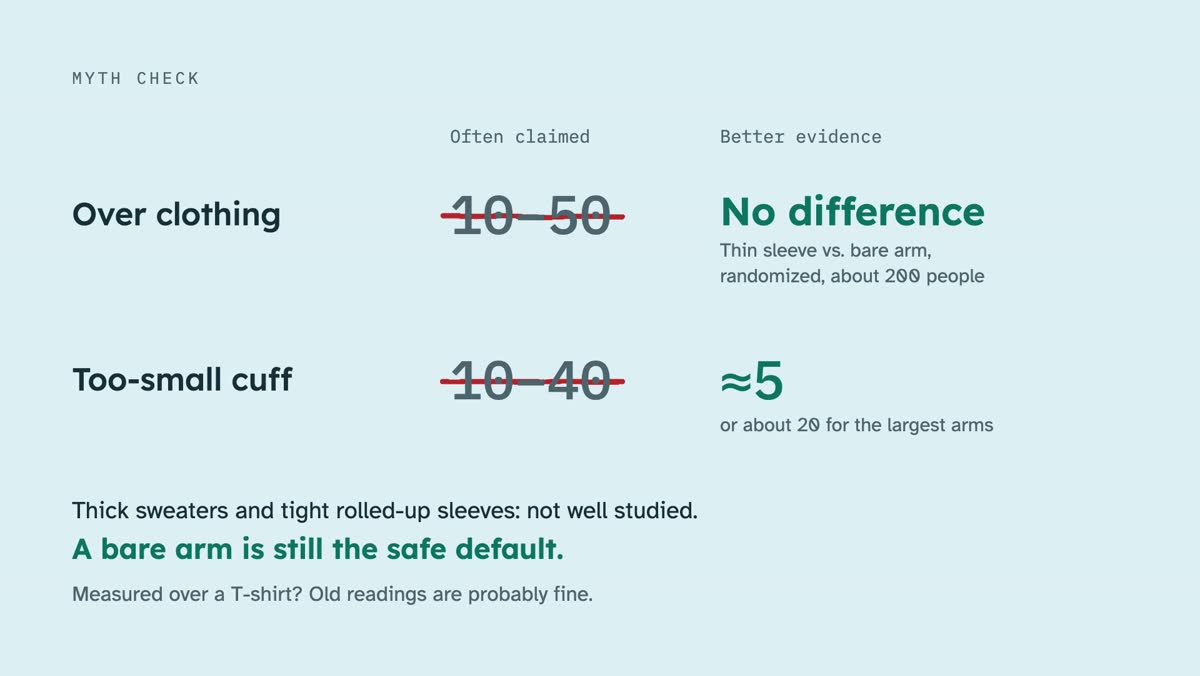
Now, a myth. Handouts from medical groups and cuff makers often say measuring over clothing can throw the reading off by ten to fifty points. The same handouts say a too-small cuff adds ten to forty, when the trial we just covered put it closer to five, or twenty for the largest arms.
And for a thin sleeve, the clothing claim doesn't hold up: a randomized study of about two hundred people found no difference between a thin sleeve and a bare arm. Thick sweaters and tight rolled-up sleeves haven't been studied as well, so a bare arm is still the safe default. But if you've been measuring over a T-shirt, your old readings probably aren't ruined.
How you sit
Next, your arm. The cuff should sit at heart level, with your forearm resting on a table. A 2024 crossover trial tested what people actually do.
Resting your hand in your lap read about four points high on both numbers. Letting your arm hang at your side read about six and a half points high on top. Arm height is pure physics.
For every inch the cuff sits below your heart, the reading rises by about two points. For every inch above, it drops by about the same. Legs come next.
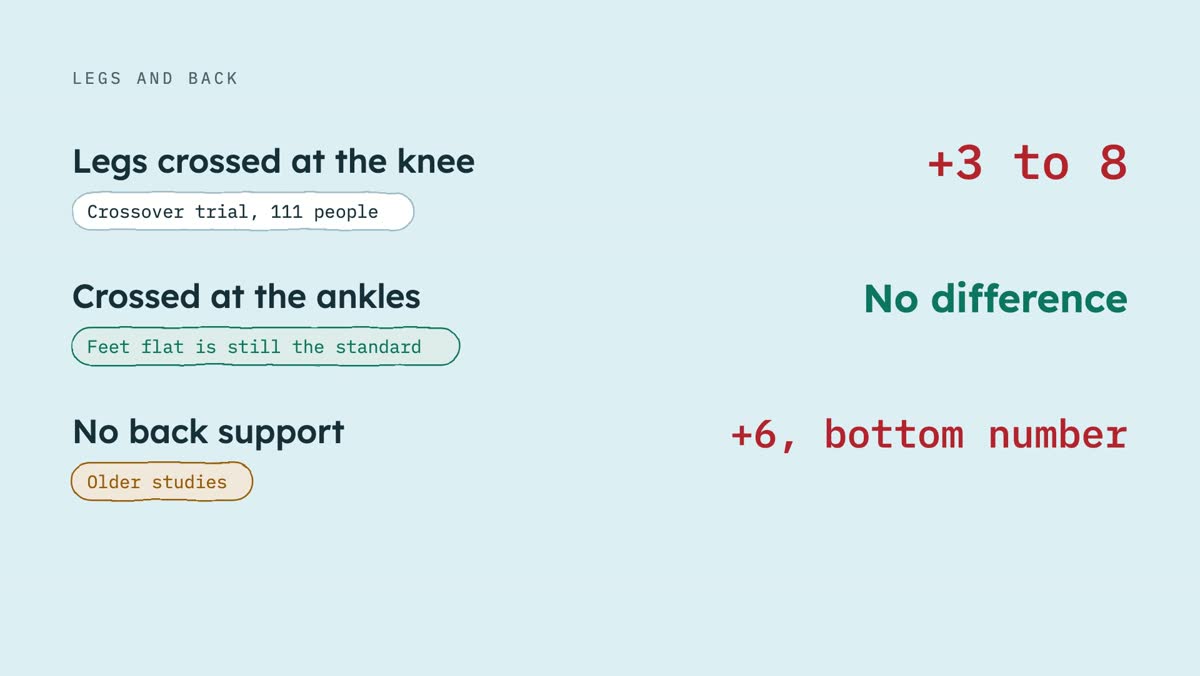
In a study of a hundred and eleven people, crossing your legs at the knee raised the top number by three to eight points. Crossing at the ankles made no difference, but feet flat on the floor is still the standard. And your back.
Sitting without back support, like perching on the edge of an exam table, raises the bottom number by about six points in older studies. That evidence is thinner, but the fix costs nothing: sit back in a chair.
What you did beforehand
A full bladder matters a little. In a study of a hundred and seventy-two women, a bladder confirmed full on ultrasound raised readings by about four over three. It wasn't randomized and it only included women, but the advice is easy: go to the bathroom first.
Caffeine and nicotine in the half hour before a reading both push it up. Estimates vary, but a coffee adds roughly five to ten points, and a cigarette about six. Alcohol is the wild card.
Depending on how much and how recently, a systematic review found effects ranging from about twenty-four points lower to twenty-four points higher. Readings after drinking just aren't reliable. Exercise usually does the opposite of what people expect.
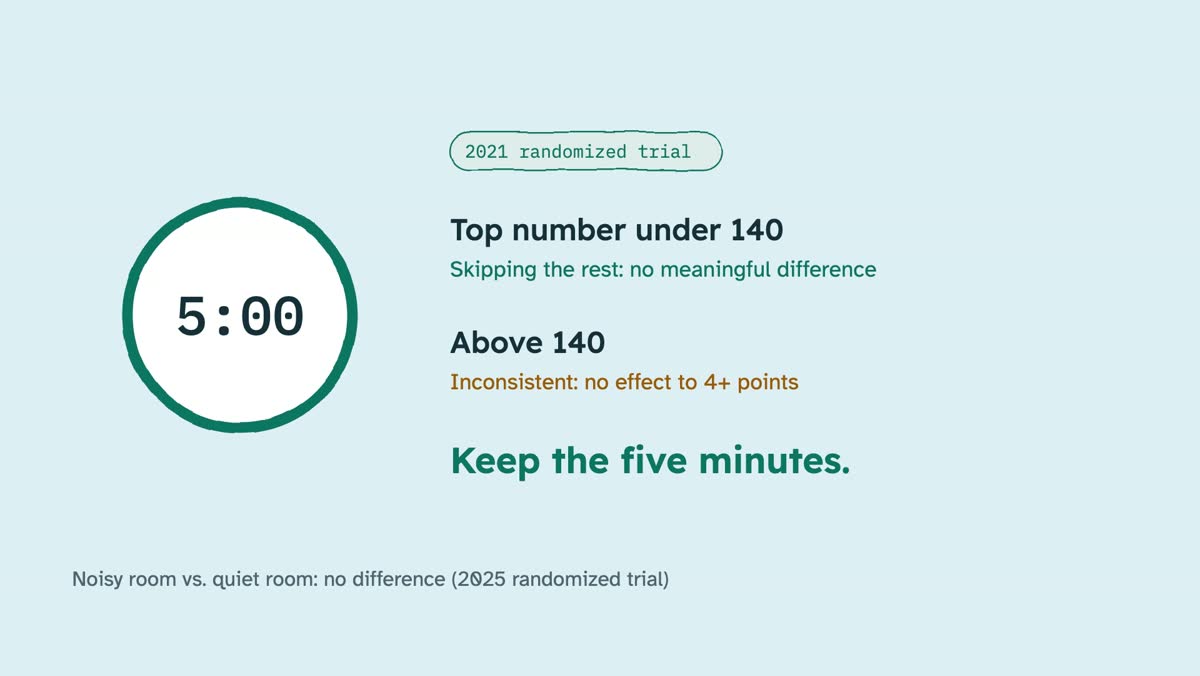
In the half hour after aerobic exercise, readings tend to come out low, because your blood vessels stay relaxed for a while. Then there's the five minutes of quiet rest that every guideline asks for. A 2021 randomized trial actually tested it.
For people with a top number under 140, skipping the rest made no meaningful difference. Above 140, the results were inconsistent, from no effect to four points or more. So keep the five minutes, especially if your numbers run high.
They'll turn out to be useful for another reason, too. One thing that doesn't seem to matter: background noise. A 2025 trial compared a noisy public space with a quiet private room and found no difference.
During the reading
Talking is the classic mistake. Studies say talking, or even actively listening, raises the top number by four to nineteen points and the bottom by five to fourteen. The trials behind those numbers were weak, but nobody's reading gets more accurate from a chat with the nurse.
Stay quiet until the cuff lets go. One reading is a snapshot, and the first one in a sitting tends to run highest. The American Heart Association recommends two readings, a minute apart, written down each time.
Your two arms can disagree. The first time you measure, check both, and from then on, use the arm that reads higher. The device matters too.
Use an automatic upper-arm cuff that's been independently validated. In the U.S.
, you can look yours up at validatebp.org. Wrist and finger monitors are less reliable.
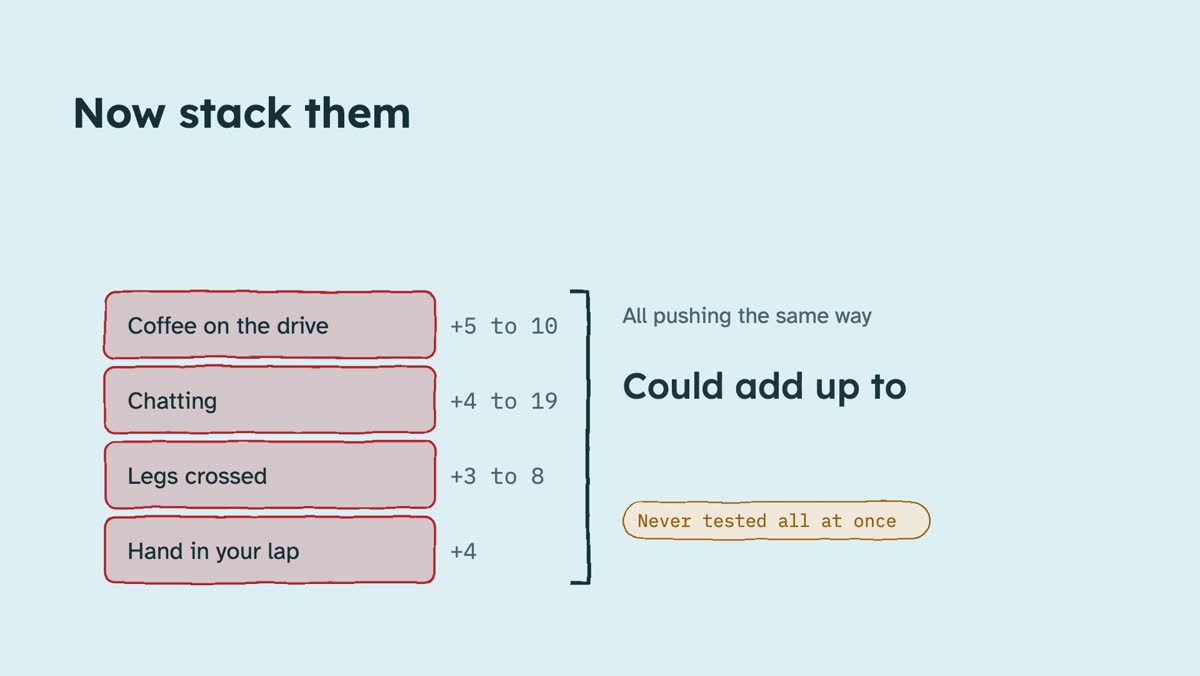
And if you have atrial fibrillation or another irregular rhythm, a home cuff may not read accurately at all, so ask your clinician. Now stack these. Hand in your lap, legs crossed, chatting, and a coffee on the drive over.
Each one is a few points, all pushing the same direction. Nobody has tested them all at once, but it's easy to see how they could add up to ten or fifteen points.
When the cuff makes you anxious
Now the second half of the question: what if taking your blood pressure makes you anxious? First, the effect is real, and it's been measured directly. In the 1980s, researchers in Italy led by Giuseppe Mancia recorded patients' blood pressure continuously, through a thin catheter in an artery.
Then a doctor walked in and took a normal cuff reading. Pressure jumped. It peaked within the first four minutes, then drifted back down.
And the size of the jump varied enormously, from four to seventy-five points. When a nurse took the reading instead, the rise was smaller. And in a follow-up study, when an automatic cuff inflated with no person involved, pressure didn't rise at all.
So it isn't the squeeze. It's the situation: the attention, the anticipation, and the number. That points to what helps.
One: make it scheduled and boring. Measure at the same times each day, morning and evening, two readings a minute apart, written down. A week of that before an appointment gives your clinician a solid average.
Outside those times, don't check just because you feel off. Two: judge the average, not the reading. Single readings bounce around.
Some cuffs take three readings automatically and show only the average, and most store your readings, so you can review the whole week at once. Three: don't chase a high number. Re-checking again and again while your heart is pounding mostly measures your worry.
Researchers have flagged that home monitoring can feed anxiety and lead to obsessive measuring that skews the results. Take your two readings, log them, and you're done. Four: use the five-minute rest to settle.
Breathe calmly and normally. One caution: deliberately slow breathing during the reading itself can nudge the number down, which just trades one distortion for another. Five: tell your clinician that measuring makes you anxious.
That changes how they read your numbers. They can have a nurse take it, leave you alone in the room with an automatic cuff, or order 24-hour ambulatory monitoring, where a cuff inflates on its own while you go about your day. That's the gold standard, and automatic office readings and home readings track it better than a manual reading in the office does.
One warning about the other extreme: don't write off high office readings as just nerves. Whether white-coat hypertension, high in the office but normal elsewhere, carries extra risk is honestly unsettled. A 2019 meta-analysis of twenty-seven studies linked it to a thirty-six percent higher risk of cardiovascular events.
But a 2025 update from the same team found the link to death was no longer statistically significant. Either way, the conclusion is the same: confirm your numbers outside the office before anyone decides you do or don't need treatment. And if the checking has become something you can't stop, or the anxiety reaches beyond the cuff, that's worth treating in its own right.
Therapy such as cognitive behavioral therapy can help with health anxiety.
Before you go
One safety rule before we go. If a reading comes back above 180/120, wait five minutes and test again. If it's still that high, contact your clinician right away.
And if a reading that high comes with chest pain, shortness of breath, back pain, numbness or weakness, vision changes, or trouble speaking, don't wait. Call 911. Here's the whole checklist in one breath.
The right size cuff, on a bare arm. Arm supported at heart level. Back supported, feet flat.
Empty bladder. No coffee, cigarettes, or exercise for half an hour. Five quiet minutes, no talking.
Two readings, a minute apart, and average them. Thanks to our listener for a great question. If you've got one you want us to dig into, send it in, and we'll go through the evidence together.
Sources
16 sources cited in the video, in the order they come up.
Sources
- CFPC Tools for Practice #415 (June 2026), which reports these trials: Rahimi 2021, Lancet (5-point drop, about 10% fewer major cardiovascular events); Ishigami 2023, JAMA Intern Med (cuff size); Liebl 2004, Blood Pressure (thin sleeve); Liu 2024, JAMA Intern Med (arm position); Adiyaman 2007, Blood Press Monit (crossed legs); Choi 2011, Korean J Fam Med (full bladder); Brady 2021, Hypertension (5-minute rest); Ishigami 2025, Ann Intern Med (noisy room); Roerecke 2019, JAMA Intern Med (office vs. home readings)
- American College of Cardiology, 2023 (claims about clothing, cuff size, coffee and smoking)
- SunTech Medical, 10 factors that can affect blood pressure readings (clothing claim, back support)
- CDC training guide (cigarettes)
- Kallioinen 2017, J Hypertens, via J Fam Pract (alcohol, talking)
- CSPI, How to measure blood pressure correctly (exercise)
- American Heart Association, Monitoring your blood pressure at home (two readings, 180/120 rule, atrial fibrillation)
- American Heart Association, home monitoring infographic (which arm, validatebp.org)
- Mancia 1983, Lancet (doctor-triggered rise of 4 to 75)
- Mancia 1985, J Hypertens Suppl (peak in the first 4 minutes)
- Mancia 1987, Hypertension (smaller rise with a nurse)
- Parati and Mancia (no rise with automatic inflation)
- Cross-sectional study, 2022 (home monitoring and anxiety)
- Cohen 2019, Ann Intern Med (white-coat hypertension and cardiovascular risk)
- 2025 update, J Hum Hypertens, summarized by Penn DBEI (link to death not significant)


